
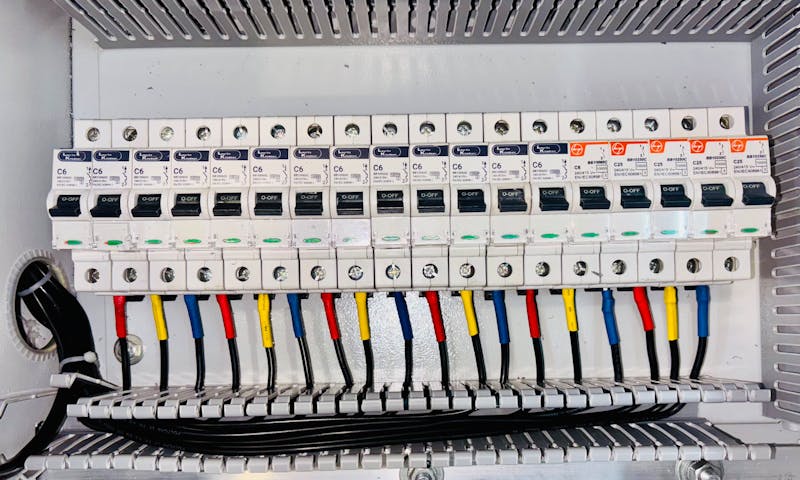
If you’ve had electrical work done in your Cape Coral or Fort Myers home recently, you may have noticed your electrician installing breakers that look a little different — or heard them mention something called AFCI protection. Arc-Fault Circuit Interrupters are one of the most important fire-prevention tools in modern residential electrical work, and understanding how they apply to your home can help you make smarter decisions when hiring an electrician or planning a renovation.
Here’s what you need to know about AFCI requirements, how they differ from the GFCI protection you already know, and what it means for homes throughout Southwest Florida.
What Is an AFCI and What Does It Actually Do?
An Arc-Fault Circuit Interrupter (AFCI) is a specialized breaker or outlet device designed to detect dangerous electrical arcing inside your walls — the kind of low-level sparking that a standard breaker won’t catch, but that can ignite insulation, wood framing, or other materials inside the wall cavity long before it ever trips a breaker.
Unlike a standard breaker that trips based on current overload, an AFCI continuously analyzes the electrical waveform on the circuit. When it detects patterns that match known arc signatures, it shuts the circuit down immediately.
What AFCI protection detects:
- Parallel arcing — hot-to-neutral, hot-to-ground, or neutral-to-ground
- Series arcing — caused by loose connections, broken wire strands, or damaged cords
- Low-current arcing that would never trip a standard breaker
One important point: AFCI protection is a fire prevention tool. It protects your wiring and your structure — not people from shock. That’s what GFCI protection is for (more on that below).
Where Are AFCIs Required in Florida Homes? (NEC 210.12)
Florida follows the National Electrical Code, and as of the current NEC adoption, AFCI protection is required for all 120-volt, single-phase, 15- and 20-amp branch circuits (and now 10-amp circuits as of NEC 2023) that supply outlets or devices in dwelling units.
Rooms and areas in your home that require AFCI protection include:
- Bedrooms
- Living rooms, family rooms, and dens
- Dining rooms and kitchens
- Libraries, sunrooms, and parlors
- Recreation rooms
- Hallways and closets
- Laundry areas
- Any similar finished living area
It’s worth noting that “outlet” means more than just a receptacle. Lighting fixtures, hardwired smoke detectors, and CO alarm circuits all count as outlets under the NEC — meaning AFCI protection applies to those circuits too.
Areas that are generally exempt from AFCI requirements include unfinished garages, outdoor circuits, bathrooms, and unfinished utility spaces — though you should always confirm with your local Authority Having Jurisdiction (AHJ), as Florida municipalities can adopt local amendments.
What About Renovations and Remodels?
This is where we get a lot of questions from homeowners in Cape Coral and Fort Myers. Here’s the straightforward answer:
- Adding a new circuit in a covered area → AFCI required
- Modifying, extending, or replacing wiring on an existing circuit → AFCI required
- Replacing a receptacle in a room that requires AFCI → AFCI protection required per NEC 406.4(D)(4)
The 6-foot extension exemption that used to allow small wiring extensions without upgrading to AFCI was removed in the 2023 NEC. If your electrician is extending a circuit in a bedroom or living area, AFCI protection is required regardless of how short the extension is.
Types of AFCI Protection: Breakers vs. Outlet Devices
The NEC provides several methods to achieve AFCI protection. In practice, one method stands out as the most reliable and inspection-friendly:
Combination-Type AFCI Breaker (Recommended)
Installed at your electrical panel, this breaker protects the entire branch circuit from the panel to every outlet on that circuit. It detects both series and parallel arcing, offers the cleanest installation path, and is the method most inspectors expect to see. When our electricians install AFCI protection in Southwest Florida homes, this is our standard approach.
Outlet Branch-Circuit AFCI Devices
These are installed at the first outlet on a circuit and protect everything downstream of that point. They come with strict wiring-length limits (50 feet for #14 wire, 70 feet for #12 wire), require the first outlet to be clearly marked, and require continuous wiring with no splices between the panel and the device. While the NEC allows several hybrid combinations using these devices alongside standard breakers, most of those methods are impractical in real-world installs because the required listed “system combination” products don’t yet exist on the market.
Bottom line: If you want a clean inspection and reliable protection, a breaker-type AFCI at the panel is the right call.
AFCI vs. GFCI — Understanding the Difference
One of the most common sources of confusion we encounter is homeowners (and sometimes contractors) mixing up AFCI and GFCI protection. They do completely different things:
| AFCI | GFCI | |
|---|---|---|
| Purpose | Fire prevention | Shock protection |
| Detects | Series & parallel arcing | Current imbalance (4–6mA) |
| Protects | Your wiring & structure | People from electrocution |
In many rooms — kitchens, laundry areas, and finished basements — both AFCI and GFCI protection are required simultaneously. The cleanest solution in those situations is a dual-function AFCI/GFCI breaker, which handles both requirements in a single device at the panel. Don’t confuse this with a “combination-type AFCI” breaker — that’s a different term referring only to the arc-detection method.
Common AFCI Inspection Failures
Having inspected and permitted countless electrical projects across Cape Coral, Fort Myers, and the surrounding communities, here are the AFCI-related issues we see come up most often:
- Shared neutrals (MWBCs) on single-pole AFCI breakers — Multi-wire branch circuits require a 2-pole common-trip AFCI breaker per NEC 210.4(B). Single-pole breakers on shared neutrals will cause nuisance trips and fail inspection.
- Lighting outlets missed — Hardwired light fixtures and ceiling fan outlets in covered rooms must be AFCI protected. These are frequently overlooked.
- Smoke detector circuits skipped — Hardwired smoke and CO detector circuits in finished areas count as outlets and require AFCI protection.
- Device-method outlets not marked — When using outlet-type AFCI devices, the first outlet must be clearly labeled. Inspectors look for this.
- Nuisance tripping not investigated — If an AFCI breaker is tripping regularly, don’t just reset it. Common causes include loose terminations, back-stabbed receptacles, aging extension cords, and certain motor loads or dimmers. These warrant investigation, not a breaker swap.
Do Older Homes in Cape Coral Need AFCIs?
Many homes in Cape Coral and Fort Myers were built in the 1970s, 80s, and 90s — well before AFCI requirements existed. The good news is that the NEC generally does not require you to retrofit existing wiring throughout your entire home retroactively. However, AFCI protection kicks in whenever you:
- Add a new circuit to a covered area
- Extend or modify an existing circuit
- Replace a receptacle in a room that requires AFCI
- Upgrade your electrical panel (in practice, the whole panel gets updated)
If you’re renovating a kitchen, adding a bedroom, finishing a bonus room, or upgrading your panel, an AFCI upgrade will be part of the job. We factor this into every estimate upfront so there are no surprises.
Key Takeaways
- AFCI protection is required in virtually all finished living areas of Florida homes
- A combination-type AFCI breaker at the panel is the most reliable and inspector-preferred method
- AFCI and GFCI do different jobs — use dual-function breakers where both are required
- Renovations and circuit extensions in covered rooms trigger AFCI requirements
- Nuisance tripping should be investigated, not ignored
- Replacing receptacles in AFCI-required rooms requires AFCI protection
Questions About AFCI Protection in Your Home?
ElectriciansX installs and upgrades AFCI protection throughout Cape Coral, Fort Myers, Naples, and all of Southwest Florida. Every installation is permitted, inspected, and backed by our workmanship guarantee.