
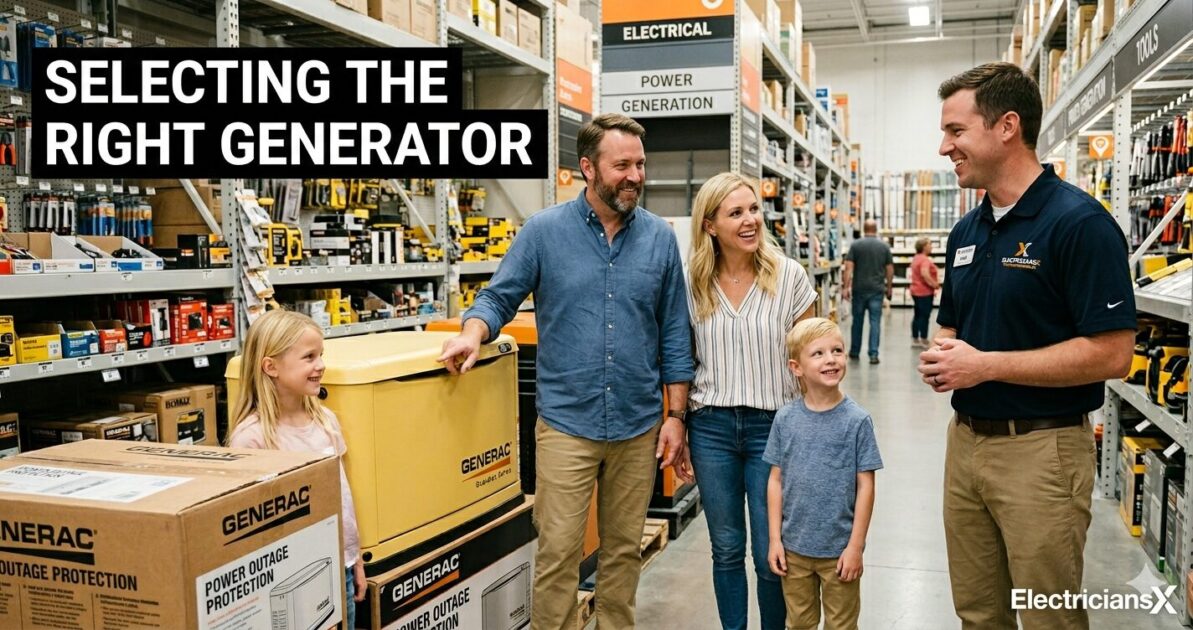
Quick Answer: A portable generator in the 5,000–7,500-watt range handles most Florida homes during a hurricane outage — keeping the refrigerator cold, a window AC unit running, lights on, and phones charged. For full whole-home coverage, a standby generator of 10,000–20,000 watts connected through a transfer switch is the right answer. NEC Article 702 governs optional standby systems and mandates proper transfer equipment to prevent dangerous backfeed onto utility lines. Never connect a generator directly to your home’s wiring without a listed transfer switch or interlock kit installed by a licensed electrician.
Every June, hardware stores across Cape Coral and Fort Myers sell out of portable generators within hours of a named storm forming in the Gulf. Every year, some of those generators end up either underpowered for what the homeowner actually needs, or improperly connected in ways that create serious safety hazards for the household and for the utility linemen trying to restore power after the storm.
Selecting the right generator is not complicated — but it requires a few minutes of planning before you walk into a store. The two questions that drive the decision are: how much power do you actually need, and how are you going to connect it safely? In Southwest Florida, where power outages can last days after a major storm, getting both of those answers right matters more than it does in most parts of the country.
In this guide I am going to walk you through the different types of generators available, how to calculate what size you actually need, what the National Electrical Code requires when you connect one to your home, and the specific considerations that apply to homeowners in our coastal climate.
Types of Generators: Matching the Tool to the Need
Not all generators are built for the same job. Understanding the categories helps you avoid both overspending on capacity you do not need and underspending on a unit that leaves you without AC in a Florida August.
Small Inverter Generators (Up to 2,000 Watts)
These are the lightest, quietest, and most portable option available. They run efficiently at partial load, which makes them practical for keeping a few critical devices — a CPAP machine, phones, a small refrigerator — running during a brief outage. What they cannot do is power an air conditioner, a full-size refrigerator, and lights simultaneously. If your outages are rare and short, a small inverter gets the job done for essentials only.
Midsized Inverter Generators (2,000–3,500 Watts)
A step up in capacity, midsized inverters can handle a refrigerator, several lights, phone chargers, and a small window AC unit — though not all of those at their peak draw simultaneously. These are limited to standard 110-volt household outlets. They are quiet, relatively fuel-efficient, and manageable to move and store. For a Florida homeowner who mainly needs to keep food cold and run a couple of window units during a 48-hour outage, this range is often the right balance of capability and cost.
Large Inverter Generators (5,000–7,500 Watts)
This is the category most Florida homeowners with serious hurricane preparedness plans end up in. A 7,500-watt inverter generator can power a 5,000-BTU window AC unit, a full-size refrigerator, lights, a television, and phone chargers simultaneously — with headroom remaining. Inverter models in this range produce clean, stable power (low total harmonic distortion) that is safe for sensitive electronics. They are significantly quieter than conventional portable generators, which matters when you are running one for days at a time in a residential neighborhood.
Large Portable Conventional Generators (5,000–8,500 Watts)
These offer the most wattage per dollar but come with trade-offs: they are loud, consume fuel quickly, and are heavy to move. What they have that smaller inverter units typically do not is a 240-volt outlet, which allows connection to a home’s circuit breaker panel through a transfer switch or interlock kit — meaning you can power hardwired circuits rather than running extension cords through the house.
Home Standby Generators (10,000–20,000+ Watts)
A standby generator is a permanently installed appliance — connected to your home’s natural gas or propane supply — that monitors utility power and starts automatically within seconds of detecting an outage. You do not have to be home. You do not have to start it. It runs until power is restored, then shuts itself down and recharges the battery. For households with medical equipment, elderly residents, or a home office that cannot tolerate downtime, a whole-home standby is the right investment. Installation requires a licensed electrician, a licensed gas contractor, and a permit.
How to Calculate the Wattage You Actually Need
The most reliable method for sizing a generator is to list every device you intend to run during an outage, note the wattage for each, and add them up. Then add 20 percent as headroom for startup surges and unexpected loads. Generator manufacturers typically print wattage requirements on appliance nameplates or in the owner’s manual.
Common wattage figures for typical household items:
- Refrigerator: 150–200 watts running / 600–800 watts starting
- Window AC (5,000 BTU): 500–550 watts running / 1,200–1,500 watts starting
- Window AC (10,000 BTU): 1,000–1,200 watts running / 2,200–2,500 watts starting
- Central AC (2-ton): 2,000–2,500 watts running / 3,500–5,000 watts starting
- Central AC (3-ton): 3,000–3,500 watts running / 4,500–6,000 watts starting
- Pool pump (1 HP): 900–1,200 watts running / 2,000–2,500 watts starting
- Sump pump (1/2 HP): 800–1,050 watts running / 1,300–2,150 watts starting
- Ceiling fan: 15–75 watts
- LED lights (per bulb): 8–15 watts
- 55″ television: 80–150 watts
- Phone or laptop charger: 20–65 watts
- Microwave: 900–1,200 watts
The most important number to understand is not the running wattage but the starting wattage. Motor-driven appliances — air conditioners, refrigerators, pool pumps — draw two to three times their running current in the first second or two of startup. A generator sized only for running loads may start, run, and then stumble or shut down every time a motor kicks on. Generator manufacturers list two ratings: continuous watts and peak or surge watts. Size so your largest motor-driven appliance falls well within the peak rating, with room for other devices running simultaneously.
Transfer Switches and the NEC: The Code You Cannot Skip
This is the section most homeowners skip — and the one that matters most from a safety and legal standpoint.
When you connect a generator to your home’s wiring, you are introducing power from a second source into the same conductors that normally carry utility power. If utility power is restored while your generator is running and both are connected simultaneously, the result is called backfeed — live voltage pushed back onto the utility lines that workers in the field may believe are de-energized. Linemen have been electrocuted by generator backfeed. This is the reason NEC 702.12 requires automatic or manual transfer equipment on optional standby systems — not as a recommendation, but as a mandatory code requirement.
Transfer Switch
A transfer switch is a device installed at your main electrical panel that physically disconnects your home from the utility grid before connecting generator power. A manual transfer switch requires you to throw a lever. An automatic transfer switch (ATS) monitors line voltage and switches automatically the moment it detects an outage — typically in under 10 seconds. Transfer switches can be whole-house units that allow any circuit to run on generator power, or critical-load panels that cover only your most essential circuits: refrigerator, AC, lights, and selected outlets.
Interlock Kit
An interlock kit is a mechanical device installed on your existing panel that prevents the main breaker and the generator input breaker from both being in the ON position simultaneously — physically blocking backfeed at the panel. Interlock kits are a less expensive alternative to a full transfer switch for homeowners connecting a portable generator via a generator inlet (a weatherproof outlet installed on the exterior of the home). Interlock kits must be listed for your specific panel brand and model, and must be installed by a licensed electrician to be code-compliant.
What is never acceptable under any code interpretation is a “suicide cord” — a double-male extension cord plugged into a wall outlet on one end and the generator on the other. This bypasses every protection in your electrical system, creates an immediate electrocution hazard for utility workers, and is illegal in every jurisdiction. If you see one for sale or someone recommends using one, it is not a cost-saving shortcut — it is a life-safety violation.
Common Mistakes Homeowners Should Watch For
1. Buying based on typical outage duration, not worst-case.
A generator sized for a three-hour grocery-store outage may be completely inadequate for five days post-hurricane when air conditioning is not optional. Size for your worst-case scenario, not your average one.
2. Ignoring startup surges when comparing models.
If your generator stumbles or shuts down every time the refrigerator compressor kicks on, the unit is undersized for that startup load — even if the running wattage appears to fit. Always compare the generator’s peak rating against the starting watts of your largest motor-driven appliance.
3. Operating a generator in a garage or too close to the home.
Carbon monoxide is odorless and colorless. It is produced by every gasoline engine and accumulates fatally in enclosed or semi-enclosed spaces. Operate every generator outdoors, a minimum of 20 feet from any door, window, or air conditioning intake, with exhaust directed away from the structure. This is not a precaution — it is a requirement that saves lives.
4. Connecting without listed transfer equipment.
Direct connection through extension cords run to your panel without a transfer switch or interlock kit is illegal under NEC 702.12 and dangerous to linemen. If a contractor quotes you a generator installation without any mention of transfer equipment, ask directly how they are meeting NEC 702.12. If there is no good answer, find a different contractor.
5. Neglecting routine maintenance.
A generator that has not been started and run under load in 18 months may not start in an emergency. Run your unit for 30 minutes under load quarterly. Change the oil annually. Add a fuel stabilizer if the unit will sit unused for more than 30 days. Inspect and clean air filters, spark plugs, and electrical terminals every season.
Florida and Southwest Florida Considerations
Fuel Supply During and After a Storm
After a major hurricane, fuel stations in Cape Coral, Fort Myers, and throughout Lee County can be closed or out of fuel for three to five days. A standby generator connected to natural gas or an in-ground propane tank eliminates this problem entirely — natural gas service is typically restored faster than electrical service. If you are committed to a portable unit, maintain a minimum 72-hour fuel supply in approved containers with fuel stabilizer added, and rotate the supply every six months.
Salt Air and Generator Corrosion
In coastal Lee County, salt air accelerates corrosion on carburetors, fuel caps, electrical terminals, and transfer switch components. Store portable generators in a covered, ventilated area when not in use. For permanently installed standby units, specify a stainless steel or powder-coated enclosure rated for coastal environments. Inspect and clean electrical connections and terminals annually.
Pool Equipment and Generator Sizing
Pool pumps are among the highest startup-draw devices in a residential electrical system. If you plan to run your pool pump during an extended outage, account for its full starting watts when sizing your generator. Variable-speed pool pumps start at dramatically lower current than single-speed models — upgrading to a variable-speed pump can allow a smaller, quieter generator to handle the same pool equipment load.
Flood Zone Placement for Standby Units
If your home sits in a FEMA AE or VE flood zone — common throughout Cape Coral, Fort Myers Beach, and coastal Lee County — the location of a permanently installed standby generator must account for base flood elevation. A generator at ground level in a flood-prone area needs to be elevated or enclosed in flood-resistant housing. Your licensed electrician and the local Authority Having Jurisdiction (AHJ) can advise on compliant placement for your specific zone.
Ready to Add Generator Power to Your Home?
Whether you need a transfer switch or interlock kit for a portable generator, a generator inlet installed on your exterior wall, or you are ready to plan a whole-home standby system, we pull permits, install to current code, and give you a straight answer on what it takes to do this safely and correctly.
We serve Cape Coral, Fort Myers, Naples, Bonita Springs, Estero, Marco Island, Lehigh Acres, and Port Charlotte. We do not guess and we do not upsell — just an honest assessment and quality electrical work.
Call or text: (239) 880-9473
Serving all of Southwest Florida
Florida Electrical License #EC13016674 · Verify
electriciansx.com
Expert Video Resource
For a thorough technical walkthrough of transfer switch requirements and generator connection safety under the NEC, search YouTube for “Mike Holt generator transfer switch NEC 702” on the Mike Holt Enterprises channel. Mike Holt is one of the most respected NEC educators in the country, and his coverage of optional standby systems is among the most practical available for both homeowners and working electricians.
Related Articles: Browse All Articles | Generator Inlet vs. Transfer Switch | Will Your Standby Generator Actually Start? | The 3 Levels of Surge Protection