
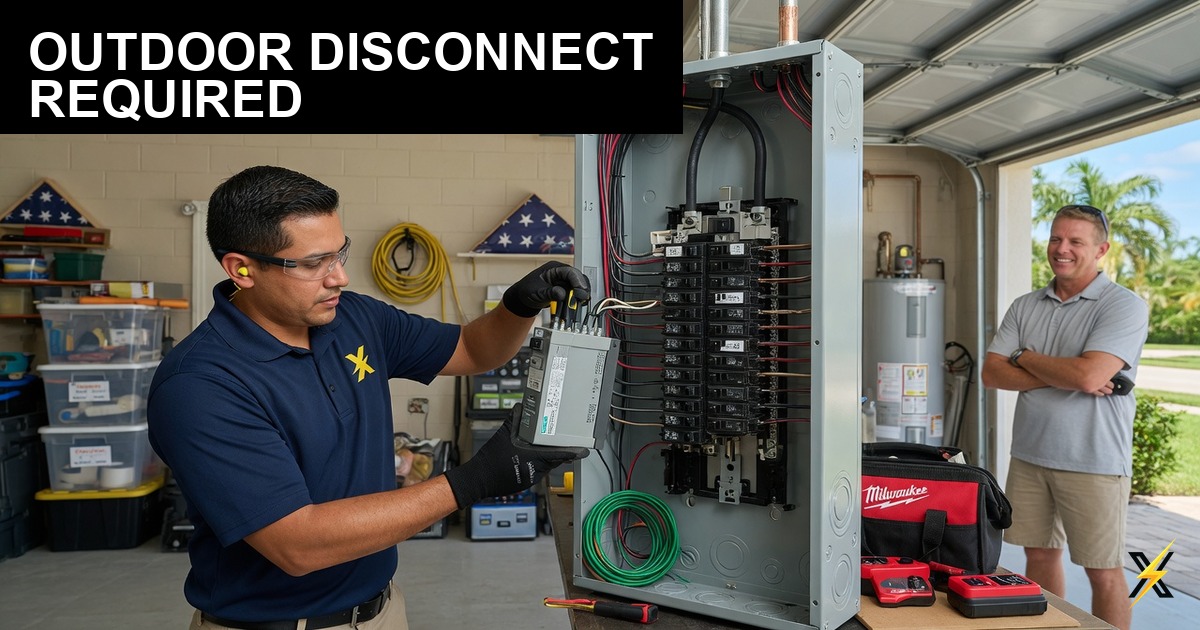
Quick Answer: The 2020 National Electrical Code (NEC), Section 230.85, now requires an emergency disconnect installed outside your home on all one- and two-family dwellings. In Florida this rule took effect December 31, 2023 under the Florida Building Code 8th Edition. If you are replacing your electrical panel, your electrician is required by code to install or verify an outdoor disconnect as part of that work. This is not optional — it is the law, and it exists to protect your family and first responders.
What Is NEC 230.85 and What Does It Actually Require?
The National Electrical Code is published by the National Fire Protection Association (NFPA) and governs electrical installations across most of the United States. Florida adopts a new edition of the NEC every few years through the Florida Building Code. NEC 230.85 is a section that was brand new in the 2020 edition. It is titled Emergency Disconnecting Means and it applies specifically to one- and two-family dwellings — meaning single-family homes and duplexes.
Here is what it requires in plain English:
- Every home must have a means to disconnect all power to the building from outside — or immediately inside at the point where the utility power enters the structure.
- That disconnect must be readily accessible — meaning a firefighter, EMT, or utility worker can reach it without a ladder, a key, or having to move anything out of the way.
- It must be permanently and plainly marked with the words “Emergency Disconnect.”
- If power comes from multiple sources such as solar or a standby generator, it must also be marked “Service Energized from Multiple Sources.”
What Counts as a Compliant Outdoor Disconnect?
The code gives electricians a few options depending on your existing service setup:
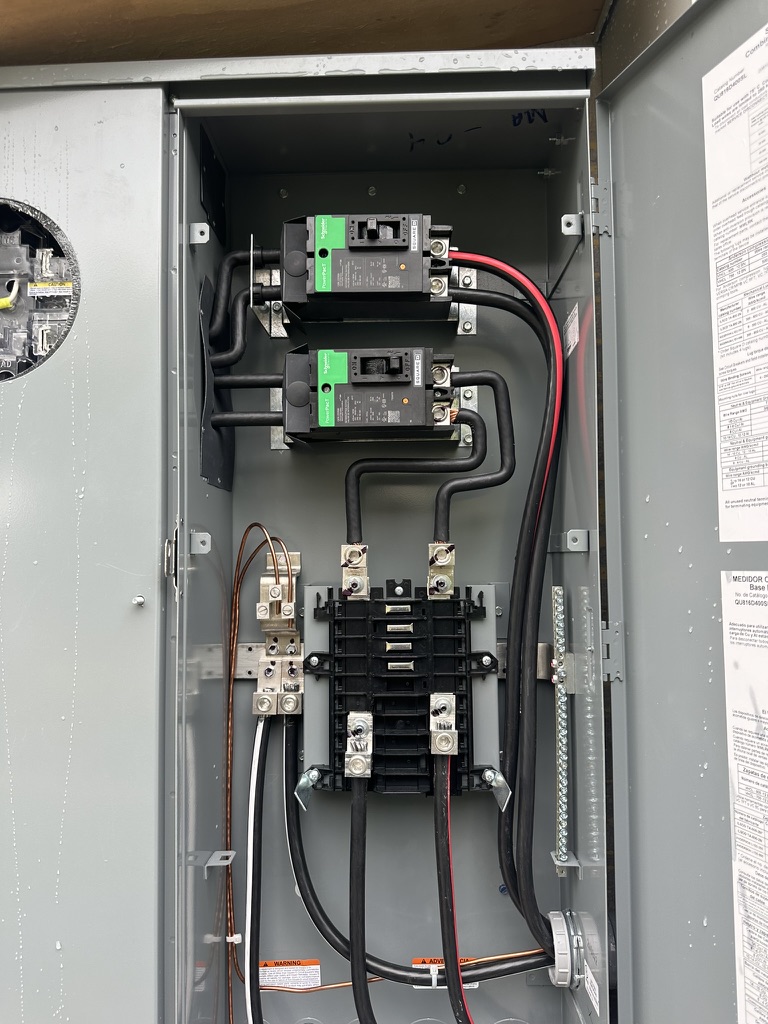
- Meter-main combination unit — The most common solution. A single enclosure that houses both your utility meter socket and a main circuit breaker, mounted on the exterior wall. One flip of that breaker kills all power to the home.
- Separate outdoor disconnect switch — A dedicated disconnect enclosure installed near the meter, separate from the main panel.
- A main breaker panel located outside — If your main panel is already mounted on an exterior wall and accessible without entering the home, that may satisfy the requirement depending on placement.
The key word in all of these is outside. A main breaker mounted inside a garage or utility room does not satisfy NEC 230.85 in most interpretations, because it requires someone to enter the structure.
Why Was This Rule Added? The Life-Safety Reasoning Behind 230.85
When firefighters arrive at a structure fire, one of the first things they need to do is cut electrical power to the building. Live circuits in a burning building create serious electrocution hazards for crews working in smoke, darkness, and compromised conditions. Until 230.85, there was no guarantee that any disconnect existed outside a home — the only way to kill power was often to enter the building and find the main breaker panel, which could already be in a dangerous area.
The NFPA’s research on residential fire data has long shown that electrical involvement significantly increases fire severity and firefighter risk. The emergency disconnect requirement is a direct response to feedback from fire departments, emergency medical services, and electrical inspectors who had been requesting this kind of outside shutoff capability for years. The International Association of Electrical Inspectors (IAEI) has supported NEC 230.85 as a meaningful step forward in residential life safety.
It Is Not Just About Fires
The outdoor disconnect also matters during:
- Flooding — Being able to kill all power from outside before water enters the home is a critical safety advantage. In Southwest Florida flood-prone areas this is genuinely relevant.
- Medical emergencies — EMS crews responding to an electrocution need a fast way to shut down power without entering a potentially live environment.
- Utility maintenance — Workers performing work on your meter or service entrance benefit from a clearly labeled, accessible disconnect.
What This Means When You Replace Your Panel
If you are replacing your electrical panel — whether it is a like-for-like swap of a failed panel, an upgrade from 100A to 200A service, or a full service upgrade — your electrician is required to bring your service entrance into compliance with current code, which now includes NEC 230.85.
This typically means one of the following will be part of your panel job:
- Installing a new meter-main combination unit on the exterior of the home, replacing the old meter socket and providing the code-required outdoor disconnect.
- Adding a separate outdoor disconnect enclosure near the meter if a full meter-main is not practical for your setup.
- Verifying and labeling an existing outdoor disconnect that already meets the requirement.
The meter-main combination approach is generally the cleanest solution. It consolidates your main breaker and meter into one exterior enclosure and satisfies 230.85 cleanly, often resulting in a neater overall installation.
Common Mistakes Homeowners Should Watch For
1. A quote that does not mention an outdoor disconnect at all.
Any licensed electrician pulling a permit for a panel replacement in Florida today must account for 230.85 compliance. If a quote makes no mention of it, ask directly: Does this include an outdoor emergency disconnect to meet NEC 230.85?
2. Work quoted without a permit.
Panel replacements require an electrical permit and inspection in Lee County and throughout Southwest Florida. A permit is how the local Authority Having Jurisdiction (AHJ) verifies your installation is code-compliant. Never allow an electrician to replace your panel without pulling a permit — it creates liability for you as the homeowner and can cause problems when you sell.
3. An outdoor disconnect that is not labeled.
NEC 230.85 explicitly requires the disconnect be marked “Emergency Disconnect.” An unlabeled exterior disconnect does not fully satisfy the code requirement and may fail inspection.
4. A main breaker inside a garage presented as the outdoor disconnect.
A main breaker panel inside your garage does not satisfy 230.85 in most AHJ interpretations because it still requires entry into the structure.
Florida and Southwest Florida Considerations
Salt Air and Corrosion
Exterior electrical enclosures in Southwest Florida take a beating from salt air. Make sure your electrician specifies equipment rated for coastal environments. NEMA 3R enclosures are the minimum standard for exterior use. In high-salt-air zones close to open water in Cape Coral or along the Fort Myers waterfront, discussing additional corrosion-resistant finishes or stainless hardware is worthwhile.
Hurricane Preparedness
The outdoor emergency disconnect has an added benefit here that most of the country does not think about — storm prep and post-storm safety. When a hurricane is approaching and you are evacuating, being able to shut down all power to your home from outside before you leave is a genuine safety and practical advantage. After a storm, first responders assessing flood damage benefit enormously from a clearly marked exterior shutoff.
Flood Zones
Many homes in Cape Coral and low-lying parts of Fort Myers are in FEMA flood zones. The ability to kill power from outside before floodwater enters the structure can be the difference between a safe evacuation and a dangerous one.
Florida Building Code Timing
Florida adopted the 2020 NEC on December 31, 2023. Work permitted before that date was governed by the 2017 NEC, which did not include 230.85. If you are replacing your panel now, there is no grandfather clause. Current code applies to new work.
Ready to Upgrade Your Panel the Right Way?
If you are planning a panel replacement or service upgrade in Cape Coral, Fort Myers, Bonita Springs, Estero, or anywhere in Southwest Florida, we would be glad to walk you through exactly what your home needs — including 230.85 compliance — before you commit to anything. We pull permits on every job, install to current code, and give you a straight answer on what is required versus what is optional.
Call or text: (239) 880-9473
Serving Cape Coral, Fort Myers, Naples, Bonita Springs, Estero, Marco Island, Lehigh Acres, and Port Charlotte
Florida Electrical License #EC13016674 · Verify
electriciansx.com