Fan-Rated Box • All Brands • Indoor & Outdoor • Licensed & Insured • (239) 888-8888
A ceiling fan is one of the most cost-effective upgrades in any Southwest Florida home. Running a ceiling fan in the summer allows you to raise your thermostat 4–8°F without any loss of comfort — reducing cooling costs significantly in our year-round heat. ElectriciansX installs all types of ceiling fans: standard indoor fans, damp-rated lanai fans, wet-rated outdoor fans, and smart fans with app control.
Cape Coral’s 400+ miles of canals and coastal geography make it one of the most storm-exposed communities in Lee County — and one of the most active residential electrical markets in Southwest Florida. Whether you’re replacing an old fan, adding a fan where only a light exists, or running new wiring to an entirely new location, our licensed electricians handle every step — from fan-rated box installation to final blade balancing.
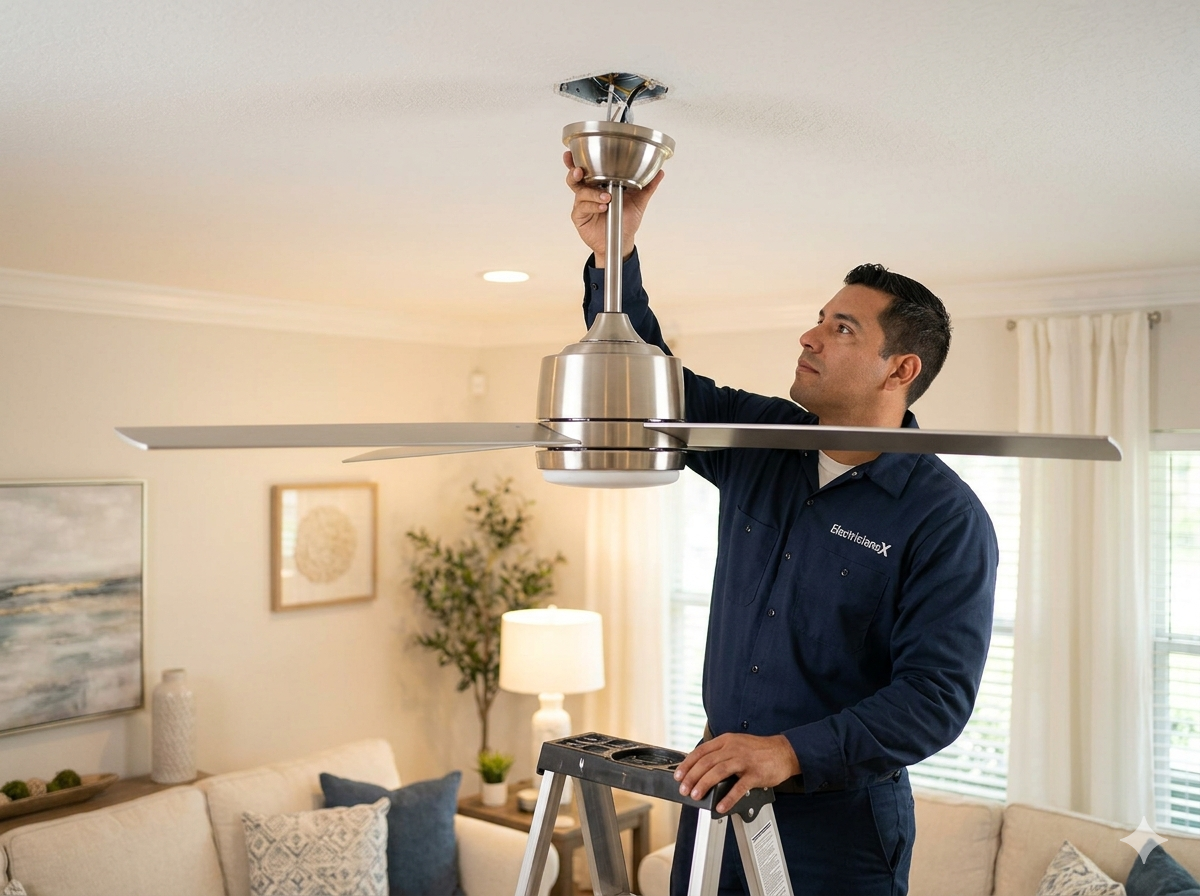
From a simple swap to a full new wiring run — we handle every type of ceiling fan installation.
Swap an old or broken fan for a new one. We verify box rating, connect wiring, and balance blades for quiet, wobble-free operation.
No box? No problem. We install a fan-rated ceiling box and run wiring from your existing circuit or add a new dedicated circuit.
Covered lanais and uncovered patios need damp- or wet-rated fans. We install weatherproof fans that hold up to Southwest Florida humidity and rain.
Smart ceiling fans (Alexa, Google, app-controlled) require proper wiring with a neutral wire. We verify your wiring and configure smart controls.
Vaulted and high ceilings require correct downrod sizing to keep blades 8–9 ft off the floor. We size and install downrods for any ceiling height.
Fans with integrated or separate light kits need proper switch wiring. We wire separate controls for fan speed and light dimming where desired.
We check whether a fan-rated box is present, inspect wiring gauge, and confirm the circuit can handle the new fan.
If your existing box is not fan-rated, we install an expandable brace kit or properly anchored fan-rated box rated for your fan's weight.
We connect live, neutral, and ground wires per the manufacturer's wiring diagram and NEC requirements.
Blades are attached at the correct pitch. Downrod length is set so blades hang 8–9 ft above the floor for optimal airflow.
We balance the blades, test all speeds and light functions, verify the remote or wall control, and clean up completely before leaving.
Click another city to see local service details.
Yes — always. Ceiling fans require a fan-rated box that supports both the static weight (up to 35 lbs standard, 70+ lbs with a brace kit) and the dynamic vibration load. Standard light fixture boxes are not rated for fans and can fail over time. ElectriciansX verifies or upgrades your box as part of every installation.
Yes. When there is no existing wiring at the ceiling location, we run a new circuit from your panel, install a fan-rated box, and provide a complete, ready-to-use installation. This work typically requires an electrical permit in Florida.
A standard ceiling fan replacement on an existing fan-rated box typically runs $125–$200 in labor. Installing a new fan where no fixture exists (new wiring required) ranges from $250–$500+ depending on ceiling height, distance from panel, and circuit requirements. We provide free estimates.
Indoor-rated fans are for dry interior spaces only. Damp-rated fans can handle covered outdoor areas like screened lanais and covered porches — they are the right choice for most Southwest Florida outdoor spaces. Wet-rated fans tolerate direct rain exposure and are required for uncovered outdoor installation.
Blade span should match room size: 29–36 inches for rooms under 75 sq ft; 36–42 inches for 76–144 sq ft; 44–54 inches for 144–225 sq ft; 54–72 inches for large great rooms. We can advise on the correct size during our estimate visit.
No — ceiling fans typically share a lighting circuit. However, if you’re adding multiple fans or running a high-wattage light kit on an already-loaded circuit, we may recommend a dedicated circuit to prevent breaker trips.