Breaker Replacement • AFCI • GFCI Breakers • Won’t Reset Diagnosis • Licensed • (239) 888-8888
A circuit breaker that trips repeatedly, won’t reset, runs warm to the touch, or makes a buzzing sound is not a minor annoyance — it is a warning sign that something is wrong, either with the breaker itself or with the circuit it protects. ElectriciansX diagnoses circuit breaker problems throughout Southwest Florida and replaces failed, undersized, or obsolete breakers with properly rated units, including AFCI and GFCI breakers where code requires them.
Port Charlotte, in Charlotte County just north of Lee County, is a growing residential community where ElectriciansX regularly serves homeowners with all types of residential electrical work. Florida’s high HVAC loads and aging electrical panels make breaker issues particularly common. Whether you have a single breaker that won’t hold or a panel full of breakers that need inspection, our licensed electricians identify the root cause and resolve it correctly.
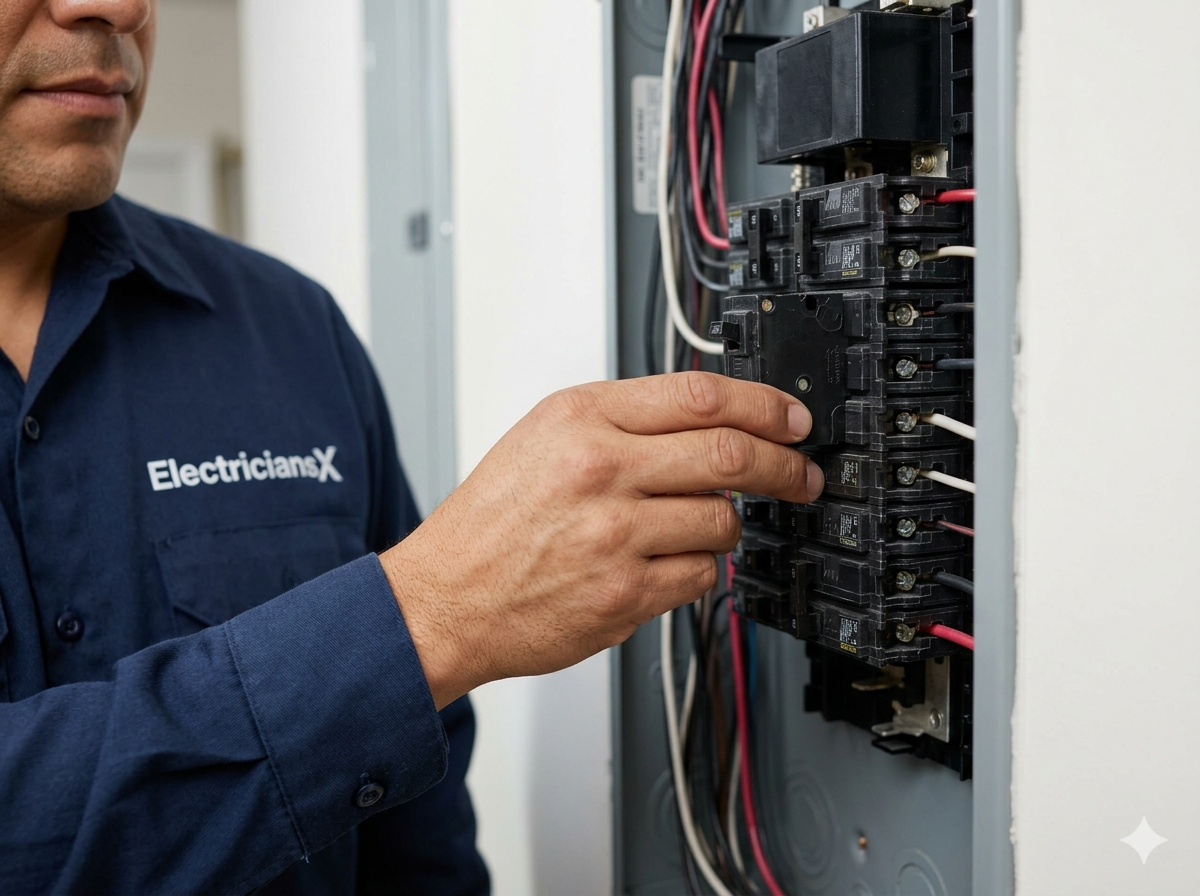
From a single failed breaker to AFCI upgrades and main breaker replacement — we handle the full range.
Replace a 15A or 20A single-pole breaker that trips, won’t reset, or has failed. We match the exact breaker type required for your panel brand.
Replace 240V double-pole breakers (30A, 40A, 50A, 60A) for ranges, dryers, HVAC units, water heaters, and other large appliances.
Arc-Fault Circuit Interrupter (AFCI) breakers are required by NEC for bedroom circuits and other living areas. We upgrade your panel to AFCI protection where code requires it.
GFCI breakers provide ground fault protection for an entire circuit from the panel — ideal for garage, bathroom, outdoor, and kitchen circuits.
When panel space is tight, tandem breakers fit two circuits into a single breaker slot. We verify your panel’s compatibility before installing.
The main breaker controls power to your entire panel. When it fails or becomes unreliable, we replace it safely — with power coordination from FPL when required.
We identify whether the issue is a failed breaker, an overloaded circuit, a wiring fault, or a short circuit downstream that is causing the trip.
We confirm the panel brand, breaker type (standard, AFCI, GFCI), and correct amperage rating required for your circuit.
We shut down the panel, remove the failed breaker, and install a properly rated replacement per NEC requirements for your panel brand.
We restore power, test the circuit under load, and verify the breaker holds without tripping before declaring the repair complete.
If the breaker was tripping due to an overloaded circuit or wiring fault, we advise on the underlying issue — adding a circuit, upgrading wiring, or redistributing loads.
Click another city to see local service details.
Signs of a failed circuit breaker include: the breaker trips immediately when reset; the breaker feels warm or hot to the touch; you smell burning near the panel; the breaker is visibly scorched or discolored; or the breaker doesn’t fully snap to the ON or OFF position. Any of these warrant an immediate call to a licensed electrician.
Repeated tripping is caused by one of three things: (1) an overloaded circuit — too many devices drawing more current than the breaker’s amperage rating; (2) a short circuit — a direct contact between hot and neutral or ground wires somewhere in the circuit; or (3) a failing breaker that trips at a lower amperage than its rating. We diagnose which cause applies and fix it at the source.
A standard single-pole breaker replacement typically runs $100–$175 in labor plus the breaker cost ($10–$40 for standard, $30–$80 for AFCI or GFCI). Double-pole and specialty breakers cost more. We provide upfront pricing before any work begins.
A GFCI breaker protects against ground faults — electrical current flowing through an unintended path (such as through a person touching a faulty outlet). A GFCI breaker trips in milliseconds to prevent electrocution. An AFCI breaker protects against arc faults — electrical arcing caused by damaged wiring or connections — which can ignite fires even without tripping a standard breaker. Many newer NEC code sections require both types in specific locations.
You can safely reset a breaker once by switching it fully OFF, then back ON. If the breaker trips again immediately or shortly after reset, do not keep resetting it — a persistent fault needs professional diagnosis. Repeated forced resets of a faulty circuit can start an electrical fire.
A circuit breaker that is warm or hot to the touch indicates either a sustained overload on the circuit, a failing breaker with high internal resistance, or loose wiring connections at the breaker. All three situations warrant immediate professional inspection — a hot breaker is a fire risk.