
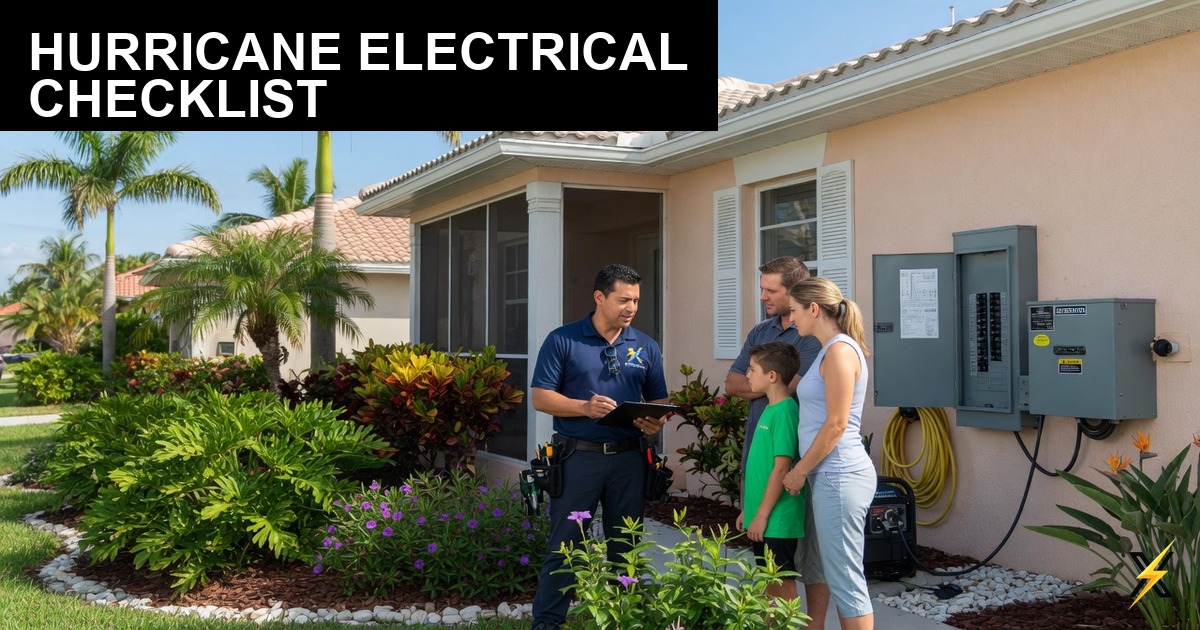
If you live in Cape Coral, Fort Myers, or anywhere else in Lee County, you know the rhythm by now. June arrives and with it comes that low-level awareness — the kind that makes you glance at the Weather Channel a little more often and wonder whether you ever replaced those outdoor outlet covers. Hurricane season is here, and while most homeowners think about storm shutters, food supplies, and evacuation routes, the electrical system often gets checked off with a vague mental note and never revisited.
That gap matters. Power outages are the obvious concern, but the real hazards — the ones that put people in the hospital and turn water damage into total losses — are the electrical failures that happen before, during, and in the days after a storm. This checklist covers what a licensed electrician actually looks for, broken down by timing, so you can work through it at your own pace before the first named storm of the season has a chance to remind you the hard way.
Before the Storm: Set Your System Up to Handle Whatever Comes
Test Every GFCI Outlet in Your Home
GFCI outlets — the ones with the small “Test” and “Reset” buttons — are required by code in kitchens, bathrooms, garages, laundry areas, and all outdoor locations. Their job is to cut power the instant they detect a difference between the current going out and the current coming back, which is exactly what happens when electricity finds an unintended path through water or a human body.
Press the “Test” button on each one. It should click and the outlet should go dead. Press “Reset” to restore it. If the outlet doesn’t respond, if the reset button won’t hold, or if you can’t find the GFCI that controls a given area of your home, you have an issue worth addressing before storm season is in full swing. A licensed electrician can locate, test, and replace every GFCI outlet in most homes in a single visit.
Walk Your Exterior and Look at Everything
SW Florida’s combination of heat, humidity, UV exposure, and salt air is genuinely hard on outdoor electrical components. A cover plate that was in good shape last October may be cracked, yellowed, or separated from the wall by now. Walk your entire property and look at:
- Outdoor outlet covers — are they weatherproof “in-use” bubble covers that stay closed even with a cord plugged in? Standard flat covers leave the outlet exposed the moment you plug something in.
- Exterior light fixtures — look for rust stains around the base, cracked globes, or any fixture that’s pulling away from the wall.
- Conduit runs along the exterior — PVC conduit gets brittle over time and can crack or pull away from the wall, leaving wiring exposed.
- Junction boxes — every junction box should have a cover plate. Open boxes, especially near the roofline or in soffits, are direct entry points for water.
Add a Whole-Home Surge Protector If You Don’t Have One
Lightning does not have to strike your house to destroy your HVAC system, refrigerator, or television. A nearby strike — even a block away — can send a voltage spike through the utility line fast enough that your power strips have no time to respond. Whole-home surge protectors install directly at your main panel and catch those spikes at the source, before they reach a single outlet in your home.
This is one of the most cost-effective electrical upgrades a Cape Coral or Fort Myers homeowner can make, and it works alongside individual power strips rather than replacing them. If you already have surge strips on your electronics, a panel-level device gives you a second layer that handles the large transients the strips weren’t designed for. Learn more about whole-home surge protection →
Schedule a Panel Inspection If Your Home Is Over 20 Years Old
Many Cape Coral neighborhoods were developed in the 1970s through 1990s. Homes from that era may still have their original electrical panels — and some of those panels have a documented problem: the breakers don’t always trip when they’re supposed to. Federal Pacific Stab-Lok panels and Zinsco panels are the two most common examples. Both brands have been the subject of safety investigations and have higher-than-expected failure rates under overload conditions.
A failed breaker doesn’t cause an outage. It causes a fire. And it tends to happen at exactly the wrong time — when your system is running harder than usual, which is precisely what happens during and after a storm when you’re cycling between utility power and a generator, running everything on battery backup, and operating through sustained heat and humidity.
A panel inspection takes roughly an hour. It gives you a clear, factual picture of what you’re working with before the season puts any demands on your system.
Verify Your Generator Is Ready
If you have a portable or standby generator, test it now — not the day the storm warning goes up. Run it under load for 30 minutes. Check the oil. Make sure you have enough fuel on hand to get through a multi-day outage, keeping in mind that gas stations in Lee County often run dry within 24 hours of a storm watch.
If you’re planning to add a generator this season, the time to get on a licensed electrician’s schedule is before June gets busy. Transfer switch installations and interlock kits require a permit and an inspection in Lee County, and lead times get long once storm season starts. See what a generator installation involves →
During the Storm: What to Leave On and When to Cut It
The Main Breaker Is Not Always the First Move
There’s a common piece of advice that circulates every June: shut off your main breaker before a hurricane hits. Like most broad rules, it’s sometimes right and sometimes wrong. Cutting the main makes clear sense if you’re evacuating, if your home has known electrical issues, or if flooding is a realistic possibility for your specific location. If you’re sheltering in place and your home is on higher ground, keeping power available for fans, refrigeration, medical equipment, and device charging may be the better call — right up until you lose utility power or water begins entering the structure.
When Water Enters, Cut the Main
The calculus changes the moment floodwater comes in. Water and live circuits don’t coexist safely, even at low levels. An inch of standing water over a floor with energized outlets in the baseboards is a hazard. If flooding begins, shut off the main breaker immediately and do not re-energize until the water is gone and an electrician has inspected the affected circuits.
Never Open a Flooded Panel
If your electrical panel is in a garage or utility space that has taken on water, do not open it — not to flip breakers, not to see what’s going on, not for any reason. Call your utility company to disconnect at the meter. Wait for a licensed electrician before the panel is opened or the main is restored. This is not a situation where taking a look costs you nothing.
After the Storm: Slow Down Before You Turn Everything Back On
Don’t Restore Power Until You’ve Walked the House
When utility power returns after an outage, the instinct is to flip the main back on and get back to normal. Take five minutes first. Walk through your home and look for water staining around outlets or fixtures, scorch marks anywhere near electrical components, or any fixture or outlet that visually doesn’t look right. Smell for burning — wet insulation that gets hot has a sharp, acrid smell that’s distinct from normal post-storm odors. If you see or smell anything concerning, leave the main off and call before you energize.
Salt Water Changes the Rules
Cape Coral’s canal system means that storm surge flooding in many neighborhoods carries salt water, not freshwater. Salt water is dramatically more corrosive to electrical wiring, connections, and components than freshwater, and the damage it causes inside a wire or outlet box isn’t visible from the outside. Any outlet, switch box, or fixture that was submerged — even briefly, even partially — in salt water should be considered compromised until an electrician opens it up and verifies it’s clean. The cost of replacement is a fraction of what a fire caused by corroded wiring costs.
Post-Storm Generator Safety
If you were running a portable generator and utility power returns while it’s still connected, you have a back-feed hazard. Generator power and utility power should never be on the same circuit at the same time. If your generator is connected through a proper transfer switch or interlock kit, the system prevents this automatically. If you’re using an extension cord arrangement, disconnect the generator completely before the utility restores service — and make getting a proper transfer switch installed your first call after the storm passes.
Schedule a Post-Storm Inspection
Lee County consistently sees a spike in electrical fires in the weeks following a major storm event. Not from the storm itself, but from damaged wiring that was energized without inspection. A post-storm electrical inspection is worth scheduling even if your home looks intact — and it’s often required documentation for a full insurance claim anyway. The earlier you get on the schedule after a storm, the faster you get cleared.
One Checklist, One Season
Hurricane season in SW Florida runs through November 30. The electrical work worth doing isn’t the kind that takes a full weekend — GFCI testing takes twenty minutes, an exterior walk takes another twenty, and a panel inspection is a single afternoon appointment. The effort is low. The protection it buys you is significant.
If you go through this list and find anything that needs attention, or if you simply want a licensed electrician to walk through your home before the season gets active, we’re available throughout Cape Coral, Fort Myers, and all of Lee County.