
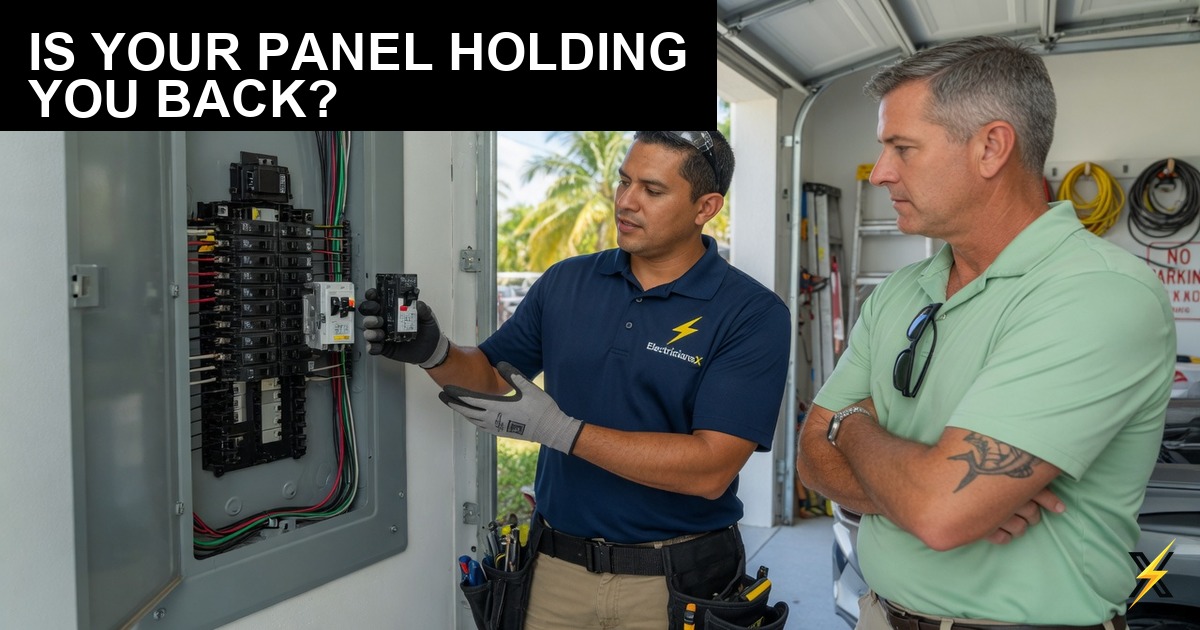
Most homeowners in Cape Coral and Fort Myers don’t think about their electrical panel until something goes wrong. A breaker trips while running the microwave and the dryer at the same time. The lights dim when the air conditioner kicks on. An inspector flags something during a home sale and suddenly there’s a number on a repair estimate that nobody saw coming.
The panel — that metal box in your garage or utility closet with the rows of switches — is the heart of your home’s electrical system. Everything flows through it: every outlet, every light, every appliance. And if it was installed 30 or 40 years ago, there’s a real possibility it wasn’t designed for the way you live today, and may not be safe under the demands that modern life puts on it.
Here’s what to look for, what it means, and what a panel upgrade actually involves.
How Old Is Too Old?
Cape Coral was one of the fastest-growing cities in the United States through the 1970s, 1980s, and 1990s. A significant portion of the housing stock in the city — and in neighboring Fort Myers — dates from that period. Those homes were built and wired for a different era: window AC units instead of central air, two-car garages without EV chargers, kitchens without multiple high-draw appliances running simultaneously, and no home offices pulling power all day.
An electrical panel from 1978 or 1988 isn’t automatically dangerous just because of its age. But age is a useful flag to investigate. If your panel is more than 25 years old and has never been inspected or upgraded, it’s worth having a licensed electrician take a look — not because something is guaranteed to be wrong, but because the cost of finding out is low and the cost of not finding out can be very high.
The Two Brands That Deserve Special Attention
Two panel manufacturers from the mid-20th century have a documented history of safety problems that makes them worth flagging specifically: Federal Pacific Electric (FPE) with their Stab-Lok panels, and Zinsco (also sold under the GTE-Sylvania name). Both were widely installed across SW Florida during the boom years, and both are still in service in a significant number of homes today.
Federal Pacific Stab-Lok
Federal Pacific was one of the most common panel brands installed in American homes from the 1950s through the 1980s. The problem with Stab-Lok panels — which you can identify by the brand name on the panel door and the distinctive slim breakers — is that their breakers have a higher-than-expected failure rate under overload conditions. A breaker that fails to trip doesn’t cause the circuit to go dead. It allows the circuit to overheat. That’s how electrical fires start inside walls, in attic spaces, and behind appliances, often without any warning.
The Federal Pacific Stab-Lok panel has been the subject of safety investigations by the Consumer Product Safety Commission and has been cited in fire investigation reports across the country. Many insurance companies in Florida now require replacement as a condition of coverage or renewal.
Zinsco / GTE-Sylvania
Zinsco panels have a similar problem: their breakers can weld themselves to the bus bar over time, meaning they physically cannot trip even if they wanted to. In some cases, homeowners and even electricians have tried to flip a Zinsco breaker and it moved without actually disconnecting the circuit — the handle moved but the connection inside did not break. This is not a subtle risk. It’s a complete failure of the fundamental safety function a breaker exists to perform.
If you don’t know what brand your panel is, that’s actually common — many homeowners have never opened the door. A quick look at the brand label and the style of the breakers is enough for a licensed electrician to identify it on the spot.
Signs Your Panel May Be Struggling — Any Brand
Even if your panel isn’t a Stab-Lok or Zinsco, there are signs that it’s working harder than it should or that it can no longer meet the demands of your home:
- Breakers that trip frequently. A breaker that trips occasionally is doing its job. A breaker that trips every time you run certain appliances together is telling you the circuit is consistently overloaded — either the circuit needs to be upgraded or the load needs to be redistributed.
- Breakers that won’t stay reset. If you flip a breaker back to “on” and it immediately trips again, there’s either a fault on the circuit or the breaker itself has failed. Don’t keep trying to force it — call an electrician.
- Lights that dim when large appliances start. Some momentary dimming when a motor starts is normal. If it’s sustained, or if it happens regularly across your home, it suggests the panel or the service entrance wiring is undersized for your current load.
- A panel that’s physically full. If every slot in your panel is occupied and you’re thinking about adding an EV charger, a hot tub, a whole-home generator, or even a dedicated circuit for a home office, you need either a sub-panel or a new main panel with more capacity.
- Warm panel or burning smell. The panel door should never feel warm to the touch. A warm panel or any smell of burning near the electrical box is a situation that warrants an immediate call — not a scheduled appointment.
What About Adding Circuits Without Upgrading the Whole Panel?
Sometimes a homeowner needs one or two additional circuits — a dedicated outlet for a home office, a 240V circuit for a new appliance — and the existing panel has open slots and sufficient capacity. In that case, adding circuits doesn’t require replacing the whole panel.
The distinction matters because a full panel replacement and adding a circuit are very different scopes of work. A licensed electrician can assess whether your panel has the capacity and the physical space to support what you need, or whether the better path is a new panel from the start. Getting that assessment before any work begins is what separates an efficient project from one that starts one way and ends up being much larger.
What a Panel Upgrade Actually Involves
A panel upgrade — replacing the main electrical panel with a new one — is not a weekend DIY project. In Florida, it requires a permit from your local building department (Cape Coral, Fort Myers, and Lee County all require permits for panel replacements), a licensed electrical contractor to perform the work, and an inspection by the building department before the panel is energized.
Here’s the typical sequence:
- Your electrician pulls the permit and schedules a disconnect with FPL to temporarily de-energize the service entrance.
- The old panel is removed and the new panel is installed in the same location (or relocated if necessary).
- All existing circuits are transferred to the new panel and labeled clearly.
- The utility reconnects service and the building inspector signs off.
For most homes, this is a one-day job. The power is off for several hours during the swap — usually a morning or afternoon. Most homeowners are back to full power by the end of the same business day the work starts.
What About the Cost?
Panel upgrades in SW Florida range significantly depending on the size of the existing service, whether you’re upgrading capacity (from 100A to 200A, for example), the condition of the service entrance wiring, and local permit fees. Rather than give a number that will be wrong for your specific situation, the honest answer is that a panel upgrade is a mid-range home improvement project — less than a kitchen remodel, more than replacing a water heater — and it’s an investment in the safety and functionality of every electrical system in your home for the next 30+ years.
Many homeowners discover during a home sale that their insurance company or the buyer’s lender has flagged the panel. Having it replaced proactively, on your schedule and without a closing date creating pressure, is almost always a smoother and less expensive experience than doing it reactively.
EV Chargers, Generators, and Panel Capacity
Two of the most common reasons Cape Coral and Fort Myers homeowners are looking at panel upgrades right now are electric vehicles and whole-home generators. Both require dedicated high-amperage circuits. A Level 2 EV charger typically needs a 50A or 60A dedicated circuit. A whole-home standby generator requires a transfer switch and a dedicated connection. If your panel is already at capacity, adding either of these without upgrading the panel isn’t possible.
The good news is that the cost of addressing the panel and adding the new circuit in a single project is almost always lower than coming back twice. If you’re planning either of these additions in the next few years, it’s worth discussing now rather than discovering the limitation mid-project. Learn more about generator installation →
How to Know If You Need to Act Now or Can Wait
Not every older panel is an emergency. Not every home with a 30-year-old panel needs to replace it immediately. What determines urgency is the specific condition of your panel, the brand, the current load, and what you’re planning to add. The only way to know which situation you’re in is to have a licensed electrician look at it.
An honest inspection tells you one of three things: your panel is in good shape and has capacity for what you need, your panel is functional but limited and you should plan an upgrade in the next few years, or your panel has a condition that needs to be addressed now. That clarity is worth more than guessing.
We serve Cape Coral, Fort Myers, and all of Lee County. If your home is more than 20 years old and your panel has never been looked at, we’ll give you a straight answer on where you stand.