
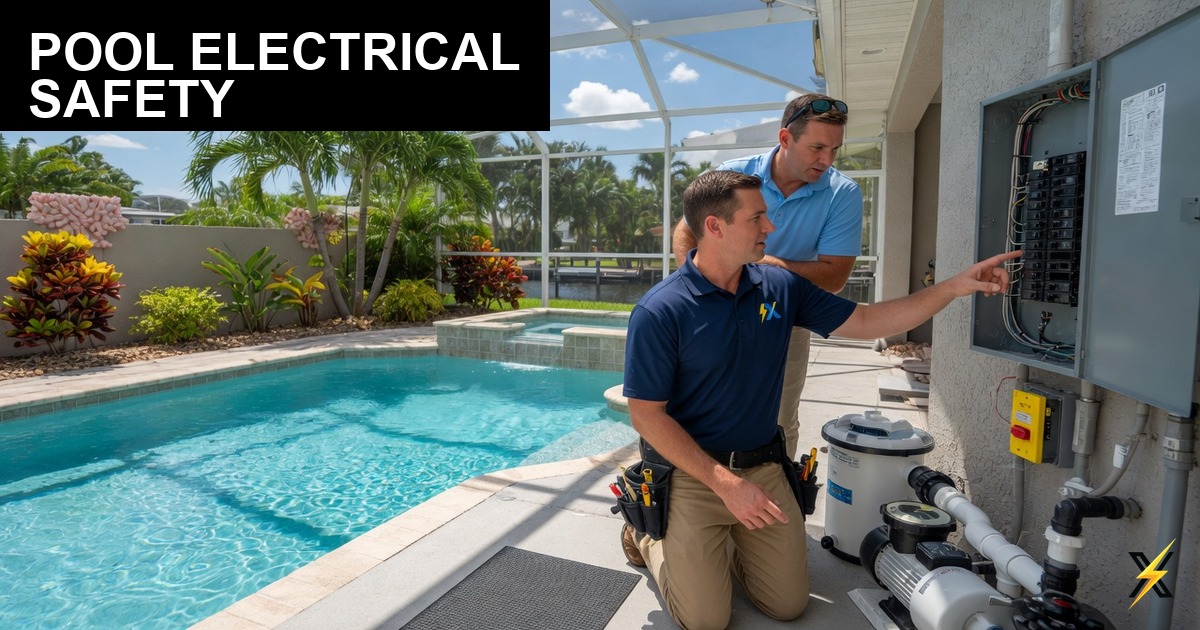
Cape Coral has more miles of navigable waterways than any city in the United States, and nearly as many backyard swimming pools. For a city built around water, it’s worth understanding something that most pool owners never think about: the electrical system beneath and around your pool is more complex than the rest of your home’s wiring, carries higher stakes when something goes wrong, and is one of the most commonly under-inspected systems in residential properties throughout Lee County.
This isn’t written to alarm you. The vast majority of pools in SW Florida are safe. But understanding what the code requires, what can go wrong, and what a pool electrical inspection actually covers will make you a more informed owner — and will help you catch the kind of problem that’s invisible until it isn’t.
Bonding and Grounding: Two Different Things That Both Matter
The most common source of confusion in pool electrical safety is the difference between bonding and grounding. These two terms are often used interchangeably, but they refer to different systems that do different jobs.
Grounding
Grounding is what provides a safe path for fault current to return to the panel and trip a breaker. Every electrical circuit in your home is grounded — it’s a standard requirement. Grounding protects you from shock by giving electricity a path back to the source when something goes wrong, rather than through you.
Bonding
Bonding is specific to pool environments and addresses a different problem. When different metal components around a pool — the water, the pump, the light fixtures, the metal ladder, the reinforcing steel in the concrete shell — are at slightly different electrical potentials, current can flow between them. If a person is in the water at that moment, they can become the path that equalizes those potentials. The result is electric shock drowning, or ESD.
Bonding connects all of those metal components together — including the water itself, through a bonding grid in the pool shell — so they’re all at the same electrical potential. When everything is at the same potential, there’s no difference to equalize, and no current flows through the water. Bonding doesn’t rely on tripping a breaker or cutting power. It prevents the hazard from existing in the first place.
The National Electrical Code requires bonding for all conductive pool components within 5 feet of the pool’s interior wall. In Florida, where pool equipment is often located adjacent to the pool and where metal pool deck furniture, railings, and spa equipment are common, the scope of what needs to be bonded is often broader than homeowners expect.
Electric Shock Drowning: Understanding the Real Risk
Electric shock drowning occurs when a person in water is exposed to low-level alternating current that’s sufficient to cause muscle paralysis but not immediate death from electrocution. The person can’t swim, can’t call for help, and can drown in what appears to be a completely calm situation. It is not rare, and it is not confined to areas with obvious electrical problems.
The AC power that causes ESD often comes from a fault in pool equipment — a pump with degraded wiring insulation, a light fixture with a failing seal, or an improperly installed outlet near the pool. In some cases it comes from an induced current from nearby overhead power lines or from neighboring properties’ electrical systems through shared water features. The current levels involved are in the milliamp range — far too low to trip a standard circuit breaker.
This is why the NEC requires GFCI protection on all pool receptacles and on all 120V pool lighting circuits. A GFCI cuts power at 5 milliamps — exactly the range where ESD current operates. It’s the specific protection designed for this specific hazard.
What Florida Code Requires for Pool Electrical
Pool electrical systems in Florida are governed by both the NEC and the Florida Building Code, and inspected by your local building department. The key requirements for residential pools include:
- GFCI protection on all 120V pool equipment, all underwater lighting, and all outdoor receptacles within 20 feet of the pool’s inside wall
- A dedicated circuit for the pool pump, typically 240V
- Equipotential bonding connecting all metal pool components, the water, and the pool shell reinforcement
- Proper burial depth for underground conductors serving pool equipment (typically 6″ for GFCI-protected circuits, 12″ for others)
- Weatherproof enclosures for all pool-area electrical equipment
- Separation distances between overhead power lines and the pool surface (minimum 22.5 feet for service conductors)
Pools that were installed before current code versions were adopted — and many Cape Coral pools were installed in the 1980s and 1990s — may not meet today’s requirements. That doesn’t mean they’re illegal to own, but it does mean the safety features that current code requires may not be present.
The Pool Equipment That Ages Out of Safe Operation
Underwater Light Fixtures
Pool light fixtures are immersed in water and must maintain a watertight seal throughout their service life. The seals on underwater fixtures degrade over time — typically 10 to 15 years under Florida’s UV exposure and thermal cycling. When a fixture seal fails, water enters the fixture housing. If the bulb or fixture wiring is live inside a water-filled housing, the risk of current entering the pool water is significant.
Replacing incandescent pool lights with LED fixtures when the original fixtures reach end of life is now standard practice — LED fixtures run much cooler, which extends seal life, and they draw a fraction of the power. But the replacement requires proper installation by a licensed electrician and must be done with the pool power properly de-energized.
Pool Pumps
The pool pump motor is typically the largest electrical load in a residential pool system, and it’s located in a wet, outdoor environment. Pump motor windings and their insulation degrade over time. An aging pump motor with compromised insulation can allow current to leak to the pump housing and from there to any bonded metal in the pool system — or into the water if the bonding connection has failed.
Variable-speed pump motors, which are now required by Florida’s energy code for new pool installations and major replacements, are also more complex electronically and can develop faults that older single-speed motors don’t. Having pool pump motors inspected as part of a routine pool electrical inspection makes sense, particularly for pumps that are 8+ years old.
Salt Chlorine Generators
Salt water pools are common throughout Cape Coral and Fort Myers, and the salt chlorine generator (SCG) adds an additional electrical component to the pool system that wasn’t present in traditionally chlorinated pools. SCGs operate at low voltage but are connected to your electrical system and produce a mild chlorine concentration through electrolysis. They require proper bonding and grounding like all other pool equipment, and their connections should be verified as part of any pool electrical inspection.
When to Call an Electrician, Not a Pool Service Company
Pool service technicians handle chemistry, cleaning, equipment maintenance, and many mechanical issues. They are not licensed to perform electrical work, diagnose electrical faults, or test bonding systems. If you notice any of the following, call a licensed electrician, not your pool service company:
- Any sensation of tingling or “pins and needles” in the water, or when touching the pool ladder or handrails while in the water
- A tripped GFCI that won’t reset, or a GFCI that trips repeatedly when pool equipment runs
- Pool lights that flicker, fail frequently, or show water inside the fixture housing
- Visible corrosion or damage to the wiring at the pump equipment pad
- A pool that’s more than 15 years old and has never had an electrical inspection
- Any recent storm damage or flooding near pool equipment
A tingling sensation in pool water is not a minor issue to monitor. It is an active electrical hazard that should be treated as an emergency.
What a Pool Electrical Inspection Covers
A thorough pool electrical inspection by a licensed electrician in the Cape Coral or Fort Myers area typically includes:
- Testing all GFCI protection on pool circuits
- Verifying continuity of the bonding system across all required components
- Inspecting underwater light fixtures for seal integrity and water intrusion
- Checking the condition of wiring at the equipment pad
- Verifying separation distances from overhead lines
- Confirming that all outdoor receptacles near the pool have in-use weatherproof covers
- Looking at the age and condition of the pump motor and identifying any visible fault indicators
For pools that haven’t been inspected in a decade or longer, this inspection can identify deferred maintenance issues that are worth addressing before they become failures — and before the pool season is in full swing.
Ready for Summer
Cape Coral’s pool season is essentially year-round, but the months when pools see the heaviest use — and when the most people are in the water — are the same months when SW Florida’s afternoon thunderstorms are most frequent. Knowing your pool’s electrical system is sound before that overlap arrives is the right time to find out.
We serve Cape Coral, Fort Myers, and all of Lee County. Pool electrical inspections, bonding system testing, light fixture replacement, and equipment pad upgrades — all licensed, all permitted where required.