
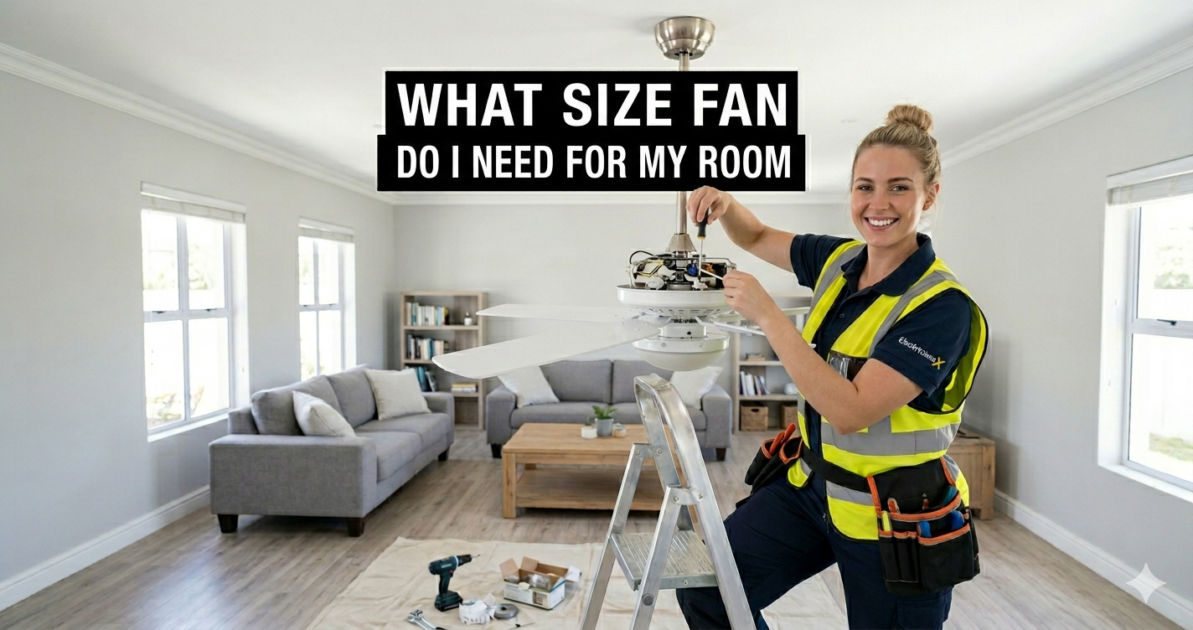
Quick Answer: For rooms under 75 sq ft, a 29–36-inch ceiling fan is sufficient. Rooms between 144 and 225 sq ft — the size of a typical Fort Myers master bedroom — need a 44–52-inch fan. For spaces over 400 sq ft, use a 60-inch fan or install two fans spaced at least 10 feet apart. Before any ceiling fan goes up, NEC 314.27(C) requires a listed, fan-rated electrical box rated for at least 35 pounds — standard light fixture boxes are not rated for the dynamic load of a spinning fan and can fail, causing the fixture to fall from the ceiling.
Ceiling fans are one of the most cost-effective comfort upgrades a Florida homeowner can make. In a state where air conditioning runs eight to ten months a year, a properly sized ceiling fan can make a room feel four to eight degrees cooler — allowing you to raise your thermostat setpoint and cut cooling costs without sacrificing comfort. The key word is “properly sized.” A fan that is too small for the room barely moves the air. A fan that is too large creates an uncomfortable wind-tunnel effect and runs noisier than it should.
In Southwest Florida, ceiling fans pull double duty. Indoors, they extend the effective reach of your air conditioning. On lanais, pool decks, and covered outdoor spaces — which most homes in Cape Coral and Fort Myers have — wet-rated and damp-rated outdoor fans handle the heat and humidity that would destroy an indoor unit within a season. Getting the size right applies in both environments.
In this guide I will walk you through how to size a ceiling fan for any room, provide a calculator you can use right now, explain the ceiling height and mounting considerations that affect performance, and cover what an electrician needs to verify before a new fan goes up.
How to Measure Your Room for a Ceiling Fan
Start with the simplest measurement: square footage. Measure the length and width of the room at floor level and multiply the two numbers together. For irregular room shapes — an L-shaped great room or a room with a bay window alcove — break the space into rectangular sections, calculate each section’s area, and add the totals together.
For open floor plans where the kitchen, dining room, and living room flow together without walls between them, do not treat the entire open space as one room for fan sizing purposes. Divide it into functional zones — the seating area, the dining area — and size a fan for each zone independently. One large fan positioned poorly covers far less of an open plan than two well-placed, appropriately sized fans.
Fan Size Calculator
Enter your room dimensions below to find the right ceiling fan blade span for your space.
Room Fan Size Calculator
Fan Size Reference Chart
| Room Size (sq ft) | Blade Span | Target CFM | Typical Room |
|---|---|---|---|
| Under 75 | 29–36 in | 1,000–2,000 | Small bedroom, bathroom |
| 75–144 | 36–42 in | 1,500–3,000 | Standard bedroom |
| 144–225 | 44–52 in | 2,000–4,000 | Master bedroom, medium living room |
| 225–400 | 52–60 in | 4,000–5,500 | Large living room, great room |
| Over 400 | 60 in or 2 fans | 5,000+ | Open floor plan, large lanai |
These recommendations assume standard 8-foot ceilings. If your ceilings are higher, step up one size category — a room that would normally take a 44-inch fan with 8-foot ceilings may benefit from a 52-inch fan with 10-foot ceilings, where the blade sweep is farther from the occupants and needs more diameter to move the same volume of air effectively.
Understanding CFM: The Number That Actually Determines Comfort
Blade span tells you what size fan fits the room. CFM — cubic feet per minute — tells you how much air the fan actually moves. A fan with a high CFM rating on a lower speed setting delivers the same airflow as a lower-rated fan running flat out, with significantly less noise. When you are comparing models, CFM efficiency (CFM per watt) is the metric that separates a quality fan from a cheap one.
For reference, target CFM ranges by room type in a Florida climate — where fans often run year-round — lean toward the higher end of each range:
- Bedroom: 2,000–3,000 CFM
- Kitchen or dining room: 3,000–4,000 CFM
- Living room: 4,000–6,000 CFM
- Covered lanai (outdoor, sheltered): 4,000–6,000 CFM — use a damp-rated fan
- Open patio (exposed to weather): 4,000–6,000 CFM — use a wet-rated fan only
- Garage or workshop: 6,000+ CFM
Published CFM figures on fan boxes reflect maximum speed. At medium speed — where most fans spend most of their runtime — expect roughly 70 percent of the listed maximum. A fan advertised at 6,000 CFM at high delivers approximately 4,200 CFM at medium. Factor this in when sizing for rooms where you prefer quieter operation.
Ceiling Height and Mounting: Getting the Installation Right
A properly sized fan installed at the wrong height underperforms regardless of its CFM rating. Blade height above the floor affects both air circulation effectiveness and safety clearance.
NEC 314.27(C) requires a listed electrical box rated specifically for ceiling fan support — not a standard light fixture box. Standard octagon boxes are rated to hold a static fixture weight; they are not rated for the dynamic, oscillating load of a spinning fan. A fan-rated box is rated for a minimum of 35 pounds and is designed to handle the movement and vibration a ceiling fan generates over thousands of hours of operation. Using the wrong box is a code violation and a fall hazard.
Blade clearance requirements:
- Minimum blade height above floor: 7 feet (8 feet preferred)
- Minimum blade clearance from ceiling: 8–10 inches
- Minimum blade clearance from walls: 18 inches on all sides
- Sloped ceilings: 12 inches clearance on the high side; use an adjustable sloped-ceiling mount
Mounting guidance by ceiling height:
- Under 8 feet: Flush/hugger mount — blades sit 6–8 inches below the ceiling
- 8 feet: Standard mount with a 3–5-inch downrod
- 9 feet: 6–9-inch downrod
- 10 feet: 12-inch downrod
- 12–15 feet: 24–36-inch downrod
- Vaulted or cathedral ceilings: Extended downrod plus a sloped-ceiling canopy — blades must still clear 7 feet above the floor at the lowest point
Outdoor Fans in Florida: Damp-Rated vs. Wet-Rated
This is a distinction that matters more in Southwest Florida than almost anywhere else in the country. The UL listing on every ceiling fan specifies one of three ratings:
- Dry-rated: Indoor use only — never outdoors or in bathrooms
- Damp-rated: Covered outdoor areas protected from direct exposure to rain — lanais, screened porches, covered patios
- Wet-rated: Exposed outdoor areas where rain contact is possible — open pool decks, pergolas without full roof coverage, boat docks
Installing a dry-rated fan on a Florida lanai will result in rapid corrosion of the motor, blade brackets, and electrical components. Installing a damp-rated fan in a location that receives direct rain is equally problematic. NEC 410.10(C) requires luminaires and fans installed in wet locations to be specifically listed and marked for wet locations. Using a dry-rated fan outdoors violates this section and will fail inspection.
For sizing outdoor fans, use the same square footage method but note that open outdoor spaces may benefit from one size category larger — airflow dissipates in open air faster than in enclosed rooms.
Common Mistakes Homeowners Should Watch For
1. Mounting a fan on a standard light fixture box.
This is the most common and most dangerous ceiling fan installation error. If you are replacing a light fixture with a ceiling fan in a location that has never had a fan before, the existing electrical box is almost certainly not fan-rated. A licensed electrician replaces the box with a listed fan-rated box before the fan goes up. Do not skip this step.
2. Choosing fan size by aesthetics rather than room size.
A 42-inch fan looks proportional in a 10×10 photo, but it will be undersized for a 15×18 master bedroom. Size the fan first, then find a model you like within that size range.
3. Oversizing in a small room.
Bigger is not always better. A 52-inch fan in a 10×10 bedroom runs noisier, creates uncomfortable drafts, and looks out of scale. Match the blade span to the room.
4. Ignoring the direction switch for Florida seasons.
Ceiling fans have two rotation directions. Counterclockwise (viewed from below) pushes air straight down, creating the wind-chill effect you want during Florida’s long cooling season. Clockwise at low speed pulls air up and pushes the warm air collected at the ceiling down the walls without creating a direct draft — useful during the brief Florida winter. Most fans have a direction switch on the motor housing.
5. Installing a damp-rated fan in a wet location.
On an open pool deck, pergola, or dock, only a wet-rated fan is appropriate. Damp-rated fans fail quickly in direct rain exposure and create a shock hazard as motor insulation degrades.
Florida and Southwest Florida Considerations
Salt Air and Fan Longevity
In coastal communities like Cape Coral, Fort Myers Beach, and Marco Island, salt air attacks unprotected metal components within months. For outdoor fans in coastal locations, look specifically for models with rust-resistant blade brackets, a sealed motor housing, and a powder-coated or weatherproof finish. All-weather ABS plastic blades outperform wood blades in humid, salty air. Check the manufacturer’s warranty — quality outdoor fans designed for coastal use typically carry 5-year or lifetime motor warranties.
Year-Round Operation
In Southwest Florida, ceiling fans typically run ten to twelve months per year rather than the seasonal use common in northern climates. This makes energy efficiency — CFM per watt — a meaningful cost factor over the life of the fan. DC motor fans use significantly less electricity than traditional AC motor fans and run quieter at lower speeds, which matters when the fan runs around the clock during a Florida summer.
New Wiring for Lanai and Outdoor Fans
Many Cape Coral and Fort Myers homes were built with lanai ceiling boxes wired as light-only circuits with no separate fan control wire. Adding a ceiling fan where only a light existed may require running a new switch leg to enable independent control of the fan and light kit. A licensed electrician can assess the existing wiring and advise whether a single-pole switch with a remote control receiver (which requires no new wiring) or a dedicated dual-switch circuit is the right solution for your installation.
Need a Ceiling Fan Installed or Replaced?
Whether you are adding a fan where no wiring exists, replacing a light fixture with a fan, or upgrading an outdoor fan on your lanai or pool deck, we handle the full installation — including the fan-rated box, switch wiring, and any new circuits needed. We serve Cape Coral, Fort Myers, Naples, Bonita Springs, Estero, Marco Island, Lehigh Acres, and Port Charlotte.
We install to current code, pull permits when required, and leave the job clean. No guesswork, no upselling.
Call or text: (239) 880-9473
Florida Electrical License #EC13016674 · Verify
electriciansx.com
Expert Video Resource
For a clear walkthrough of ceiling fan installation from an electrical standpoint — including fan-rated box requirements and wiring — search YouTube for “Mike Holt ceiling fan installation NEC” on the Mike Holt Enterprises channel. For a practical sizing and product walkthrough, the This Old House channel also has well-produced ceiling fan installation guides worth reviewing before you purchase.
Related Articles: Browse All Articles | Ceiling Fan Hums or Wobbles After Installation | Pool Equipment & Lanai Cage Lighting | Why Does My Breaker Keep Tripping?