
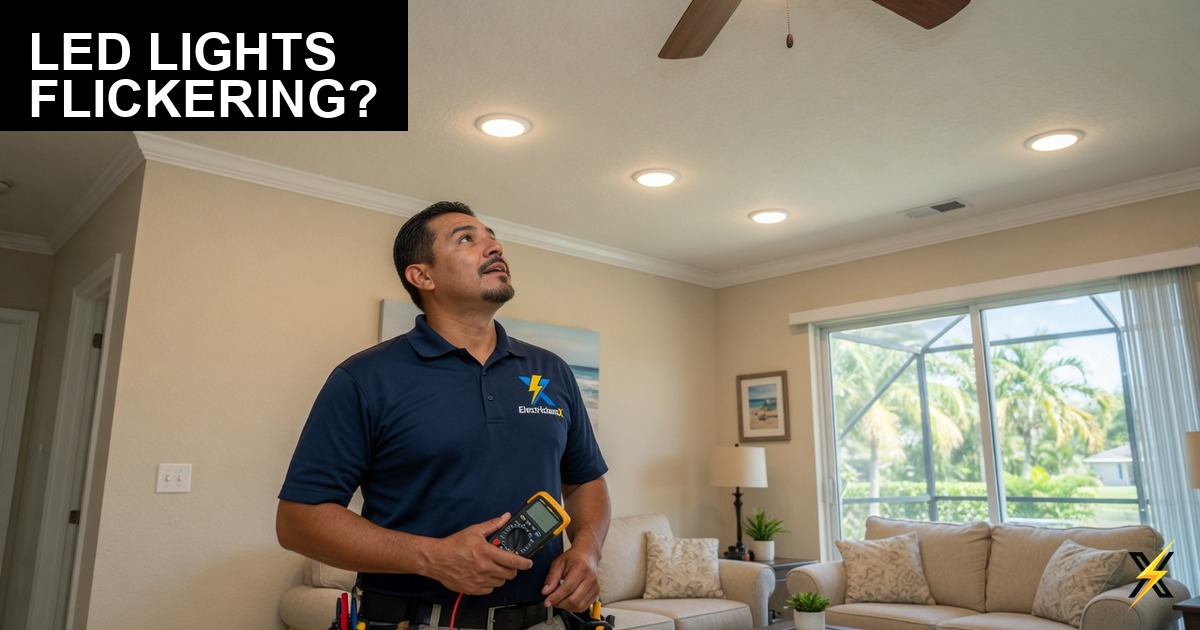
You replaced the LED bulbs. You tried different brands from Home Depot. The recessed lights in your Estero living room still flicker — sometimes a subtle pulse you notice at night, sometimes a strobe-like flash when the A/C kicks on. If flickering is happening in more than one room, the problem is almost certainly not the bulbs. It is your wiring, your dimmer switches, your electrical panel, or your utility power — and in Southwest Florida, all four are common culprits.
LED flickering is one of the most frequent lighting calls we get from Estero, Bonita Springs, Naples, and the Villages of Country Creek area. New construction homes with builder-grade dimmers, older homes retrofitted with LEDs on incandescent dimmers, and homes with overloaded panels after pool additions and EV chargers all show the same symptom: lights that will not stay steady. Here is how to diagnose whether your flicker is annoying or dangerous, and what fixes actually work.
LED Flicker vs. Incandescent Flicker — Why LEDs Are Different
Old incandescent bulbs flickered too — you just could not see it as easily because the filament had thermal mass that smoothed out voltage dips. LED bulbs convert AC to DC through an internal driver circuit. That driver is fast and sensitive. Small voltage fluctuations that an incandescent bulb ignored will cause visible flicker in an LED. This means LED flickering is often the first visible sign of an underlying electrical problem that was always there but hidden.
In Estero’s 1990s and 2000s-era homes — common in communities like Stoneybrook, Bella Terra, and Grandezza — we regularly find marginal neutral connections, shared neutrals from DIY renovations, and dimmer switches that were never designed for LED loads. The flicker is the symptom. The cause needs professional diagnosis.
Most Common Causes of Whole-House LED Flickering
- Incompatible dimmer switches. The number-one cause in SW Florida. Standard leading-edge (TRIAC) dimmers designed for incandescent bulbs often cause flicker, buzzing, or strobing with LED retrofits. You need trailing-edge (ELV) dimmers or dimmers specifically listed as LED-compatible.
- Mixed bulb types on one dimmer circuit. Combining LED cans, LED bulbs, and one leftover halogen on the same dimmer confuses the dimmer’s load sensing and causes pulsing.
- Loose neutral connection. A loose neutral at an outlet, switch, or panel causes voltage to swing between 120V legs — lights brighten and dim rhythmically. This is a fire hazard and requires immediate electrician attention.
- Overloaded circuit or failing breaker. When a large load like A/C or pool pump starts, voltage drops momentarily. If lights flicker in sync with the A/C, the circuit or panel may be undersized or the breaker contacts may be worn.
- Utility voltage fluctuations. FPL’s grid in Southwest Florida experiences dips during peak summer demand and after storm restoration. Brief flicker when the whole neighborhood’s A/C loads surge at 4 PM on a July afternoon may be utility-side — but persistent flicker is your house.
- Bad LED driver or cheap bulbs. If only one fixture flickers and swapping bulbs fixes it, the driver failed. If every bulb on the circuit flickers, look at the dimmer and wiring.
- AFCI breaker nuisance tripping interaction. Some older AFCI breakers interact poorly with certain LED drivers, causing flicker before tripping. Common in homes built 2008–2015 across Lee and Collier counties.
How to Diagnose: One Fixture vs. Whole House
Start by narrowing the scope. The fix depends entirely on whether flickering is isolated or systemic.
- One bulb or fixture only. Replace the bulb with a known-good LED. If flicker stops, it was the driver. If a recessed can flickers, the trim/driver module may need replacement.
- All lights on one dimmer circuit. Turn the dimmer to full brightness. If flicker stops at 100%, the dimmer is incompatible — not the wiring. Replace with an LED-rated dimmer (Lutron Diva, Caseta, or CL series are reliable choices).
- Lights flicker when A/C, dryer, or pool pump starts. Voltage drop on an overloaded circuit or panel. Check whether the A/C and lights share a circuit (they should not). This may indicate you need a panel upgrade or a dedicated circuit for the A/C.
- Lights flicker throughout the house, with or without dimmers. Suspect a loose neutral at the panel or meter base. Turn off power and call an electrician — do not keep investigating yourself.
- Flicker at a consistent rhythm (every few seconds). Often a failing appliance cycling on a shared circuit, or a pool automation system, water heater, or sump pump drawing intermittent load. Unplug or isolate devices to find the source.
Dimmer Compatibility — The Estero Homeowner’s Checklist
If your home was built with builder-grade Lutron or Leviton dimmers from the early 2000s, assume they are not LED-compatible until proven otherwise. Here is what to check:
- Look for “LED compatible” or “C•L” on the dimmer faceplate or model number
- Trailing-edge (ELV) dimmers work better with most modern LEDs than leading-edge dimmers
- Count the total wattage of LED fixtures on the circuit — some dimmers need a minimum load (often 10–40W) to function without flicker
- Smart dimmers (Caseta, Z-Wave, Wi-Fi) have their own compatibility lists — check the manufacturer’s website for your bulb brand
- Outdoor lanai and pool cage LEDs on dimmers are especially problematic in Florida humidity — corrosion at the dimmer or fixture accelerates driver failure
Our lighting installation service includes dimmer upgrades, recessed LED retrofits, and whole-room lighting plans with compatible components — no guesswork at the hardware store.
When Flickering Signals a Serious Wiring Problem
Not all flicker is cosmetic. Call a licensed electrician promptly if you notice any of these alongside flickering lights:
- Lights brighten and dim on their own — not just flicker, but visible intensity swings
- Outlets feel warm, smell hot, or show discoloration
- Breakers trip when lights flicker
- Buzzing from the panel, switches, or fixtures
- Flickering started after a storm, flood, or electrical repair
- Multiple rooms affected simultaneously without a shared dimmer
A loose neutral can heat up connections inside your walls and panel without tripping a breaker. This is one of the most underdiagnosed fire hazards in Florida homes. If whole-house flicker appeared suddenly, treat it as urgent — not as a bulb problem.
Southwest Florida Local Context
Estero sits between Fort Myers and Naples in one of the fastest-growing corridors in Lee and Collier counties. Newer homes in Rapallo, Coconut Point area developments, and Wildcat Run often have 200-amp panels but builder-grade lighting packages that fail within five years of LED retrofit. Older homes near US-41 and the original Estero village core may still have aluminum branch circuit wiring — flickering LEDs on aluminum wiring circuits is a known compatibility and safety concern that requires CO/ALR devices or rewiring.
Florida Power & Light (FPL) serves most of Estero. Summer peak demand — every pool pump and 3-ton A/C running at once in a subdivision — can cause brief voltage sag across the neighborhood. But if your neighbor’s lights are steady and yours are not, the problem is inside your house, not on FPL’s grid.
Lee County requires permits for new lighting circuits, panel work, and hardwired dimmer replacements in many jurisdictions. ElectriciansX pulls permits when required so your lighting upgrades are documented for insurance and resale.
Frequently Asked Questions
Can a bad bulb cause flickering in other rooms?
No. A failed LED driver affects only that fixture. Multi-room flicker always points to a shared circuit, panel, neutral, or utility issue.
Will a whole-house surge protector stop LED flickering?
A surge protector helps with transient spikes — useful after lightning storms in SW Florida — but it will not fix dimmer incompatibility or loose neutrals. It is a good addition, not a cure for flicker.
How much does it cost to fix LED flickering?
Replacing one incompatible dimmer: $150–$300 installed. Diagnosing and repairing a loose neutral or panel issue: $200–$800+. Full panel upgrade if the root cause is capacity: $2,000–$3,500. We provide flat-rate quotes after diagnosis.
Stop the Flicker — Get a Professional Diagnosis
LED dimmer upgrades, recessed lighting, and electrical troubleshooting in Estero, Bonita Springs, Naples, and all of SW Florida.