
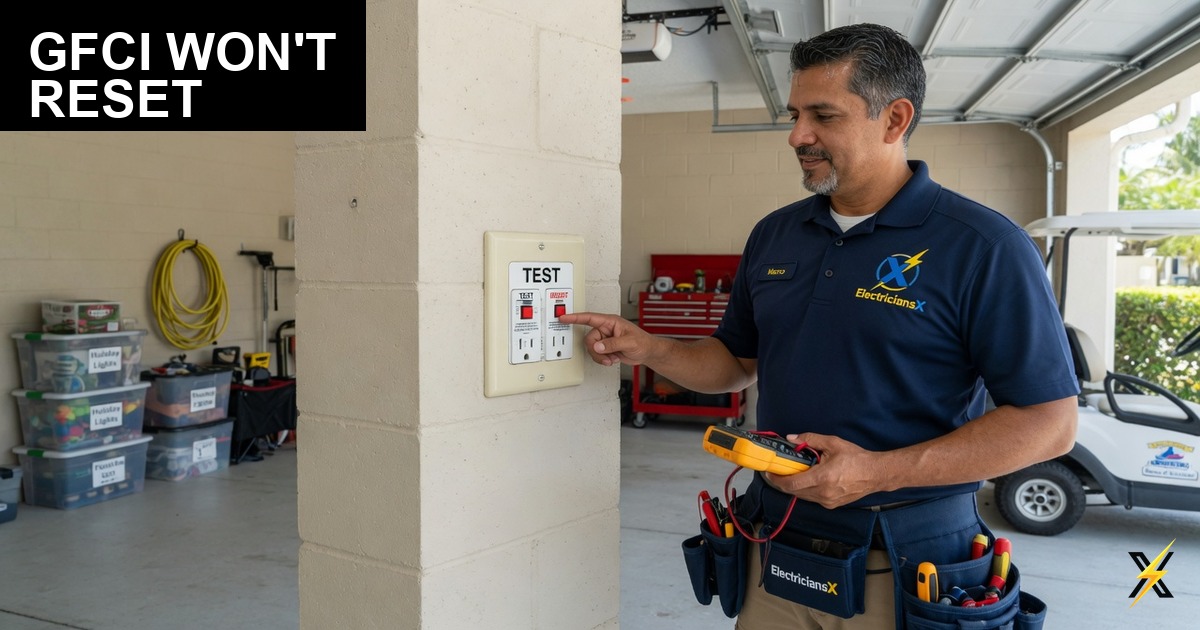
You unplugged everything, dried off the outdoor cover, and pressed the RESET button on your GFCI outlet — but it will not stay in. It pops back out immediately, or it pushes in without a click and nothing gets power. Maybe the little indicator light stays off no matter what you try. This is different from a GFCI that trips occasionally under load. A GFCI that flat-out refuses to reset is sending a specific message, and understanding that message keeps you safe.
At ElectriciansX, we field this question constantly from homeowners in Fort Myers, Cape Coral, Naples, and the barrier islands. The answer almost always falls into one of four categories: there is still a ground fault on the circuit, the GFCI device has failed, the circuit has no power, or the outlet was wired incorrectly. Here is how to tell which one you are dealing with — and what to do about it.
What a GFCI Reset Actually Does
Inside every GFCI outlet and GFCI breaker is a sensor that compares current on the hot and neutral conductors. When the device detects an imbalance — current leaking to ground — an internal solenoid trips a mechanism that opens the circuit. Pressing RESET re-engages that mechanism, but only if two conditions are met: the ground fault is gone, and the device itself is still functional.
Think of it like a seatbelt latch that will not click because something is stuck in the buckle. You can push all you want, but until the obstruction is removed, it will not lock. A GFCI that will not reset is either still detecting a fault, or the internal mechanism is broken.
The Four Most Common Reasons a GFCI Will Not Reset
1. An Active Ground Fault on the Circuit
This is the most common cause and the one the GFCI is designed to catch. Something on the circuit — or in the wiring itself — is allowing current to leak to ground right now. Common sources include:
- Water inside the outlet box, a cord end, or an outdoor fixture
- A damaged appliance still plugged in (even if it appears off)
- Cracked wire insulation touching the metal box or a ground wire
- Corroded connections at a downstream outlet on the same protected circuit
What to do: Turn off power to the circuit at the breaker panel. Unplug every device. Remove the GFCI cover plate and inspect for visible moisture, burn marks, or loose wires — only if you are comfortable doing so. If you see water, let the box dry for 24 hours with power off. Turn power back on and try RESET again. If it still will not hold with everything unplugged and the box dry, the fault is in the wiring and you need an electrician.
2. The GFCI Device Has Failed
GFCIs are electromechanical devices with a finite lifespan. In Southwest Florida’s heat, humidity, and salt air, they wear out faster than the manufacturer’s optimistic lab ratings suggest. A failed GFCI often shows these signs:
- RESET pushes in but there is no click and no power
- The TEST button does nothing — pressing TEST does not trip the outlet
- The outlet is 10+ years old, especially if it is outdoors or in a bathroom
- RESET worked yesterday but will not work today with nothing changed
What to do: If TEST does not trip the outlet, the GFCI has failed and must be replaced. Replacement is a straightforward job for a licensed electrician. Do not substitute a standard outlet — you would lose shock protection in a code-required location.
3. No Power to the Circuit
Sometimes the GFCI is fine — it just has nothing to work with. If the circuit breaker is tripped, if a upstream GFCI elsewhere on the property has tripped, or if a wire connection in the panel is loose, the GFCI outlet will not reset because it is not receiving power.
What to do: Check your breaker panel for a tripped breaker (handle in the middle position). Flip it fully OFF, then back ON. Walk through your home and check every other GFCI — bathrooms, kitchen, garage, laundry, exterior, pool equipment — and press RESET on each one. A tripped GFCI in the garage can kill power to a bathroom outlet on the same circuit, and vice versa. If the breaker trips immediately when you reset it, you have a short circuit or ground fault that needs professional diagnosis.
4. Incorrect Wiring (Line vs. Load)
GFCI outlets have two sets of terminals: LINE (power in) and LOAD (power out to downstream protected outlets). If a previous homeowner or handyman swapped these, or connected the LOAD terminals when there are no downstream outlets, the GFCI may not reset or may behave unpredictably. This is especially common in DIY renovations and in homes where standard outlets were swapped for GFCIs without understanding the wiring.
What to do: This requires opening the outlet with power off and verifying LINE vs. LOAD connections with a voltage tester. Not a DIY job for most homeowners. Our residential wiring team traces and corrects miswired GFCIs regularly.
Safe DIY Steps Before You Call
- Check the breaker panel — reset any tripped breaker.
- Find and reset every other GFCI in the house — start with garage, exterior, and bathroom.
- Unplug all devices on the affected circuit.
- Press RESET firmly — listen for the click.
- Press TEST — the outlet should trip. Then press RESET. If TEST does not work, replace the GFCI.
- If still dead, turn off the breaker and inspect the outlet for moisture or damage.
- Still won’t reset? Call a licensed electrician.
When to Call an Electrician Immediately
Do not keep pressing RESET repeatedly or force the button. Call ElectriciansX if:
- RESET will not hold with the breaker on and nothing plugged in
- You see scorch marks, melted plastic, or smell burning
- The GFCI is at a pool, spa, hot tub, or dock
- The breaker trips the instant you try to reset it
- Multiple outlets in different rooms are dead at the same time
- You are not sure when the wiring was last inspected
For urgent situations — sparking, smoking, or buzzing outlets — call our emergency electrical service at (239) 880-9473.
Southwest Florida Local Context
Fort Myers Beach and Sanibel condos often have GFCIs in bathrooms that protect outlets in the bedroom and living room through the LOAD terminals. When one outlet gets salt corrosion from a window leak, the bathroom GFCI will not reset and the whole room goes dark — even though the breaker never tripped. This confuses a lot of seasonal residents who are not familiar with how GFCI protection chains work.
Older Cape Coral and Lehigh Acres homes frequently have GFCIs that were added during remodels but wired incorrectly — protecting only themselves instead of the downstream outlets that need it, or vice versa. If you are buying or selling a home in Lee or Collier County, a professional electrical inspection catches these issues before they become closing-day surprises.
After hurricane season, we see a spike in failed GFCIs that took surge damage but do not show visible burn marks. The internal sensor is fried even though the outlet looks normal. If your GFCI died after a close lightning strike or power surge, replacement — not repeated reset attempts — is the fix.
Get Your GFCI Working Again — Safely
Licensed electricians serving Cape Coral, Fort Myers, Naples, and all of Southwest Florida.