
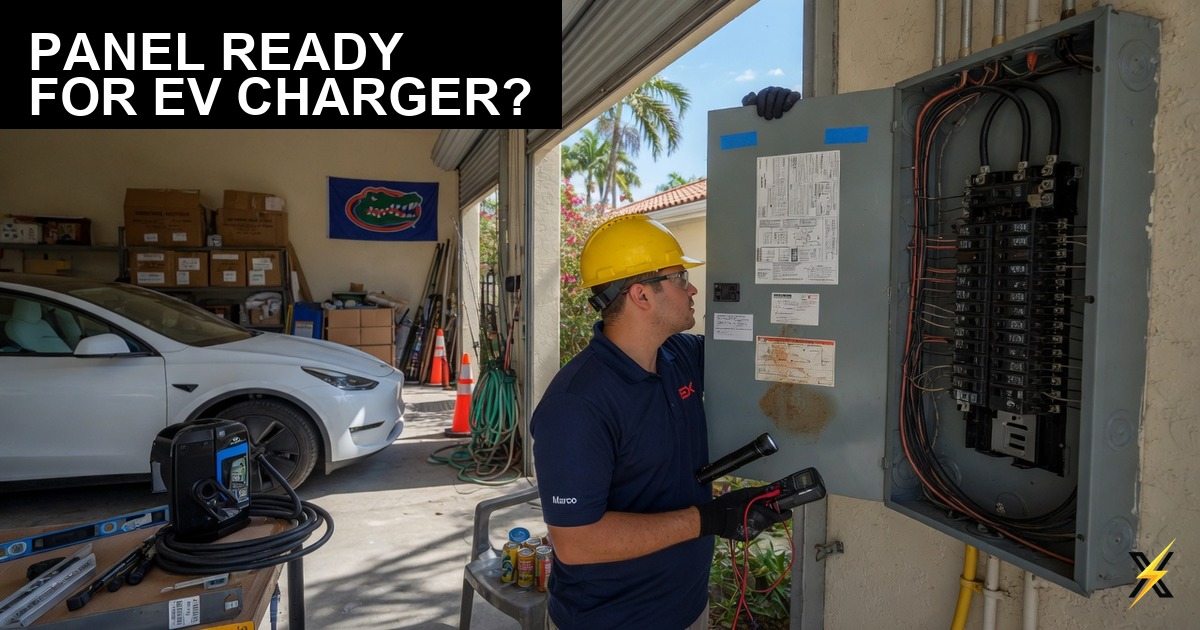
You bought the Tesla. Or the Rivian, the Hyundai Ioniq, the Ford Lightning — it does not matter. The charger arrives, the electrician quote comes back, and suddenly the conversation is not about the charger at all. It is about your electrical panel. Can a 100-amp panel handle a Level 2 EV charger? Do you have open breaker spaces? Is your main breaker already running warm on summer afternoons when the pool pump and central A/C are both on?
These are the questions Naples homeowners ask us every week in Pelican Bay, Grey Oaks, Golden Gate, and communities across Collier County. Level 2 EV charging pulls 30 to 48 amps continuously for hours — not a brief spike like a microwave, but a sustained load that exposes every weakness in an aging panel.
What a Level 2 EV Charger Actually Draws
Level 2 EVSE (electric vehicle supply equipment) runs on 240 volts — the same voltage as your dryer or range. Most home chargers are configured for one of these circuit sizes:
- 30-amp circuit (24A continuous) — Delivers roughly 5.7 kW. Adds about 20–25 miles of range per hour. Minimum for practical overnight charging.
- 40-amp circuit (32A continuous) — Delivers roughly 7.7 kW. About 28–32 miles per hour. Common for Tesla Wall Connector and ChargePoint Home Flex.
- 50-amp circuit (40A continuous) — Delivers roughly 9.6 kW. About 35–44 miles per hour. Standard for maximum-speed home charging on long-range EVs.
- 60-amp circuit (48A continuous) — Delivers roughly 11.5 kW. Requires larger wire (6 AWG) and a panel with real capacity. Common in new construction; challenging in older Naples homes.
NEC 625.42 requires EV charger loads to be calculated at 125% for circuit sizing — meaning a 40-amp charger needs a 50-amp breaker and wire rated for 50 amps. This is not optional. Undersized circuits overheat and trip breakers every time your car charges.
Quick Panel Assessment — What to Look For Before You Buy
Open your panel door and check these five things. They tell you more than any online calculator:
- Main breaker rating. Look at the number on your main breaker: 100, 125, 150, or 200 amps. This is your total household budget. A 100-amp service in a Naples home with central A/C, pool equipment, and an electric range may have only 20–30 amps of spare capacity — not enough for a 40-amp EV circuit without upgrades or load management.
- Open breaker spaces. Count empty slots. A 2-pole breaker for an EV charger needs two adjacent spaces (or a quad breaker in some panels). No spaces means a sub-panel or panel upgrade — not a tandem breaker squeezed into a full panel.
- Panel brand and age. Challenger, Federal Pacific (FPE), and Zinsco panels should be replaced before any EV installation — not because of the charger, but because they are fire hazards. See our guide on Challenger and FPE panel insurance requirements.
- Signs of overheating. Discoloration around breakers, a burning smell, buzzing, or breakers that trip frequently when A/C runs. These mean your panel is already at or past capacity. Adding an EV charger without addressing this is dangerous.
- Existing large loads. List your 240V appliances: A/C (often 30–50A), pool pump (15–20A), water heater (30A), range (40–50A), dryer (30A). In Naples, pool homes are the norm — and pool equipment runs year-round, not seasonally like up north.
The Load Calculation — Why Guessing Fails
Your neighbor’s 100-amp panel might handle an EV charger fine. Yours might not. The difference is load calculation — a formal NEC Article 220 calculation that accounts for your specific square footage, appliances, A/C tonnage, and demand factors. ElectriciansX performs load calculations on every EV charger quote in Collier County before we commit to a circuit size.
Here is what the calculation typically reveals in Naples homes:
- 1980s–1990s 100A homes with pool and central A/C: Often exceed 100A calculated load before the EV charger. Panel upgrade to 200A is the right answer.
- 2000s 200A homes with gas range and no pool: Usually have 40–60A of spare capacity. A 40-amp or 50-amp EV circuit fits without panel upgrade.
- 2010s+ 200A homes with heat pump pool heater and two A/C units: Borderline. May need load management or a 30-amp EV circuit instead of 50-amp.
- Condos and townhomes: Often have shared panels or HOA restrictions. May require HOA approval and utility coordination before any installation.
Signs your panel is already overloaded — even before the EV charger — include breakers that trip when you run the dryer and A/C together, lights that dim when the pool pump starts, and a warm panel cover on summer afternoons. Read our signs your electrical panel is overloaded guide for the full checklist.
Options When Your Panel Is Borderline
If a full 200-amp panel upgrade is not in the budget right now, you have alternatives — but they come with trade-offs:
- Install a 30-amp EV circuit instead of 50-amp. Slower charging (about 20 miles per hour) but often fits without panel upgrade. Adequate for most daily commuting if you charge overnight.
- EV charger with load management. Devices like the Emporia Level 2 or certain ChargePoint models monitor total panel load and throttle charging when the A/C or dryer runs. Requires a CT clamp at the panel and smart configuration. Good middle ground for borderline panels.
- Time-of-use scheduling. Charge only between midnight and 6 AM when A/C load is lower and pool equipment timers are off. Reduces peak demand but does not fix an undersized service.
- Adds capacity for the EV charger, future solar, and additional A/C as homes get renovated. Learn about panel upgrades →
- 400-amp service. For large estates in Port Royal, Aqualane Shores, or homes adding solar + battery + two EVs. Requires utility coordination with FPL.
Naples and Collier County Specifics
Collier County requires electrical permits for EV charger installations. Inspections verify correct wire gauge, GFCI or disconnect requirements per NEC 625, and proper grounding. If your panel upgrade includes service entrance work, FPL may need to coordinate a meter pull and reconnection — we handle that process.
Naples homes built before 1995 frequently have 100-amp or 125-amp services that were adequate when the house was built but are now stretched by pool additions, kitchen renovations, and Florida’s year-round A/C demand. The EV charger is often the last straw that makes a panel upgrade unavoidable — but it is also the best reason to upgrade before something overheats.
HOA communities in Naples — especially gated neighborhoods with architectural review — may require documentation of the installation location, conduit routing, and charger brand. We provide spec sheets and installation drawings for HOA submissions on request.
What ElectriciansX Includes in a Naples EV Charger Quote
Our EV charger installation service is not just running wire. Every quote includes:
- NEC Article 220 load calculation for your specific home
- Panel capacity assessment with written recommendation
- Dedicated 240V circuit with correct wire gauge and breaker size
- Mounting and connection of your charger (Tesla, ChargePoint, Emporia, JuiceBox, Grizzl-E, and others)
- Permit application and inspection scheduling in Collier County
- Flat-rate pricing before work begins — no hourly surprises
If the load calculation shows you need a panel upgrade first, we tell you before you buy the charger — not after we are halfway through the install.
Frequently Asked Questions
Can I just plug my EV into a regular outlet?
Level 1 charging (120V standard outlet) adds about 3–5 miles of range per hour. It works as a temporary solution but is not practical for daily driving in Naples. Most homeowners need Level 2 within the first month of ownership.
Will a 100-amp panel definitely need upgrading for an EV?
Not always — but in pool homes with central A/C, it is common. The only way to know is a load calculation, not a guess based on panel size alone.
How long does EV charger installation take?
A straightforward install with panel capacity available: half a day. With a panel upgrade: one to two days including FPL coordination. We schedule most Naples installs within one week of quote acceptance.
EV Charger Ready — Panel Checked First
Level 2 EV charger installation and panel upgrades in Naples, Golden Gate, and all of Collier County.