
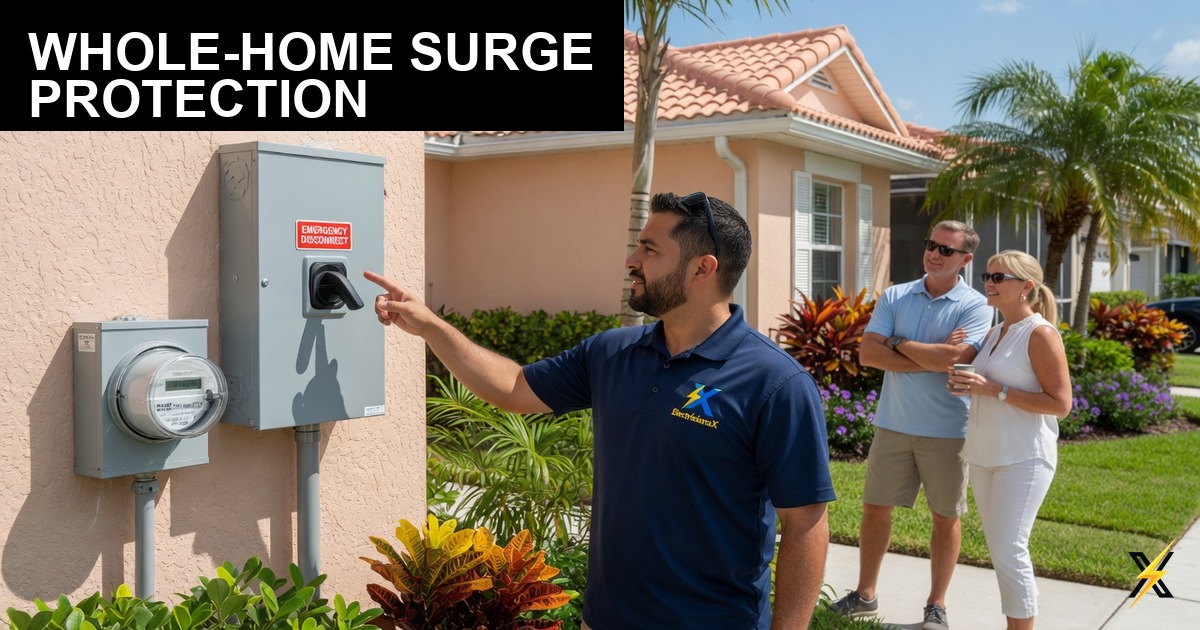
If you’ve lived in Cape Coral for more than one summer, you already know the drill. The skies turn dark in minutes, lightning cracks over the canals, and the lights flicker. It’s part of life here in Southwest Florida — beautiful, warm, and occasionally dramatic. What most homeowners don’t realize is what those storms are doing to their home’s electrical system while it’s all happening, and why the cheap power strip plugged in behind the TV isn’t protecting much at all.
Florida Is the Lightning Capital of the Country — and Cape Coral Is Right in the Middle of It
Florida leads every other state in annual lightning strikes, and Southwest Florida sits at the heart of one of the most active storm corridors in the country. The combination of warm Gulf waters, the Caloosahatchee River, and miles of interconnected canals creates conditions that draw in and intensify electrical storms from June through September. Cape Coral averages more than 100 thunderstorm days per year. That’s not occasional bad weather — that’s your home’s electrical system under repeated voltage stress, season after season, year after year.
And it’s not just lightning. Power surges also come from utility company switching events, transformer failures, and the internal cycling of your own major appliances. Your HVAC system creates a small surge every time the compressor kicks on. Most of these events are invisible and seem harmless. Over time, they aren’t.
What Exactly Is a Power Surge?
A power surge is a brief, sudden spike in electrical voltage that travels through your home’s wiring. The worst surges — the ones that fry electronics and kill appliances — come from lightning strikes near the power lines that feed your home. But moderate surges happen constantly: when power is restored after an outage, when a large motor starts up, or when the grid experiences a switching event at your local utility substation.
Small, repeated surges degrade the sensitive internal components of your electronics over months and years, cutting their lifespan in half without any single dramatic event. Large surges can destroy a refrigerator, an HVAC control board, a smart TV, or a home security system in an instant.
“But I Already Have a Surge Protector” — Here’s the Problem
Most homeowners have power strips that advertise surge protection. These are useful for a limited set of plugged-in devices, but they have real limitations. Every surge protector has a joule rating — the total amount of energy it can absorb before it stops working. Once that limit is reached, the strip no longer protects anything, even if the indicator light still glows green. They wear out silently, without any warning.
More importantly, a power strip does absolutely nothing for hardwired systems. Your central air conditioner, refrigerator, water heater, pool pump, well pump, garage door opener, and irrigation system are all connected directly to your electrical panel. A surge arriving through the utility line hits those systems first — before it ever reaches a power strip. If you want those things protected, the protection has to be at the panel level.
What Is Whole-Home Surge Protection?
A whole-home surge protective device (SPD) is installed directly at your main electrical panel by a licensed electrician. When a voltage spike enters your home through the utility lines, the SPD intercepts it at the source — before it can reach any circuit, appliance, or outlet in your home. Every circuit is protected simultaneously, all the time, automatically.
Installation typically takes one to two hours. There’s no visible hardware, no change to how your home looks or operates. The SPD sits inside your panel enclosure and works silently in the background, every day. You won’t think about it until the day you really need it — and on that day, you’ll be very glad it’s there.
For more about the surge protection options we install, see our whole-home surge protection service page.
Everything a Whole-Home SPD Protects
Because it works at the panel, a whole-home SPD covers every circuit and every device connected to your home’s electrical system:
- Central AC and heat pump systems
- Refrigerators, freezers, and dishwashers
- Washers and dryers
- Smart home hubs, thermostats, and security systems
- Televisions, home theater equipment, and computers
- Garage door openers
- Pool and spa equipment
- Irrigation systems and well pumps
- Boat lifts and dock electrical systems
- EV chargers
- Outdoor lighting and landscape systems
In a waterfront community like Cape Coral — where many homes have boat lifts, canal-side entertainment areas, and outdoor electrical systems — comprehensive surge coverage is especially valuable.
The Same Risk Applies Across SW Florida
This isn’t a problem unique to Cape Coral. Homeowners in Fort Myers, Fort Myers Beach, and Sanibel all face the same combination of intense summer lightning, coastal storm exposure, and aging utility infrastructure. If your home anywhere along the Southwest Florida coast doesn’t have a panel-mounted surge protective device, you’re relying entirely on power strips and luck.
Frequently Asked Questions
Can a whole-home SPD stop a direct lightning strike?
A direct strike to your home carries more energy than any SPD is rated to handle — but direct strikes to structures are rare. The far more common problem is nearby lightning strikes that induce a surge through your utility lines, traveling into your home through the meter and panel. That’s exactly what whole-home SPDs are designed to intercept. Pairing a panel-mounted SPD with quality point-of-use protectors at your most sensitive electronics gives you layered defense against both scenarios.
How do I know if my panel is compatible?
Most residential panels manufactured since the early 1990s support panel-mounted SPDs. A licensed electrician can confirm compatibility during a quick visit. If your panel is older or if you have a Challenger or Federal Pacific panel that’s already due for replacement, this is a good opportunity to address both at once.
How long does installation take?
For most homes, the job takes one to two hours. There’s no drywall work, no new wiring runs through walls, and no disruption to your home beyond a brief power interruption at the panel during the installation itself.
Is surge protection now required by code?
Yes, for new construction. The 2020 National Electrical Code (NEC) updated requirements to mandate surge protection for new residential dwelling units. Existing homes are not required to retrofit, but if you’re doing permitted electrical work or building new anywhere in Cape Coral or the surrounding area, your inspector will likely require it.
Does the SPD need to be replaced after a big storm?
After a significant surge event, a good-quality SPD will have an indicator showing whether it absorbed a large event. Many are designed to be replaced following major surges — your electrician can show you what to watch for after installation and advise on the right replacement schedule for your device.
Ready to Protect Your Home Before the Next Storm?
Cape Coral homeowners have enough to manage before hurricane season. Whole-home surge protection is one of the simplest, most affordable steps you can take to protect your biggest investment. Call us today — we’ll assess your panel, recommend the right SPD for your home, and have it installed fast. Don’t wait for the next lightning strike to find out what wasn’t protected.