
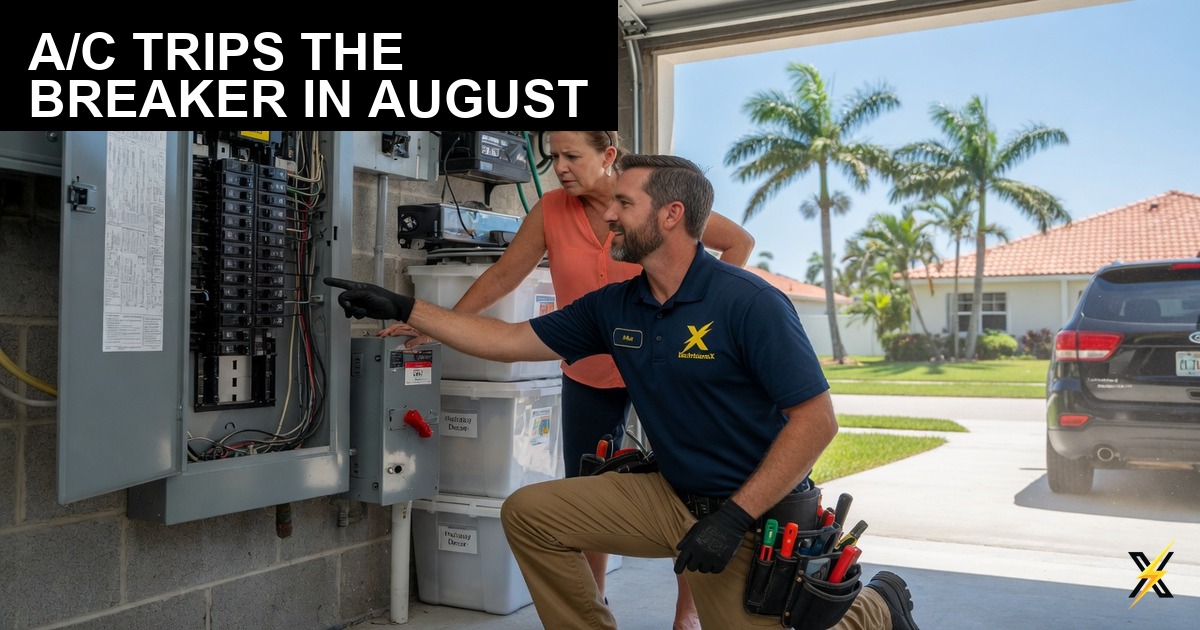
It is the most predictable call of our year. The air conditioning worked fine in March. Now it is August, and every afternoon around three o’clock the breaker trips and the house starts warming up.
Nothing about your electrical system changed. What changed is how hard your A/C is working — and August is when a marginal problem that has been developing quietly finally becomes a problem you notice.
Here is what is actually happening, and how to tell whether you need an electrician or an HVAC tech.
Why August Specifically
Three things stack up in a Southwest Florida August.
Your compressor is working against much higher outdoor temperatures, which raises its current draw. Your system is running far longer cycles — sometimes barely shutting off through the afternoon — so components spend more time hot. And the breaker itself is sitting in a panel that may be on a west-facing wall or in a hot garage, and breakers are thermal devices that trip a little more readily when they are already warm.
So a circuit that was operating at eighty percent of capacity in March can be pushing right up against its limit in August. Nothing failed. The margin just disappeared.
That is the benign version. The other possibility is that something genuinely is failing, and the summer load is what exposed it.
The Usual Culprits
- A failing capacitor — this is the single most common cause, and it is an HVAC repair rather than an electrical one. The start capacitor helps the compressor get moving. As it weakens, the compressor draws far more current getting started, and that inrush trips the breaker. Often the very first symptom is a hum followed by a trip.
- A compressor that is hard-starting or failing — worn compressors draw more current, particularly starting hot. If your system trips specifically when restarting shortly after shutting off, this is a strong suspect.
- A dirty condenser coil — a coil packed with dust, grass clippings and pollen cannot shed heat, so the system runs hotter and draws more current. This is the cheapest possible fix and it is genuinely common here.
- Low refrigerant — makes the system run continuously without satisfying the thermostat, so it never gets a break.
- Loose connections at the disconnect or breaker — this one is ours. Terminations loosen over years of thermal cycling. A loose lug creates resistance, resistance creates heat, and heat causes both nuisance trips and a genuine fire risk. We find this often, and it is a serious finding rather than a nuisance one.
- A worn-out breaker — breakers do not last forever. One that has tripped hundreds of times, or that has been carrying near its limit for a decade in a hot panel, can begin tripping below its rating. Also ours.
- Corroded or undersized conductors — especially on older installs, or where a larger system was installed on the original wiring without upgrading it. Common in homes where the A/C has been replaced but nobody re-evaluated the circuit.
Electrician or HVAC Tech? How to Tell
Rough guide, and it will be right most of the time.
Call an HVAC contractor first if the system is cooling poorly, making new noises, short-cycling, freezing up, or if the trips started alongside any change in how well it cools. Capacitors, refrigerant, coils and compressors are all theirs. For that work we recommend Tundra Air — ask for Alex, he is the owner and he will take good care of you.
Call us first if the system cools perfectly well when it is running, if the breaker feels hot to the touch, if you see or smell any scorching at the panel or disconnect, if other circuits in the house are also acting up, or if the breaker has begun tripping with no change in cooling performance at all.
If you are not sure, start with HVAC — component failures are more common than electrical ones. But if a tech tells you the equipment checks out fine and it is still tripping, that is our call, and there is a real answer to be found.
One thing you should never do: do not replace a tripping breaker with a larger one. It is the most dangerous “fix” in residential electrical work. The breaker protects the wire, not the appliance. Putting a 40-amp breaker on a circuit wired for 30 amps means the wire can now overheat inside your walls with nothing to stop it. The breaker was doing its job. Find out what it was telling you.
Would a Soft Starter Help?
Sometimes, and it is worth knowing about. A soft starter limits the inrush current when your compressor kicks on, and it can meaningfully reduce nuisance trips on a circuit that is right at its limit.
It is also the single most useful accessory if you have or are considering a standby generator, because compressor inrush is usually what determines how large a generator your home needs. A soft starter can genuinely drop you a full generator size — often cheaper than the larger unit. Our generator sizing calculator lets you toggle it on and see the difference for your own house.
What a soft starter will not do is fix a failing capacitor, a dying compressor or a loose connection. It reduces the demand; it does not repair a fault. Diagnose first.
When It Is Not Really the A/C
Occasionally the air conditioning gets blamed for something else. If your breaker trips when the A/C and another large load run together, the issue may be total capacity rather than the A/C itself — we covered that in this article on microwave and A/C trips.
And if your home has added a pool heater, an EV charger, a garage mini split, or a workshop over the years without anyone revisiting the service, you may simply be out of room. A panel upgrade solves that permanently, and our load calculator will tell you whether that is where you are.
Do Not Just Keep Resetting It
The instinct is to walk out, flip it back on, and get through the afternoon. Understandable — but a breaker that trips repeatedly is reporting a condition, and repeated tripping degrades the breaker itself, which makes the situation worse over time.
If it happens more than once, get it looked at. In August, in this heat, a system that is limping is not one you want to gamble on.
Talk to a Licensed Electrician
ElectriciansX is a licensed and insured electrical contractor serving Cape Coral, Fort Myers, Naples, Bonita Springs, Estero, and all of Southwest Florida. We pull the permit, do the work to code, and stay through inspection. Call (239) 880-9473 or request a free quote.