
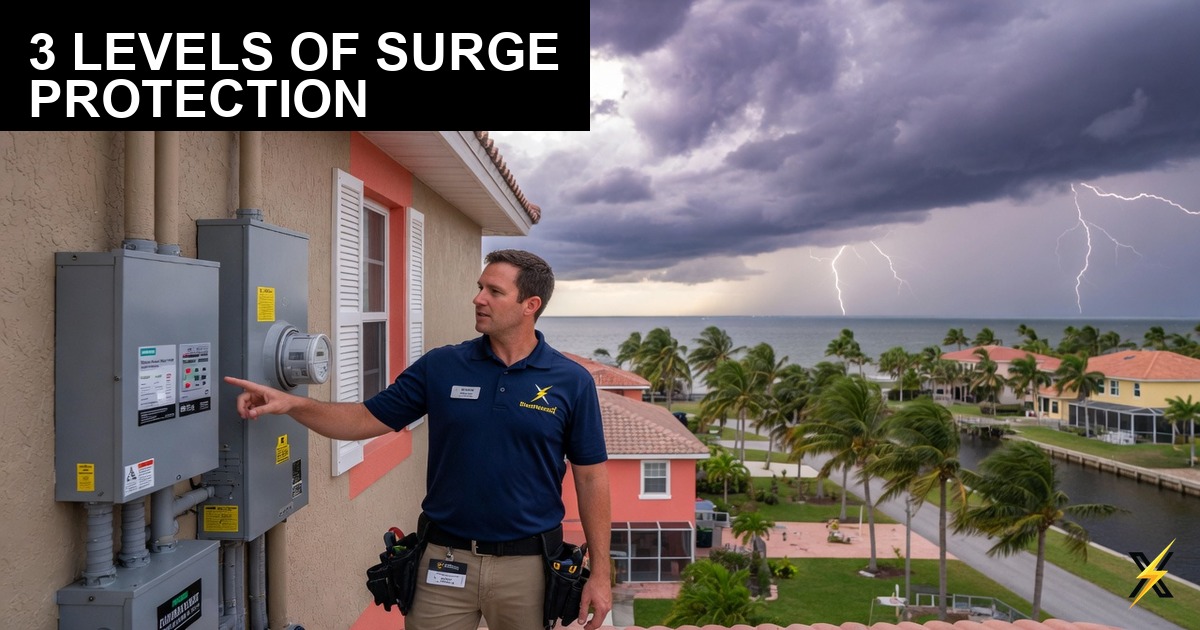
Florida records more lightning strikes than any other state in the country, and Southwest Florida sits in the busiest part of it. Right now — August into September — is the peak. If you have lived here through a summer, you have watched the afternoon storms roll in off the Gulf and you know how routine this is.
Here is the part that surprises people: most surge damage does not come from a direct strike on your house. A direct hit is dramatic and rare. Far more common is a strike a quarter mile away that induces a voltage spike onto the utility lines, or the switching transient that arrives when FPL restores power after an outage. Those events happen dozens of times a season, and each one takes a small bite out of the electronics in your home.
That is why surge protection is not one device. It is layered — three levels, each doing a different job.
Level 1: Type 1 — Protection at the Service Entrance
A Type 1 surge protective device is installed on the line side of your main breaker, at or near the meter. It is the first thing an incoming surge meets, and it is built to take the largest hits.
This is your heavy artillery. A Type 1 device is rated to handle the big external events — the lightning-induced surges arriving on the utility feed and the switching transients from the grid. It clamps the enormous spike down to something the rest of your system can survive.
What it does not do is catch everything. A Type 1 device lets through a residual amount of energy — much smaller, but still more than a sensitive circuit board wants to see. That is what the next level is for.
Level 2: Type 2 — Protection at the Panel
A Type 2 device installs on the load side of your main breaker, inside or adjacent to your panel. This is the most common whole-home surge protector and, for most Southwest Florida homes, the single most valuable one.
Type 2 protection catches two things: whatever residual energy made it past the service entrance, and surges that originate inside your house. That second category is underrated. Every time your air conditioning compressor cycles, your pool pump starts, or a well pump kicks on, it puts a small transient onto your wiring. Those internal events are constant, and over years they are what quietly ages the electronics in your home.
We most often install Type 2 protection as a panel-mounted device or a surge breaker that occupies a slot in your existing panel. If you have a Square D QO panel — extremely common in this area — there are QO-compatible surge devices that install cleanly into the panel you already have, which keeps the job simple and the cost reasonable.
A few things worth understanding when comparing devices:
- UL 1449 listing — this is the standard surge protective devices are tested to. Anything we install carries it. If a device does not, that tells you something.
- Voltage protection rating (VPR) — the let-through voltage. Lower is better, and this number matters more than the marketing on the box.
- Surge current capacity — often quoted in kiloamps. Higher capacity generally means a longer service life in a high-strike environment like ours.
- A status indicator — surge protectors are sacrificial. They wear out absorbing hits. A device with an indicator light tells you when it has given its life for your house, which matters because a dead one looks identical to a working one.
Level 3: Type 3 — Point-of-Use Protection
Type 3 devices are the ones you already recognize: the surge strip behind the TV, the protected outlet, the unit in front of a home office setup. They install at or near the equipment they protect.
On their own, these are not enough — a plug strip is not built to absorb a lightning-induced surge arriving from the street. But as the last layer, behind Type 1 and Type 2 protection, they are genuinely useful. They catch the small residual and they cover transients generated by whatever else is plugged into that same circuit.
This is the level worth spending on selectively. Your television, your computer and network gear, your home theater, the control board on an expensive appliance — those justify it. The lamp in the guest room does not.
Why All Three Together
The layers exist because no single device does the whole job. Type 1 handles magnitude. Type 2 handles what gets through plus everything generated inside the house. Type 3 protects individual sensitive equipment at the point where it lives.
Skip Type 1 and Type 2, and your plug strips are absorbing hits they were never designed for. Install only Type 1, and internal surges go completely unaddressed. Install only Type 3, and you have protected the TV while leaving your air handler, pool automation, well pump, garage door opener, LED drivers and every hardwired circuit in the house exposed.
For most homes here, the honest priority order is: Type 2 at the panel first, because it delivers the most protection per dollar and covers hardwired equipment nothing else protects. Add Type 1 at the service entrance for meaningfully better coverage. Then put Type 3 on the handful of things you would genuinely hate to replace.
What Surge Protection Will Not Do
We would rather set the expectation honestly. No surge protective device will save your home from a direct lightning strike. A direct hit carries energy that nothing in a residential panel can absorb. What these devices do — reliably and well — is protect against the induced surges and switching transients that make up the overwhelming majority of real-world surge events.
They also do not replace insurance. What they do is make a claim far less likely, and many carriers look favorably on a documented whole-home installation.
The Practical Move Right Now
We are in the heart of the season. If your home has no surge protection at the panel, that is the gap worth closing, and it is usually a same-day job. If you already have a device installed, this is a good moment to look at its indicator light — a surge protector that took a hit last September has been sitting there doing nothing since, and you would have no way of knowing.
More on our whole-home surge protection page, and our earlier article on why every Cape Coral homeowner needs it.
Talk to a Licensed Electrician
ElectriciansX is a licensed and insured electrical contractor serving Cape Coral, Fort Myers, Naples, Bonita Springs, Estero, and all of Southwest Florida. We pull the permit, do the work to code, and stay through inspection. Call (239) 880-9473 or request a free quote.