
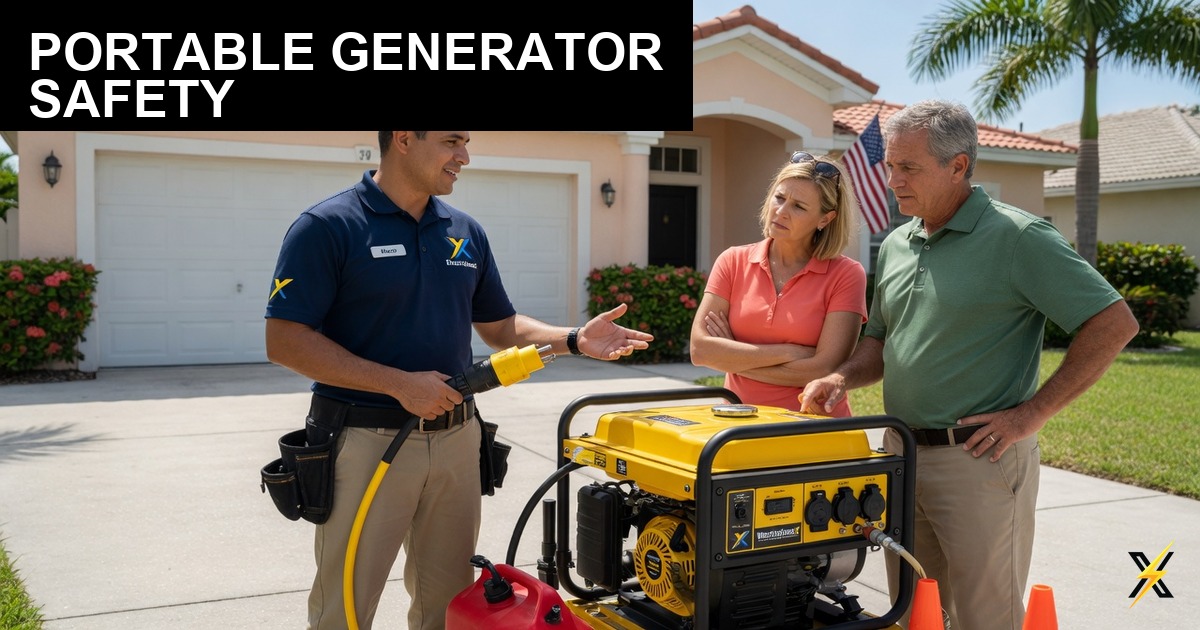
After Hurricane Ian, portable generator sales in SW Florida went through the roof. Hardware stores sold out within hours of landfall. Neighbors loaned them to each other. Some sat in boxes for weeks before they were used. The result is that a large number of Cape Coral and Fort Myers homeowners now own a generator who have never actually run one through a real outage — and an even larger number of people have been running them in ways that are either dangerous, ineffective, or both.
This article isn’t about whether you should buy a generator. You already have one. This is about the three mistakes that cause most of the problems — and what a one-day visit from a licensed electrician can do to make your existing generator actually work the way you need it to.
Mistake #1: Where You’re Running It
Carbon monoxide poisoning kills more people in Florida during and after hurricanes than the storm itself. It is not a dramatic or noisy death. It builds up in spaces faster than most people expect, and the symptoms — headache, drowsiness, confusion — are easy to attribute to stress or exhaustion until it’s too late.
The sources of CO exposure that send people to Lee Memorial and Cape Coral Hospital every storm season aren’t obscure. They’re predictable:
- Running a generator inside a garage with the door open. Many people assume an open garage door provides enough ventilation. It does not. CO builds up faster than it can dissipate, and it moves into the house through the door connecting the garage to the living space.
- Running a generator under a lanai, carport, or porch. Any partially enclosed structure concentrates CO. Exhaust blowing away from the structure does not mean the interior is safe.
- Running a generator too close to windows or doors. CO is slightly lighter than air and tends to enter buildings through any opening near the exhaust path.
The rule is simple and it doesn’t have exceptions: the generator exhaust outlet must be at least 20 feet from any window, door, or vent that leads into the house. In most Cape Coral and Fort Myers lots, that means the generator is in the driveway or well into the backyard — not on the lanai, not in the side yard, not in the garage.
If you have a CO detector in your home (and you should), place it near the bedroom hallway where it will wake you up if levels rise while you’re sleeping with the generator running. If your CO detector goes off, leave immediately and call 911 before going back inside.
Mistake #2: How You’re Connecting It to Your House
This is the mistake that kills utility workers and neighbors, not just homeowners. It’s called back-feed, and it happens when a generator is connected to the house wiring in a way that allows generator power to flow backward out through the utility meter and onto the power lines in the street.
The specific setup that causes back-feed has a name: a suicide cord, or male-to-male plug. It’s a cord with a standard plug on each end — you plug one end into the generator and the other into a dryer outlet or large outdoor receptacle on your house. This puts generator power directly into your home’s wiring, which means it also puts generator power onto the utility lines outside.
Power lines that appear to be dead because utility power is out are not dead if a generator is back-feeding them. Utility workers restoring service after a storm work with the assumption that de-energized lines are de-energized. A back-feed from a single homeowner’s generator can energize several blocks of line at dangerous levels. Lineworkers have been killed by back-feed.
Using a suicide cord is illegal. It violates the National Electrical Code, Florida building law, and your homeowner’s insurance policy. And it will not be covered if a fire or injury results from its use.
The legal, safe alternative is a transfer switch or interlock kit — both of which mechanically or electrically prevent utility power and generator power from ever being connected at the same time.
What a Transfer Switch Actually Does
A transfer switch is a dedicated panel, usually installed next to your main electrical panel, that contains a subset of circuits from your home — the ones you want to power during an outage. Typically this includes the refrigerator, a few lights, the master bedroom outlets, and the air conditioning or at least a window unit. The transfer switch has a physical mechanism that disconnects these circuits from utility power before connecting them to the generator. It’s impossible to have both sources connected at the same time because of how the switch is built.
Manual transfer switches are the most common type for portable generator use. You physically move the switch from “utility” to “generator” after starting the generator and letting it stabilize. When utility power returns, you move it back before disconnecting the generator. The whole process takes about two minutes and requires no electrical knowledge once it’s installed.
Automatic transfer switches (ATS) do this automatically — they sense when utility power drops, start the generator (if it’s a standby unit with an auto-start feature), and switch the load in seconds without any human action. They’re standard on whole-home standby generators and can be installed with portable generators that have electric start.
What an Interlock Kit Does
An interlock kit is a mechanical device that installs in your existing main panel and prevents the main breaker and a dedicated generator breaker from both being on at the same time. When you want to run on generator power, you flip off the main breaker, then flip on the generator breaker — the interlock physically prevents you from doing them in any other order. The generator connects to the panel through a dedicated inlet box (a weatherproof outlet on the outside of the house that you plug the generator into using a heavy-duty cord).
An interlock kit is typically less expensive than a transfer switch and gives you access to any circuit in your panel, rather than a subset. The tradeoff is that you have to manually manage your total load — you can’t run everything at once on a portable generator, so you need to be thoughtful about which breakers you leave on. For most homeowners with portable generators in the 5,500W–10,000W range, this is a workable approach.
Both interlock kits and transfer switches are legal, safe, and code-compliant. Both require a permit from the City of Cape Coral, City of Fort Myers, or Lee County building department, and an inspection after installation. The permit process exists specifically to ensure the installation is correct before anyone depends on it during an emergency.
Mistake #3: Running It Without Knowing Its Actual Capacity
Overloading a generator is easy to do and hard to undo in the middle of a storm. Most portable generators have two rated wattages: a “surge” or “peak” wattage (what it can handle for a few seconds when a motor starts) and a “running” or “continuous” wattage (what it can sustain over time). The surge number is always higher and is often what gets featured in marketing. The running number is what matters.
The biggest loads in a typical SW Florida home during an outage are:
- Central air conditioning compressor: 2,000–5,000W running (plus a significant surge on startup)
- Refrigerator: 100–400W running, 600–1,200W surge on compressor startup
- Window AC unit: 500–1,500W running
- Electric water heater: 4,000–5,500W (don’t run this on a portable generator)
- Sump pump: 800–1,500W
A 7,500W running generator cannot power a central AC compressor (5,000W), a refrigerator (400W), and a few lights (200W) at the same time — the AC startup surge alone can exceed 10,000W momentarily. This is why most homeowners with portable generators either power the whole house through an interlock and carefully manage what’s running, or power a window AC unit instead of the central system.
A licensed electrician can calculate your actual load requirements and help you determine what your generator can realistically power — before the storm, when there’s time to make smart decisions rather than frustrated ones in the dark.
The One-Day Fix
A transfer switch or interlock kit installation is a one-day project for a licensed electrician. It includes pulling the permit, installing the switch or interlock, installing the exterior inlet box, and verifying the full system works before leaving. Most installations in the Fort Myers and Cape Coral area are complete by end of day.
What you get at the end of that day: a generator that connects to your house legally and safely, a clear process for switching between utility and generator power, and the ability to use your generator without worrying about whether it’s being done correctly.
We serve Fort Myers, Cape Coral, Estero, and all of Lee County. If you own a generator and haven’t had a transfer switch or interlock kit installed, this is the season to take care of it. Learn more about generator installation and transfer switches →