
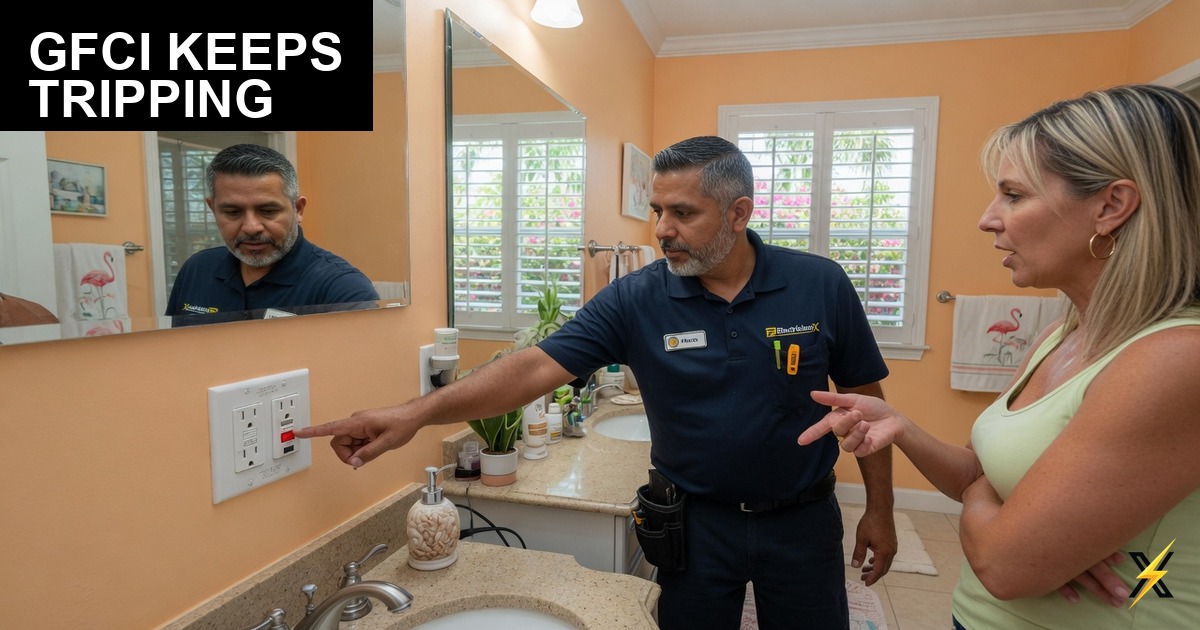
You press RESET on the GFCI outlet in your bathroom, kitchen, garage, or lanai — and within minutes (or seconds) it trips again. The indicator light goes out, anything plugged into that outlet or downstream outlets loses power, and you are stuck in a frustrating loop. In Southwest Florida, where humidity, salt air, afternoon thunderstorms, and outdoor living are part of daily life, nuisance GFCI tripping is one of the most common calls we get at ElectriciansX.
Before you assume the outlet is broken, understand what a GFCI (Ground Fault Circuit Interrupter) actually does. It monitors the current flowing out on the hot wire and back on the neutral wire. If even a small amount of current — as little as 4 to 6 milliamps — leaks to ground through a person, water, or damaged insulation, the GFCI trips in a fraction of a second. That is exactly what it is designed to do. A GFCI that trips repeatedly is usually telling you something is wrong somewhere on that circuit. Your job is to figure out whether the cause is simple and temporary, or whether it signals a wiring problem that needs professional repair.
Why GFCI Outlets Trip — The Most Common Causes
Not every trip means disaster, but not every trip is harmless either. Here are the causes we see most often in Cape Coral, Fort Myers, Naples, Estero, and Fort Myers Beach homes:
- Moisture intrusion. Water inside the outlet box, behind a weather cover, or in a cord end is the number-one cause of GFCI tripping in Florida. Condensation, driving rain, irrigation overspray, and pool splash all push moisture into outdoor and bathroom GFCIs.
- A faulty appliance or tool. Hair dryers, space heaters, refrigerators, power washers, and older extension cords can leak current to ground. Unplug everything on the circuit and reset — if it holds, plug items back in one at a time to find the culprit.
- Worn or damaged wiring. Loose connections, cracked insulation, and corrosion at wire nuts or terminal screws create ground faults that may not trip a standard breaker but will trip a GFCI instantly.
- Overloaded or miswired downstream outlets. A single GFCI often protects multiple standard outlets on the same circuit. One bad outlet in a bedroom, hallway, or garage can cause the upstream GFCI to trip even though the GFCI itself looks fine.
- A failing GFCI device. GFCIs have a limited lifespan — typically 7 to 15 years depending on environment. Units in coastal homes, near pools, or in direct sun tend to fail sooner. A GFCI that will not hold a reset after you have eliminated other causes may simply be worn out.
- Shared neutral wiring issues. Older homes and DIY renovations sometimes share a neutral between two circuits. This can cause unpredictable GFCI and AFCI behavior and requires a licensed electrician to correct.
Safe DIY Checks You Can Do at Home
GFCI troubleshooting is one of the few electrical tasks homeowners can attempt safely — as long as you stay away from opening the outlet or working inside the panel. Follow these steps in order:
- Unplug everything. Remove every device from the GFCI outlet and from all standard outlets that may be protected downstream. Outdoor circuits often feed lanai lights, pond pumps, and landscape transformers you might not think about.
- Press RESET firmly. You should feel or hear a click. If the reset button will not stay in, stop here — that usually means an active ground fault or a dead GFCI. See our guide on GFCI won’t reset for next steps.
- Wait 10 minutes. If moisture caused the trip, a dry-out period sometimes allows a reset to hold. For outdoor outlets, check that in-use covers are closed and that no sprinkler is hitting the box.
- Plug devices back in one at a time. Run each appliance for a few minutes. When the GFCI trips, you have likely found the problem device. Replace or repair it.
- Check other GFCIs on the same circuit. Kitchen, bathroom, garage, and exterior circuits often have one GFCI protecting several locations. Walk the room and reset any other GFCI you find — sometimes the tripped unit is not the one you first noticed.
- Test with the TEST button monthly. Press TEST — the outlet should trip. Press RESET — it should restore power. If TEST does not trip the outlet, the GFCI has failed and must be replaced.
Do not remove the GFCI and replace it with a standard outlet. That removes life-safety protection required by the National Electrical Code (NEC) in wet and damp locations. Do not bypass the GFCI or install a cheater plug. Do not open the outlet cover unless you are comfortable verifying power is off with a non-contact voltage tester and you understand wiring — otherwise call a pro.
When to Call a Licensed Electrician
Call ElectriciansX or another licensed contractor if any of the following apply:
- The GFCI trips with nothing plugged in — this points to a wiring fault, not an appliance.
- RESET will not stay engaged no matter what you unplug.
- You see burn marks, melting, a buzzing sound, or a burning smell at the outlet.
- The GFCI is outdoors, at the pool equipment pad, or on a dock — water + electricity demands professional diagnosis.
- Multiple GFCIs in different rooms trip at the same time — possible panel or neutral issue.
- Your home was built before GFCI requirements and you are not sure the circuit is protected correctly.
Our GFCI installation and troubleshooting service covers outlet replacement, GFCI breaker installation, downstream circuit tracing, and code-compliant upgrades for older Southwest Florida homes.
Southwest Florida Local Context
Florida adopted NEC requirements for GFCI protection earlier and more aggressively than many states. Today, GFCIs are required in bathrooms, kitchens, garages, crawl spaces, unfinished basements, laundry areas, outdoor outlets, pool and spa equipment, and within 6 feet of sinks — and the list keeps expanding with each code cycle. Homes built in the 1970s or 1980s in Cape Coral, Lehigh Acres, and Port Charlotte often have zero or partial GFCI coverage. That is both a code compliance issue and a shock hazard in a climate where every room effectively borders the outdoors.
Coastal properties in Fort Myers Beach, Sanibel, and Bonita Springs face accelerated corrosion at outlet terminals and in weatherproof boxes. We regularly find green copper oxidation, failed in-use covers, and GFCIs mounted in direct sun on south-facing walls — all of which shorten device life. After a tropical storm or hurricane, moisture intrusion into outdoor and garage GFCIs spikes. If your GFCI started tripping after Ian, Debby, or a heavy summer thunderstorm, moisture in the box is the likely cause — but have the wiring inspected if it keeps happening after things dry out.
Lee County and Collier County both require permits for new circuit work and outlet replacements in many jurisdictions when the job involves more than a like-for-like swap. ElectriciansX pulls permits and schedules inspections so your repair is documented — important for insurance claims after storm damage and for home sales.
Stop the Trip Cycle — Get a Professional Diagnosis
Serving Cape Coral, Fort Myers, Naples, Estero, Fort Myers Beach, and all of Southwest Florida.