
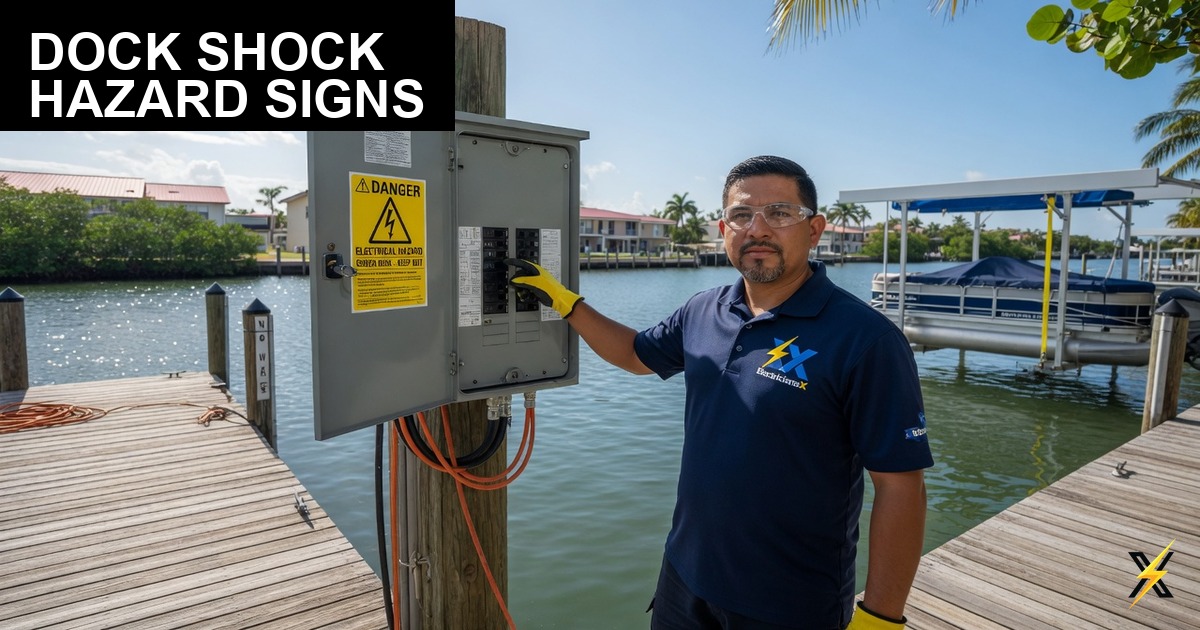
Dock electrical shock hazards kill people on Florida waterways every year — and most victims are not touching anything electrical when it happens. Electric Shock Drowning (ESD) occurs when faulty dock wiring leaks current into the water, creating an invisible electrified zone around the dock, boat, and seawall. If you own waterfront property in Southwest Florida, knowing the warning signs is not optional. It could save a life.
Cape Coral alone has more than 400 miles of navigable canals. Add Fort Myers, Naples, Punta Gorda, and the Caloosahatchee River corridor, and you have one of the densest concentrations of residential dock electrical in the country. Many of those systems were installed decades ago, never permitted, and have been degrading in salt air ever since.
Warning Signs of Dock Electrical Shock Hazard
Not every hazard announces itself with sparks or tripped breakers. Watch for these signs on your dock and neighboring docks:
- Tingling sensation in the water — The most serious sign. Even mild tingling near a dock, boat, or seawall means current is in the water. This is an emergency.
- GFCI that trips repeatedly — A GFCI doing its job is good. A GFCI that trips every time you reset it indicates an active ground fault — current leaking into the water or through wet equipment.
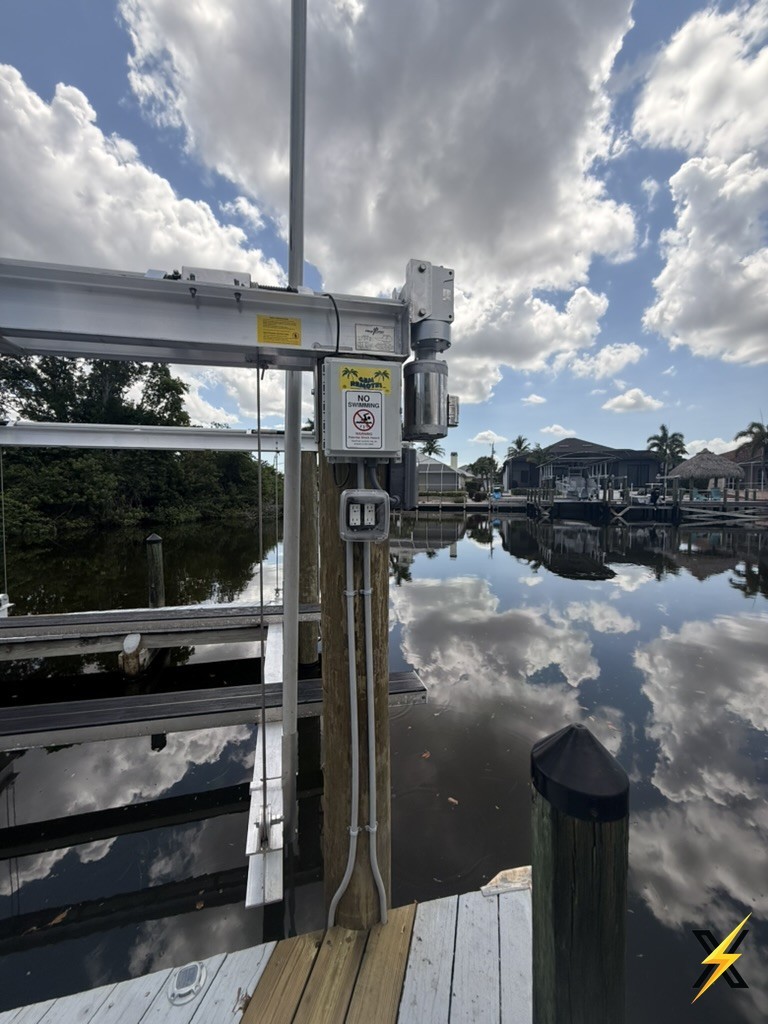
- Missing or faded “DANGER — ELECTRIC SHOCK HAZARD — NO SWIMMING” sign — NFPA 303 requires this signage at dock electrical equipment. Missing signs often correlate with outdated or unpermitted installations.
- Exposed wiring on dock pilings — Wire runs without conduit, junction boxes held on with zip ties, or cables draped over dock framing are shock hazards and code violations.
- Corrosion on panel boxes, outlets, and bonding wires — Green patina on copper, rust on steel enclosures, and crumbling wire insulation mean water has been getting in for a long time.
- Open or unprotected electrical panels on the dock — Panels without weatherproof NEMA 3R enclosures, missing dead fronts, or covers held shut with bungee cords are common on older SW Florida docks.
- Dock lights that flicker or shock you when touched — A dock light housing that tingles when you touch it is leaking current. Do not use it until it is repaired.
- Neighbor’s dock with visible DIY wiring — Faulty wiring on an adjacent dock can electrify the water in your canal. ESD does not respect property lines.
Why SW Florida Docks Are High-Risk
Several factors combine to make dock electrical shock a bigger threat here than in most of the country:
- Salt water conducts electricity better than fresh water — Lee and Collier county canals are brackish to salt. Higher conductivity means lower current levels can cause fatal shock.
- Year-round swimming and water activity — Unlike northern states, people are in the water 12 months a year. More exposure means more risk.
- Aging unpermitted installations — Thousands of docks were wired by handymen or homeowners without permits, inspections, or GFCI protection. Many are still in service.
- Lightning and storm damage — SW Florida averages 90+ thunderstorm days per year. Lightning strikes damage dock panels, GFCI devices, and underground conduit without obvious visible signs.
- Boat shore power connections — Boats plugged into dock outlets with faulty grounding or reversed polarity can energize the water around the dock. This is especially dangerous at marinas.
What Florida Code Requires for Dock Electrical Safety
Dock electrical in Florida falls under NEC Article 553 (Floating Buildings) and Article 682 (Natural and Artificially Made Bodies of Water), plus NFPA 303 (Fire Protection Standard for Marinas and Boatyards). Key requirements include:
- GFCI protection on all dock receptacles and equipment circuits
- Equipotential bonding of all metal dock components, rails, and ladders
- Weatherproof enclosures rated for marine environments (NEMA 3R minimum)
- PVC or rigid conduit for all exposed wiring runs
- “DANGER — ELECTRIC SHOCK HAZARD — NO SWIMMING” signage at all electrical equipment
- Annual inspection recommended by NFPA 303 for all marine electrical systems
If your dock was wired before these requirements existed, or if you cannot confirm it was ever inspected, schedule a professional electrical safety inspection before the next swim season.
What You Can Check From Shore (Without Getting in the Water)
- Walk the dock and look at every electrical component. Panels, outlets, light fixtures, junction boxes, bonding wires. Note corrosion, exposed conductors, or missing covers.
- Press TEST on every GFCI outlet and breaker. They should trip when tested and reset afterward. A GFCI that will not trip on test is failed and provides no protection.
- Check for the shock hazard sign. If it is missing, faded, or posted incorrectly, that is a red flag for the overall installation quality.
- Look at your neighbor’s dock. Visible DIY wiring on adjacent properties is your problem too — current does not stop at the property line.
- Ask when the dock was last inspected. If the answer is “never” or “I don’t know,” schedule an inspection.
Do not get in the water to test for voltage. Do not use homemade voltage testers on a swimming pool noodle. Professional electricians use specialized equipment to test for stray current safely from the dock surface.
What a Professional Dock Electrical Inspection Covers
ElectriciansX performs dock electrical safety inspections across Cape Coral, Fort Myers, Naples, and waterfront communities throughout Lee and Collier counties. Our inspection covers:
- GFCI function test on all dock circuits and outlets
- Bonding and grounding continuity verification
- Panel and enclosure condition assessment
- Conduit integrity and corrosion inspection
- Shore power outlet polarity and grounding check
- Stray voltage testing at the waterline
- Written report with code deficiencies and repair recommendations
If we find hazards, we provide a fixed-price repair quote. Most dock safety upgrades — GFCI replacement, bonding repair, subpanel enclosure, signage — can be completed in a single visit with permit and inspection when required.
Frequently Asked Questions
Can I test my dock water for voltage myself?
We do not recommend it. Professional electricians use calibrated stray-voltage meters and test procedures designed for marine environments. Homemade testing is unreliable and puts you in the water near a potential hazard.
My dock GFCI trips when it rains. Is that dangerous?
It means water is entering an enclosure or conduit. The GFCI is protecting you — but the underlying moisture problem needs to be fixed before someone bypasses the GFCI out of frustration.
Does my homeowner’s insurance cover dock electrical?
Most policies cover permitted, code-compliant dock electrical. Unpermitted work, known code violations, and ESD incidents may be excluded. An inspection and upgrade now can prevent a claim denial later.
Protect Your Dock — Protect Your Family
Dock inspections, GFCI upgrades, bonding repair, and code-compliant subpanel installations.