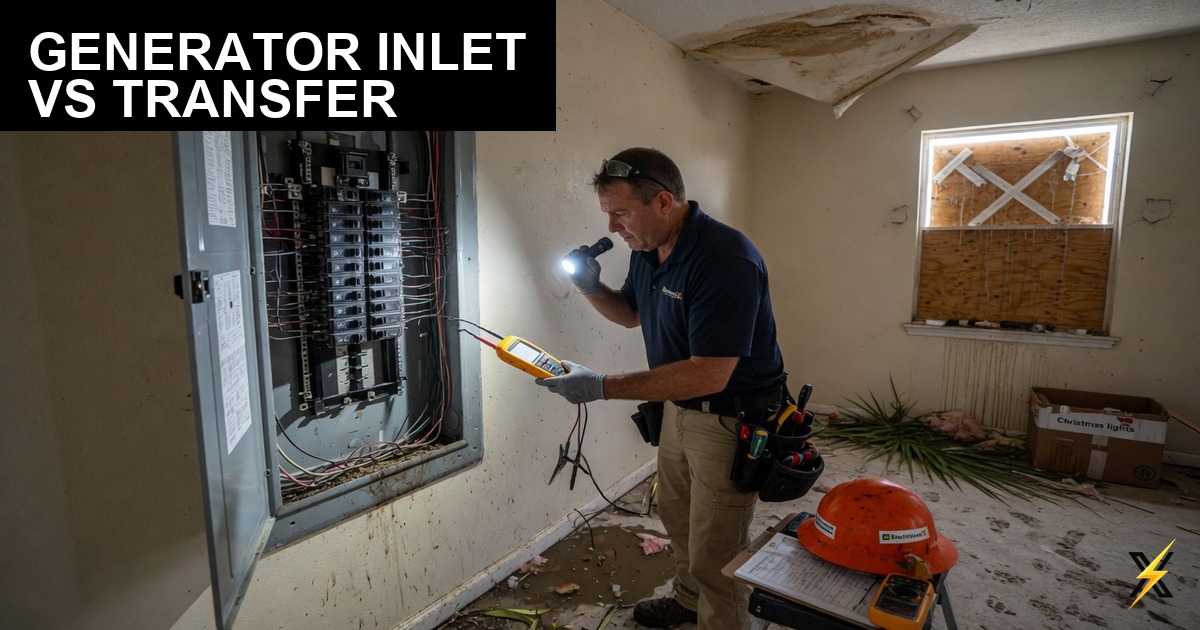
If you are shopping for hurricane backup power in Fort Myers, you have probably heard two terms thrown around interchangeably: generator inlet and transfer switch. They are not the same thing, and confusing them can lead to an illegal installation, a voided insurance policy, or — in the worst case — a lineworker killed by backfed power. Here is what Fort Myers homeowners actually need, what each component does, and how to set up portable or standby generator power the right way before the next storm season.
Fort Myers and Lee County sit in one of the most hurricane-exposed corridors in the United States. When FPL goes down after a storm, homeowners with a plan keep refrigerators cold, run fans, charge phones, and power medical equipment. Homeowners without a plan run extension cords through windows and — dangerously — plug generators into wall outlets. This guide explains the safe, code-compliant path.
What Is a Generator Inlet Box?
A generator inlet box (also called a power inlet box or Gen-Tran inlet) is a weatherproof receptacle mounted on the exterior of your home. It provides a connection point where you plug in a generator cord from your portable generator sitting outside. The inlet is wired through the wall to your electrical panel area — but it does not by itself transfer power to your circuits. It is simply the outdoor plug.
Think of the inlet as the “front door” for generator power. You still need a mechanism inside the panel to route that power to your circuits safely — and to guarantee that power cannot flow backward out to the utility grid.
What Is a Transfer Switch?
A transfer switch is the device that disconnects your home from FPL’s utility feed and connects your home to generator power. It is the critical safety component that prevents backfeeding — sending generator electricity out through your meter and into downed power lines where lineworkers are working.
There are three main types relevant to Fort Myers homeowners:
- Manual transfer switch — A physical switch (usually near the panel) that you flip to “Generator” during an outage and back to “Utility” when FPL restores power. Typically powers 6–10 selected circuits via a sub-panel. Cost-effective for portable generator setups.
- Interlock kit — A mechanical plate installed on your existing main panel that prevents the main breaker and a dedicated generator breaker from being ON simultaneously. A more affordable option when your panel is compatible and has space for a generator breaker. Must be listed for your specific panel model.
- Automatic transfer switch (ATS) — Used with permanently installed standby generators (Generac, Kohler, etc.). Monitors utility power 24/7 and switches to generator automatically within seconds of an outage. Required for whole-home standby generator installations.
Generator Inlet vs. Transfer Switch: What You Actually Need
| Setup | Inlet Box | Transfer Switch | Best For |
|---|---|---|---|
| Portable generator, selected circuits | Yes | Manual transfer switch | Budget-conscious hurricane prep |
| Portable generator, existing panel | Yes | Interlock kit | Panel-compatible, lower cost |
| Standby generator (Generac) | No (hardwired) | Automatic transfer switch | Whole-home automatic backup |
| Inlet only, no transfer switch | Yes | NOT SAFE — illegal | Never do this |
The inlet box alone is never enough. An inlet without a transfer switch or interlock kit gives you a way to get generator power into the house but no way to disconnect from the utility grid. That is backfeeding, and it is illegal under NEC Article 702.
Why Backfeeding a Wall Outlet Is Deadly
Backfeeding means connecting a portable generator to a wall outlet (usually via a homemade “suicide cord” with male plugs on both ends) to power your house through the existing wiring. This is one of the most dangerous things a homeowner can do:
- It energizes your entire panel — Including the main breaker, which you may think is off but may not fully isolate utility power.
- It sends power out through your meter — Lineworkers restoring FPL lines can be electrocuted by your generator power on the grid.
- It bypasses all overcurrent protection — Your generator can overload wiring and start a fire inside your walls.
- It is illegal — NEC 702.12 prohibits backfeeding. Unpermitted installations void insurance and create liability.
Every hurricane season, we see Fort Myers homeowners on social media recommending backfeed setups. Do not follow that advice. A proper inlet plus interlock kit or manual transfer switch costs a fraction of what you would spend on a liability claim or wrongful death lawsuit.
What a Proper Portable Generator Setup Looks Like in Fort Myers
- Portable generator (5,000–7,500W minimum) — Sized for your critical circuits: refrigerator, fans, phone chargers, a few lights, and maybe a window A/C unit. Operated outdoors only, 20+ feet from windows.
- Generator inlet box on exterior wall — Weatherproof, NEMA 3R rated, mounted near the panel side of the house. Connected via conduit to the panel area.
- Interlock kit or manual transfer switch — Installed at the panel by a licensed electrician.
- Heavy-duty generator cord — Properly rated for your generator’s output (usually 30A or 50A). Never use a standard extension cord.
- Permit and inspection — Lee County requires electrical permits for generator inlet and transfer switch installations. ElectriciansX handles permits on every generator connection job.
When a Standby Generator Makes More Sense
If you want automatic backup without hauling a portable generator out of the garage every storm, a permanently installed Generac standby generator with an automatic transfer switch is the Fort Myers standard for whole-home backup. These systems:
- Start automatically within 10 seconds of a power outage
- Run on natural gas or propane — no gasoline storage
- Power the entire home including central A/C, well pumps, and security systems
- Self-test weekly and alert you to maintenance needs
- Increase home value and satisfy insurance requirements
ElectriciansX installs Generac generators and serves Fort Myers, Cape Coral, and all of Lee County. We handle sizing, permitting, gas connection coordination, installation, and inspection. Learn about generator installation →
Frequently Asked Questions
Can I install a generator inlet myself?
The inlet box mounting is straightforward, but the wiring to the panel and the transfer switch or interlock installation must be done by a licensed electrician with a permit. Lee County inspects these installations.
Will an interlock kit work on my panel?
It depends on the panel brand and model. Interlock kits are listed for specific panels — Square D QO, Siemens, and some Eaton panels are commonly compatible. Challenger, Federal Pacific, and Zinsco panels are not candidates for interlock kits and should be replaced.
Hurricane Backup Power Done Right
Generator inlets, interlock kits, manual transfer switches, and Generac standby installations in Fort Myers and Lee County.