
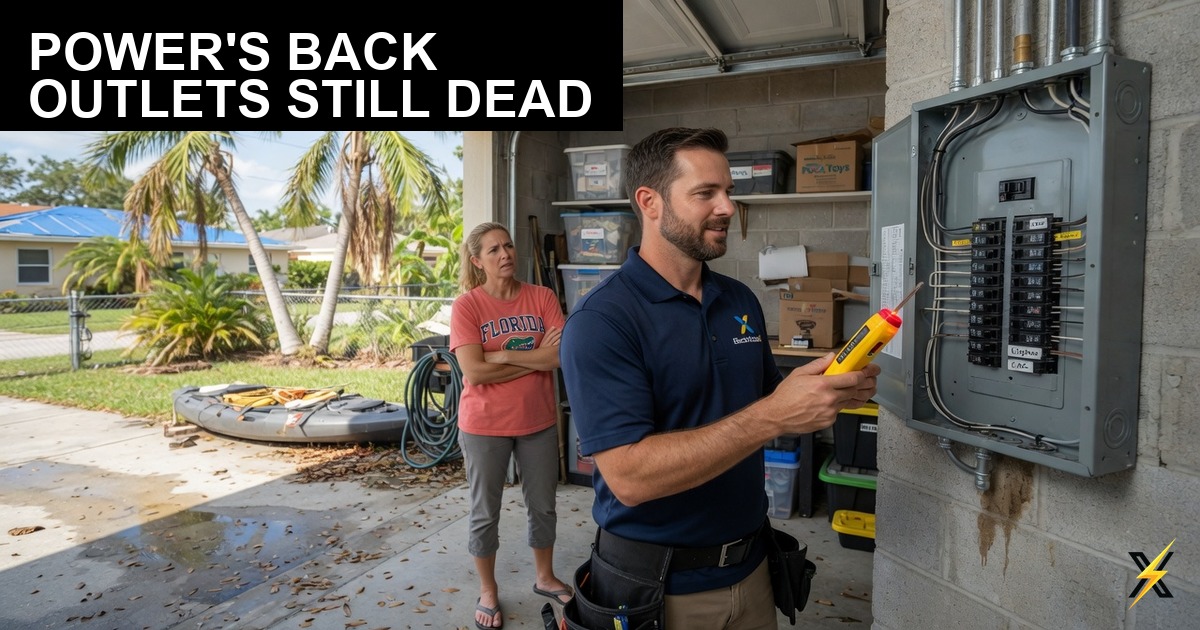
The storm passed, FPL restored power to your neighborhood, and the lights came on — but half your outlets still do not work. If you live in Southwest Florida, this is one of the most common post-hurricane electrical problems we see across Lee and Collier counties. It is frustrating, confusing, and sometimes a sign of damage that needs professional attention before you plug anything back in.
Partial power loss after a storm is almost never random. Electricity flows through a specific chain — utility feed, main breaker, branch breakers, wiring, GFCI devices, and outlets. A break at any point in that chain can leave one room, one wall, or one half of your house dark while everything else works fine. Here is how to systematically find the problem and know when to call for help.
Why Half Your Outlets Can Be Dead After a Storm
When FPL restores power after a hurricane or major storm, the re-energization event itself can cause problems. Utility switching creates voltage spikes and sags that stress your electrical system. Combined with water intrusion, flooded garages, and lightning strikes that happened during the storm, you get a cluster of common causes:
- Tripped branch breakers you have not found yet — Not all tripped breakers flip fully to the OFF position. Many sit in a middle “tripped” position that looks ON. You must flip them OFF first, then back ON.
- Blown GFCI outlets upstream — A single GFCI in a bathroom, garage, or outdoor location can protect multiple downstream outlets. If that GFCI tripped during the storm and was not reset, every outlet after it in the chain is dead — even in other rooms.
- Tripped GFCI or AFCI breakers in the panel — Modern panels have combination GFCI/AFCI breakers that trip independently of standard branch breakers. These are easy to miss because they look like regular breakers.
- Water-damaged outlets or wiring — Storm flooding in garages, lanai areas, and ground-floor rooms damages outlets and causes GFCI devices to trip and refuse to reset. This is common after Ian and Idalia-type surge flooding in Fort Myers and Cape Coral.
- Lightning surge damage — A nearby lightning strike can destroy GFCI outlets, damage breakers, and fry wiring inside walls without tripping the main breaker. Outlets on the affected circuit are dead even though the breaker appears ON.
- Loose main breaker or bus bar connection — Power restoration surges can loosen connections inside the panel, causing one side of a 240V panel (one leg) to lose contact. This kills every 120V circuit on that leg — typically half the house.
- Generator backfeed damage — If a generator was improperly connected during the outage (backfed through a wall outlet), it may have damaged breakers, wiring, or the panel itself. Some circuits work; others do not.
Step-by-Step: What to Check After Power Comes Back
Work through these steps in order before calling an electrician. Most partial power issues are resolved at steps 1–3.
- Check every breaker in the main panel. Flip each breaker firmly to OFF, then back to ON — including the main breaker at the top. A breaker that trips again immediately has a fault on that circuit. Leave it OFF and note which one.
- Check for GFCI and AFCI breakers. Look for breakers with a TEST button or yellow reset flag. Press RESET on any that have tripped. These protect bedroom, bathroom, kitchen, garage, and outdoor circuits in modern SW Florida homes.
- Find and reset every GFCI outlet in the house. Check bathrooms, kitchen, garage, laundry room, outdoor outlets, pool equipment pad, and the outlet behind your refrigerator (yes, really). Press RESET on each one. A dead outlet in the living room might be downstream of a tripped GFCI in the garage.
- Map which outlets work and which do not. Note the pattern — is it one room, one side of the house, or random outlets? One side of the house strongly suggests a lost leg at the panel. One room suggests a tripped breaker or upstream GFCI.
- Look for water damage. Check garage outlets, lanai outlets, and any outlet near where water entered during the storm. Discolored outlets, rust on cover plates, or outlets that will not reset after drying indicate water damage requiring replacement.
- Smell and look for heat. If any outlet smells burnt, looks scorched, or feels warm — do not reset it. Turn off the breaker for that circuit and call an electrician.
- Test with a lamp or phone charger. After resetting breakers and GFCIs, test dead outlets one at a time. If they are still dead after all resets, the problem is in the wiring or the breaker itself.
When Half the House Is Out: Lost Leg at the Panel
If exactly half your outlets and lights are dead — typically every other breaker column in the panel, or everything on one side of the house — you may have lost one leg of your 240V service. Residential panels in SW Florida use two 120V legs. If one leg loses connection at the main breaker, meter, or utility feed, every 120V circuit on that leg goes dead while circuits on the other leg work normally.
This can be caused by:
- A failing main breaker (common in older panels after surge events)
- Loose lug connection on a bus bar inside the panel
- Utility-side damage that FPL has not yet repaired (call FPL first if the main breaker and meter check out)
- Corroded meter socket after storm flooding
A lost leg is not a DIY fix. It requires professional diagnosis with a multimeter at the panel and may require FPL coordination or a main breaker replacement. Emergency electrical service →
Storm Surge Damage: What You Cannot See
Lightning does not have to hit your house directly to cause damage. A strike within a few hundred feet can induce surge voltage on your wiring that destroys GFCI outlets, damages AFCI breakers, and degrades wire insulation inside walls. Signs of surge damage after a storm:
- Multiple GFCI outlets that will not reset even after drying
- AFCI breakers that trip immediately when reset
- Electronics that stopped working (TVs, routers, smart home devices) while hardwired lights and outlets on different circuits are fine
- A burning smell from the panel or specific outlets
If you suspect surge damage, schedule an electrical safety inspection before filing an insurance claim. A written inspection report documents the damage for your adjuster and identifies what needs repair vs. replacement.
When to Call an Electrician After a Storm
Call a licensed electrician if:
- You have reset all breakers and GFCIs and outlets are still dead
- Any breaker trips immediately when reset
- You smell burning from any outlet, switch, or the panel
- Half the house is out and the main breaker appears fine (possible lost leg)
- Outlets were submerged or show water damage
- You used a generator during the outage without a transfer switch (possible backfeed damage)
- FPL says power is restored but you still have partial loss (may be on your side of the meter)
ElectriciansX provides post-storm electrical diagnosis and repair across Lee County, Collier County, and all of Southwest Florida. We work with insurance companies and provide written documentation for claims.
Frequently Asked Questions
Can a power surge trip breakers without obvious damage?
Yes. Surge events can trip GFCI and AFCI breakers without visible damage. They can also weaken breaker mechanisms so they trip more easily going forward. If breakers trip repeatedly after a storm, have the panel inspected.
Does FPL fix problems on my side of the meter?
No. FPL is responsible for the utility feed to your meter. Everything from the meter through your panel to your outlets is your responsibility. If FPL confirms they have restored service and you still have partial loss, the problem is in your electrical system.
Will my insurance cover storm electrical damage?
Most homeowner’s policies cover sudden electrical damage from lightning and storm events. Document everything — photos, inspection reports, and repair quotes. Unpermitted work and pre-existing code violations may affect coverage.
Post-Storm Electrical Help
Breaker diagnosis, GFCI replacement, surge damage repair, and panel inspection after hurricanes.