
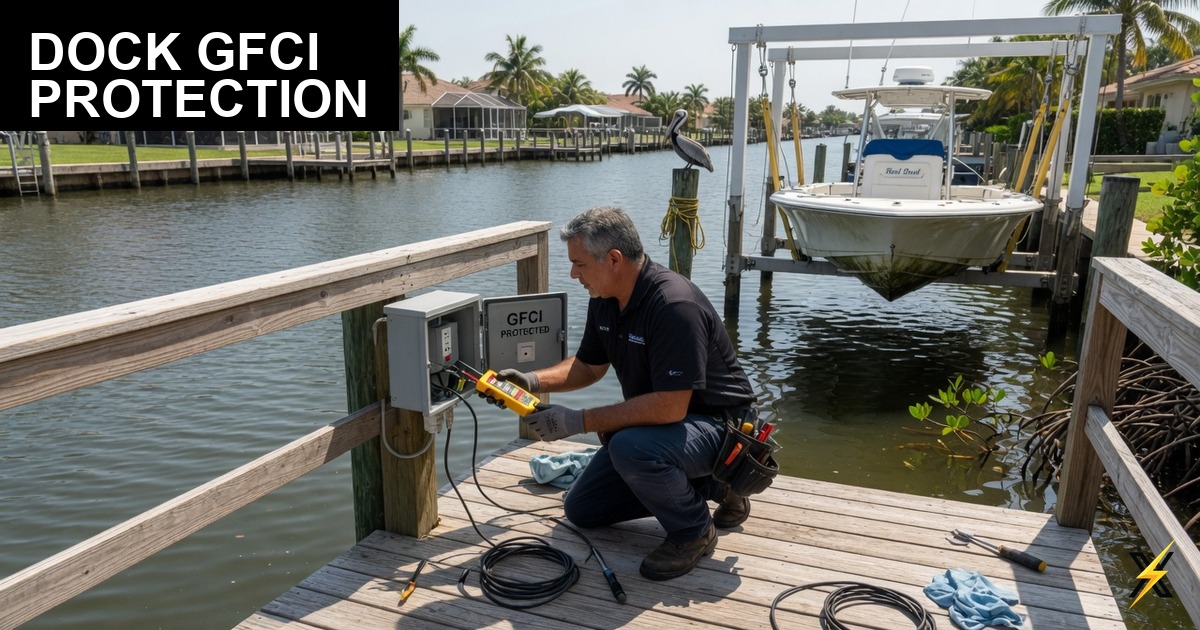
You have a dock on a canal in Cape Coral, a boat lift in Fort Myers, or a waterfront deck in Naples. There is an outlet on the dock post for the lift remote, the fish cleaning station, or the string lights you hang before a weekend on the water. But does that outlet have GFCI protection? Is it the right kind for a marine environment? And what happens if it does not — besides the obvious shock risk to anyone standing on a wet dock in bare feet?
Dock electrical is one of the most regulated and most dangerous categories of residential wiring in Florida. Water, metal dock structures, boats tied to shore power, and Florida’s aggressive NEC adoption all combine to make GFCI protection non-negotiable. At ElectriciansX, we inspect and upgrade dock electrical systems across Lee and Collier counties every week. Here is what Florida code requires, what we actually find on waterfront properties, and what you should do about it.
What Florida Code Requires for Dock GFCI Protection
The National Electrical Code (NEC), adopted by Florida with state-specific amendments, mandates GFCI protection for outlets in specific locations near water. For docks, marinas, and waterfront structures, the key requirements include:
- NEC 555 — Marinas, Boatyards, and Commercial and Noncommercial Docking Facilities. This article governs dock wiring. It requires GFCI protection for all 125-volt, single-phase, 15- and 20-ampere receptacles on docks, piers, and floating structures.
- NEC 210.8(A) and (B). Outdoor outlets and outlets within 6 feet of sinks or water sources require GFCI protection. Dock outlets fall under both outdoor and proximity-to-water rules.
- GFCI breakers or GFCI receptacles. Protection can be provided by a GFCI breaker in the dock subpanel, a GFCI outlet at the dock, or a GFCI breaker in the main house panel feeding the dock circuit. The protection must be readily accessible for testing and resetting.
- Weather-resistant (WR) rated devices. Outdoor and dock-mounted GFCIs must be weather-resistant rated and installed in weatherproof enclosures with in-use covers.
- Equipment grounding and bonding. NEC 555.20 requires bonding of metal dock structures, railings, and equipment to the grounding system. This is separate from GFCI protection but equally critical for shock prevention.
- NFPA 303. Florida also references NFPA 303 (Fire Protection Standard for Marinas and Boatyards) for waterfront fire and electrical safety, which reinforces GFCI and grounding requirements.
Permits are required for dock electrical work in Lee County and Collier County. Unpermitted dock wiring is common on older Cape Coral canal homes — and it is a liability if someone is injured.
What We Actually Find on Southwest Florida Docks
Code on paper and docks in practice are often very different. Here is what our technicians encounter:
- No GFCI at all. Outlets installed in the 1980s or 1990s before GFCI requirements expanded to docks. Standard outlets in a plastic box on a wood piling — no protection, no weather cover.
- Dead GFCIs that were never replaced. A GFCI that tripped years ago and was bypassed or replaced with a standard outlet because “it kept tripping.” This is the most dangerous scenario — the homeowner removed the safety device instead of fixing the fault.
- Household extension cords as permanent dock wiring. An orange 16-gauge cord run along the dock railing to power a boat lift — no conduit, no GFCI, no grounding. This is a fire and electrocution hazard, especially when the cord sags into the water.
- Subpanel without GFCI breaker. A dock subpanel fed from the house with standard breakers and no GFCI protection on any circuit — even though the subpanel is 10 feet from the water.
- Corroded connections from salt and spray. Cape Coral and Fort Myers canal docks see constant salt exposure. Green-corroded wire nuts, rusted box covers, and failed gaskets trip GFCIs repeatedly until the hardware is replaced with marine-rated components.
- Missing “NO SWIMMING” and shock hazard signage. NEC and NFPA 303 require warning signs at dock electrical equipment. Most residential docks we inspect have no signage at all.
Safe Checks You Can Do
Some dock electrical inspection is safe for homeowners. Other parts require a licensed marine electrician.
- Locate the GFCI. Find the GFCI outlet or breaker protecting your dock circuit. It may be on the dock itself, in a shed, in the garage, or in the main panel. Press TEST — it should trip. Press RESET — it should restore power.
- Check the outlet cover. Is it a weatherproof in-use cover that closes over plugged-in cords? Or is it a missing/broken flat plate? Open the cover (dry day only) and look for corrosion, insect nests, or water stains.
- Look at the wiring path. Is dock wiring in PVC conduit, UF cable rated for wet locations, or an extension cord zip-tied to the railing? Only conduit and rated direct-burial or wet-location cable are code-compliant.
- Check for bonding. Metal dock railings, ladders, and lift frames should be bonded to the grounding system. You cannot verify this without testing equipment, but visible bare copper bonding jumpers on metal components are a good sign.
- Feel for tingling. If anyone feels even a slight tingle touching the dock railing, metal lift, or water near the dock — stay off the dock, stay out of the water, and call an electrician immediately. This is stray current, and it can be lethal. See our article on dock electrical shock hazard signs.
Do not work on dock wiring while standing on a wet dock. Do not bypass a tripping GFCI. Do not run extension cords as permanent dock wiring.
When to Call a Licensed Electrician
Dock electrical is not a DIY project in Florida. Call ElectriciansX if:
- Your dock outlet has no GFCI protection or you are not sure
- The GFCI trips repeatedly and you do not know why
- Wiring is exposed, corroded, or run without conduit
- You are installing a new boat lift, fish cleaning station, or dock lighting
- You are buying or selling a waterfront property and need an electrical inspection
- Anyone has felt tingling near the dock or in the water adjacent to your property
- Your dock was damaged in a storm and electrical components were submerged
Our dock wiring and marine electrical service covers GFCI installation, subpanel upgrades, boat lift circuits, bonding verification, and code-compliant repairs — permitted and inspected in Lee and Collier counties.
Southwest Florida Waterfront Context
Cape Coral has over 400 miles of canals — more than any other city in the world. That means tens of thousands of residential docks, most installed before modern NEC dock requirements existed. Fort Myers River District and waterfront homes along the Caloosahatchee have the same legacy wiring challenges. Naples and Marco Island estates on the Gulf often have elaborate dock setups with multiple circuits, boat lifts, underwater lighting, and shore power connections that all require coordinated GFCI protection.
Florida Fish and Wildlife Conservation Commission and local sheriff marine units respond to electric shock drowning (ESD) incidents every year in SW Florida. ESD happens when stray AC current from dock wiring enters the water — often from a fault on a dock without proper GFCI or bonding. The current paralyzes swimmers and they drown. It does not take much current — levels below what a GFCI is designed to detect can be lethal in water. Proper GFCI protection, bonding, and annual testing are not optional extras — they are life safety.
If your boat lift will not run, the problem may be electrical or mechanical. Our guide on boat lift electrical vs. mechanical problems helps you narrow it down before you call.
After Hurricane Ian and subsequent storms, many dock electrical systems in Fort Myers Beach, Pine Island, Matlacha, and Bokeelia were submerged or ripped apart. FEMA and insurance claims require documented, code-compliant repairs by licensed contractors. ElectriciansX handles dock electrical rebuilds from the house panel to the dock outlet, including GFCI protection, bonding, conduit, and signage.
Protect Your Dock — and Everyone on the Water
Licensed dock and marine electricians serving Cape Coral, Fort Myers, Naples, and all of Southwest Florida.