
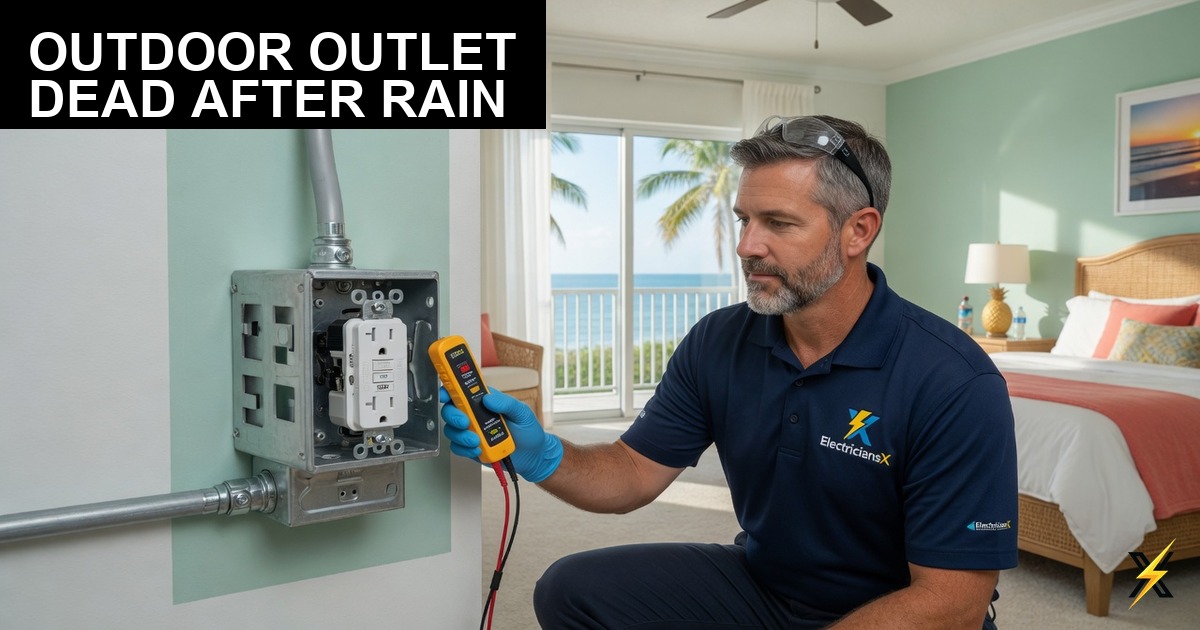
It rained last night — maybe just a typical Southwest Florida afternoon thunderstorm, maybe the tail end of a tropical system. This morning you go to plug in the pool cleaner, the string lights on the lanai, or the pressure washer in the driveway, and the outdoor outlet is dead. The GFCI will not reset, or there is no power at all. You did not change anything. The rain did.
Outdoor outlets fail after rain more than almost any other electrical problem in Florida. That is not a coincidence — it is physics. Water is a conductor. When it gets inside an outlet box, a weatherproof cover, a cord connection, or a light fixture, it creates a path for current to leak to ground. The GFCI detects that leak and trips — exactly as designed. The challenge is figuring out whether the problem is temporary moisture that will dry out, or permanent damage that needs repair or replacement.
Why Rain Kills Outdoor Outlets in Southwest Florida
Florida building codes require GFCI protection and weather-resistant covers on outdoor outlets, but codes cannot overcome physics, age, and installation shortcuts. Here is what we find on service calls in Cape Coral, Fort Myers, Naples, and Punta Gorda after every rainy season:
- Failed in-use covers. The “bubble” covers that should close over plugged-in cords often crack, warp, or lose their gasket from UV exposure. Rain blows in horizontally during storms and pools inside the box.
- Missing or wrong cover type. Flat horizontal covers on vertical outlets, missing gaskets, or covers that were never installed after an outlet replacement — all let water in.
- Corroded terminals and wire nuts. Southwest Florida humidity accelerates corrosion even without direct rain. A storm pushes moisture into connections that were already marginal, and the GFCI trips permanently until the corrosion is cleaned or the outlet is replaced.
- Damaged cord ends and plugs. Extension cords left plugged in outdoors develop cracked insulation. Rainwater wicks into the plug and trips the GFCI even though the outlet itself is fine.
- GFCI at end of life. Outdoor GFCIs in direct sun and rain cycles fail faster. A weakened GFCI may trip at the slightest moisture and refuse to reset even after the box dries.
- Improper box orientation or drainage. Outlet boxes mounted with the openings facing up, or boxes without weep holes in stucco enclosures, collect water that has nowhere to go.
Safe DIY Steps After Rain
Work through these steps before assuming the outlet is destroyed. Always start with safety: if you see sparking, buzzing, or smell burning, stop and call an electrician.
- Unplug everything from the outdoor outlet and any downstream outdoor outlets on the same circuit. Disconnect extension cords, holiday lights, fountain pumps, and landscape lighting transformers.
- Close all weatherproof covers. Make sure in-use covers latch properly and gaskets are seated. If the cover is cracked or missing, tape a plastic bag over the box temporarily — not as a permanent fix, but to keep more rain out while you troubleshoot.
- Check the GFCI. Press RESET firmly. If it trips immediately, there is still moisture or a ground fault present. Wait.
- Let it dry — at least 4 to 24 hours. Florida sun is your friend here. Leave the cover open (with nothing plugged in) on a dry, sunny day and try RESET again in the afternoon. Many nuisance trips after light rain resolve once the box dries completely.
- Check the indoor GFCI that may protect this outlet. Outdoor circuits are often fed from a GFCI in the garage, laundry, or another exterior location. Reset every GFCI in the house before focusing only on the outdoor one.
- Inspect the breaker panel. A tripped GFCI breaker (common for pool and patio circuits) looks almost ON. Flip it OFF, then ON. If it trips again immediately, call a pro.
- Test with one dry device. After the box has dried and RESET holds, plug in a single device with a dry cord — a phone charger works. Do not plug in a wet pressure washer or pool equipment right after a storm.
Do not spray WD-40, silicone, or any chemical into the outlet to “waterproof” it. Do not wrap the outlet in duct tape as a permanent solution. Do not remove the GFCI to stop the tripping. All three create fire and shock hazards.
When to Call a Licensed Electrician
Schedule a service call with ElectriciansX if:
- The GFCI will not reset after 24 hours of dry weather with nothing plugged in
- You see rust, green corrosion, or water pooling inside the box when you open the cover
- The outlet faceplate is cracked, melted, or discolored
- Multiple outdoor outlets on different walls died at the same time
- The outlet has never had a proper weatherproof cover or is not GFCI-protected
- You are a landlord or vacation rental owner and need documented, code-compliant repair
We replace outdoor outlets with weather-resistant (WR) rated GFCIs, install proper in-use covers, upgrade boxes to drain correctly, and pull permits when required. See our GFCI installation service for details.
Southwest Florida Local Context
Southwest Florida receives over 50 inches of rain annually, most of it in concentrated summer thunderstorms that dump inches of water in under an hour. Horizontal wind-driven rain is the real enemy of outdoor outlets — it defeats flat covers and blows through lanai screens into covered patios that homeowners assume are “protected.”
Cape Coral’s canal-front homes often have outlets on dockside walls and pool cages that take direct spray from automatic irrigation systems — not just rain. Fort Myers and Lehigh Acres homes with extensive landscape lighting run low-voltage transformers from outdoor GFCIs that trip every time a connector gets wet. Naples and Marco Island estates with outdoor kitchens have multiple GFCI-protected circuits that need regular testing.
After Hurricane Ian, many homeowners in Fort Myers Beach and Pine Island replaced outdoor outlets as part of rebuilds — but some used standard indoor-rated devices because supply chains were strained. If your post-storm outlet was installed by a general contractor and not a licensed electrician, it is worth having it inspected. Indoor-rated outlets in outdoor boxes fail fast in Florida and are a code violation.
Related reading: Why your GFCI keeps tripping and what it means when a GFCI will not reset.
Weatherproof Your Outdoor Electrical — the Right Way
Serving Cape Coral, Fort Myers, Naples, Punta Gorda, and all of Southwest Florida.