
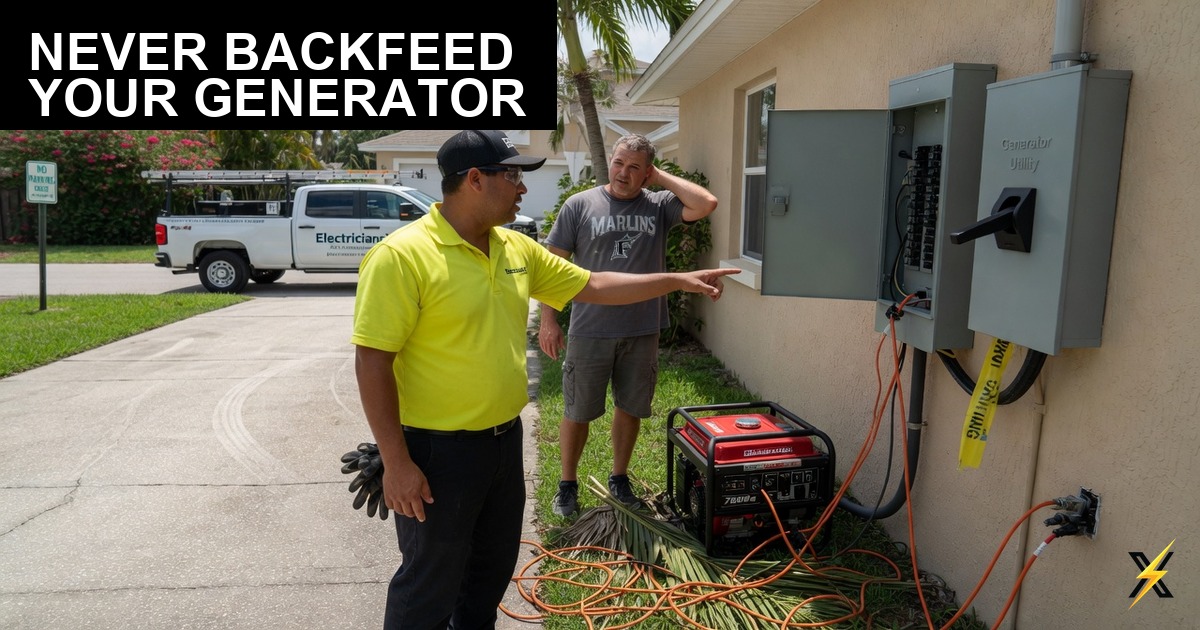
Every hurricane season, someone on a Southwest Florida Facebook group posts a “life hack”: plug your portable generator into a wall outlet with a double-male cord and flip the main breaker off. Power your whole house. Simple. Cheap. And potentially lethal.
That practice is called backfeeding — forcing generator power backward through your home’s branch circuits, through the main panel, out through your electric meter, and onto FPL’s utility lines. It is illegal under the National Electrical Code (NEC Article 702). It has killed lineworkers restoring power after hurricanes. It has started house fires when overloaded generators cooked wiring inside walls. And if something goes wrong, your homeowner’s insurance will almost certainly deny the claim because the installation was unpermitted and knowingly dangerous.
At ElectriciansX, we get calls every storm season from Cape Coral, Fort Myers, Naples, and Estero homeowners who either tried backfeeding and damaged their panel, or who want us to “just install an outlet they can plug the generator into.” We will not do that — and no licensed electrician should. Here is what backfeeding actually does, why the internet advice is wrong, and the safe, code-compliant alternatives that cost far less than a wrongful death lawsuit.
What Backfeeding Actually Means
Your home’s electrical system is designed for power to flow in one direction: from the utility transformer, through your meter, into your main panel, and out to outlets and appliances. A portable generator is meant to supply selected loads through a proper transfer path — not to become an alternate utility source hooked into random branch wiring.
When you plug a generator into a wall outlet using a homemade cord with male plugs on both ends (sometimes called a “suicide cord” or “generator cord”), you are connecting 120V or 240V generator output directly to a branch circuit. That circuit is tied to your panel bus bars. Even with the main breaker switched off, you cannot guarantee complete isolation from the utility grid. Main breakers fail. Neutral connections are shared. And FPL’s transformer can back-feed through the neutral in ways most homeowners do not understand.
The result: generator power can energize the utility lines outside your home — the same lines lineworkers are handling bare-handed because they believe the circuit is dead.
Why the “Turn Off the Main Breaker” Myth Fails
Social media instructions usually say: turn off your main breaker, plug in the generator, power your house. Here is why that is not safe or legal:
- Main breakers are not listed as transfer devices. NEC 702 requires a listed transfer equipment — manual transfer switch, interlock kit, or automatic transfer switch — to prevent parallel operation of utility and generator power.
- Main breakers can fail in the closed position. A worn or damaged main breaker may appear off while still passing current. You will not know until it is too late.
- There is no mechanical interlock. Nothing physically prevents someone from flipping the main breaker back on while the generator is running — energizing the grid and the generator against each other.
- Your generator is not sized for the whole house. Backfeeding through one outlet means power can spread to circuits you did not intend to run. A 3,500W generator trying to feed a central A/C or electric range will overload wiring and overheat connections inside walls.
- GFCI and AFCI breakers may not protect the way you expect. Generator power creates grounding and neutral issues that standard breakers are not designed to manage in a backfeed configuration.
- It violates NEC 702.12 and Florida Building Code. Unpermitted work fails inspection, voids insurance, and creates personal liability if someone is injured.
What Happens Inside Your Panel During Backfeed
When generator power enters through a 15A or 20A kitchen or dryer outlet, it does not politely stay on that one circuit. It flows through the panel bus and can energize every circuit on that leg of the panel. Your refrigerator circuit, lighting circuits, and garage outlets can all receive power — along with any fault on any of those circuits.
If the main breaker is truly off, you may still be feeding power out through the utility side of the panel via the neutral-to-ground bond. If the main breaker is on — or gets turned on accidentally — your generator and FPL’s transformer can be connected in parallel. That can destroy your generator, destroy appliances, and send high current into the utility grid.
We have seen backfeed attempts after Hurricane Ian and subsequent storms leave homeowners with melted bus bars, destroyed main breakers, and half their outlets dead even after FPL restored power. See our guide on power back but half your outlets still dead for related post-storm symptoms.
Safe Alternatives That Actually Work in SW Florida
You do not need to backfeed to run a portable generator during an outage. These are the code-compliant options ElectriciansX installs across Lee and Collier counties:
- Generator inlet box + interlock kit. A weatherproof inlet on your exterior wall connects to a dedicated breaker in your panel. A listed interlock plate prevents the main breaker and generator breaker from both being ON. You plug one cord from the generator to the inlet, flip the interlock, and power selected circuits safely. Learn about 50A generator inlet installation →
- Manual transfer switch with sub-panel. Powers 6–10 critical circuits (refrigerator, lights, fans, well pump, one A/C window unit) through a separate sub-panel. Clear, simple operation during outages.
- Permanently installed Generac standby generator with automatic transfer switch. Whole-home backup that starts automatically within seconds. No cords, no manual switching, no hauling a portable unit out of the garage in 100 mph wind. Learn about Generac installation →
- Extension cords to individual appliances (temporary). For a single night without power, run a proper outdoor-rated extension cord from the generator directly to the refrigerator or a window A/C — not through your wall wiring. Operate the generator outdoors only, 20+ feet from windows.
For a full comparison of inlets vs. transfer switches, read our generator inlet vs. transfer switch guide.
What If You Already Backfed During a Storm?
If you already used a suicide cord during a past outage and nothing bad happened, you got lucky — not smart. Have a licensed electrician inspect your panel before the next storm season. Backfeed can cause hidden damage: heat-damaged bus bars, weakened main breaker contacts, tripped AFCI or GFCI breakers that will not reset, and neutral connection problems that show up months later as flickering lights or partial power loss.
Do not wait for the next hurricane to discover your panel was compromised. An electrical safety inspection takes about an hour and gives you a written report — useful for insurance and peace of mind.
Lee and Collier County Permit Requirements
Generator inlet boxes, interlock kits, manual transfer switches, and standby generator installations all require electrical permits in Lee County and Collier County. Inspections verify that the transfer equipment is listed for your panel, that grounding and bonding are correct, and that there is no path for backfeed to the utility grid.
ElectriciansX pulls permits and schedules inspections on every generator connection job. Unpermitted generator wiring is a red flag on home sales and insurance claims — especially in hurricane-prone markets like Cape Coral and Fort Myers Beach where buyers and insurers scrutinize storm readiness.
Frequently Asked Questions
Can I plug my generator into my dryer outlet?
No. A dryer outlet is still backfeeding — same dangers, same illegality. The only safe connection is through listed transfer equipment installed by a licensed electrician with a permit.
My neighbor does it and nothing happened. Why can’t I?
Survivorship bias. For every neighbor who got away with it, there are homeowners who started fires, destroyed panels, or contributed to lineworker injuries they never hear about. The code exists because the hazard is real and documented.
Will FPL know if I backfeed?
Possibly. Backfeed can damage utility equipment, cause voltage abnormalities on the grid, and create liability you are personally responsible for. FPL does not need to “catch you” — the legal and safety consequences are enough reason never to do it.
Never Backfeed — Install It Right
Generator inlets, interlock kits, and transfer switches for Cape Coral, Fort Myers, Naples, Estero, and all of Southwest Florida.