
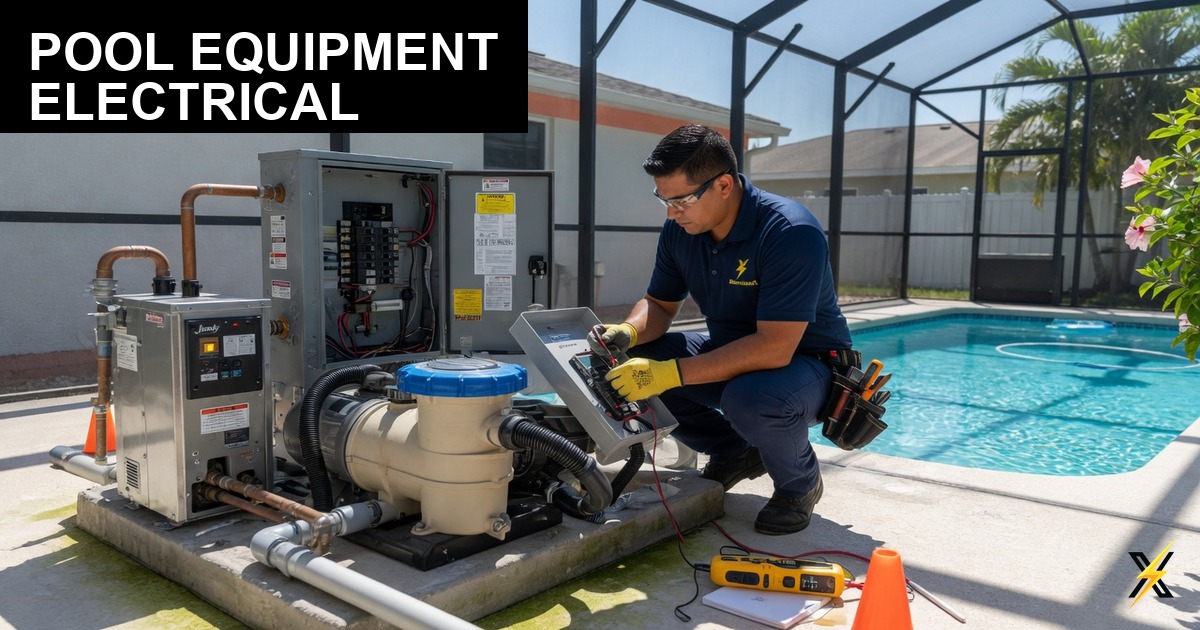
A pool in Southwest Florida is not a single piece of equipment. It is a small system — a pump, usually a heater, often an automation panel, lights in the water, and lighting around the lanai — and almost all of it runs on electricity that has to be installed to a stricter set of rules than the rest of your house.
Article 680 of the National Electrical Code exists specifically for pools, and it is one of the least forgiving sections in the book. That is not bureaucracy. Water changes what a small electrical fault can do to a person standing in it.
Whether you are building new, replacing failed equipment, or upgrading an older pad in Cape Coral, Naples, or Fort Myers, here is what the electrical side involves.
Pool Pumps
Nearly all residential pool pumps sold today are variable-speed, and that is a genuine improvement — they are dramatically more efficient than the single-speed motors they replaced, and most homeowners see it on the FPL bill within a cycle or two.
From our side, a pump replacement usually means confirming the existing circuit is correctly sized and protected, verifying the equipment is properly bonded, and making sure the disconnect and any timer or automation wiring are right. Where we most often find problems on older pads:
- Missing or corroded bonding — the #8 solid copper bonding grid that ties the pump, the pool shell, the ladder, the cage and everything else to the same electrical potential. In salt air this corrodes, and it is invisible until someone tests for it.
- GFCI protection that was never added — required on pool pump circuits, and frequently absent on pads installed decades ago.
- Weather-beaten enclosures — cracked covers, missing gaskets, unsealed conduit entries. This is the number one cause of the nuisance trips we get called about. We wrote a whole guide on why a pool pump GFCI keeps tripping if that is what brought you here.
- Undersized conductors for the run — equipment pads are often a long way from the panel.
Electric Pool Heaters — the 50-Amp Conversation
Electric heat pump pool heaters are popular here for good reason: our climate is nearly ideal for them, and they will extend your swimming season substantially for a fraction of what resistance heat would cost to run.
They also draw real current. A residential heat pump pool heater commonly lands on a 50-amp dedicated 240-volt circuit, though the exact requirement comes off the unit’s nameplate — the minimum circuit ampacity and maximum breaker size are printed there and they govern.
Fifty amps is not a trivial addition. For many homes this is the load that finally answers the question of whether the existing service has room. Before you buy a heater, it is worth knowing:
- Whether your panel has physical space for a 50-amp two-pole breaker
- Whether your service capacity supports the added load alongside your A/C, range, dryer and anything else
- Whether the run from panel to pad needs upsized conductors for voltage drop
- Whether a subpanel at the equipment pad makes more sense than individual home runs — often it does, once you are powering a pump, heater, lights and automation
Our residential load calculator will give you a solid estimate of where your service stands before you commit to equipment.
Pentair and Jandy Automation Systems
Pool automation has gotten genuinely good. Pentair and Jandy both make systems that let you run the pump, heater, lights, water features and spa from your phone, set schedules, and stop thinking about it.
These systems are typically built around a load center at the equipment pad — a single enclosure housing the relays, the transformer for low-voltage lighting, and the control board. Getting one installed correctly means:
- Clean, correctly sized power to the load center, with each controlled circuit landing where it belongs
- Proper separation of line-voltage and low-voltage wiring inside and outside the enclosure
- Bonding of the enclosure and all metallic equipment into the pool bonding grid
- Surge protection — automation boards are electronics sitting outdoors in the lightning capital of the United States. We strongly recommend protecting them, and we will explain why in the surge article below.
- A reliable network path if you want the app to actually work from the far side of the house — sometimes that means a low-voltage run rather than hoping Wi-Fi reaches the pad.
We install and wire both Pentair and Jandy systems, and we are happy to work alongside whichever pool company you already use.
Low-Voltage Pool Lights
Modern LED pool lights are a dramatic upgrade over the old incandescent fixtures — color-changing, far more efficient, and much longer-lived. Most run on low voltage through a transformer, which is both safer in a wet environment and easier to service.
What matters on installation is the niche and the bonding: the fixture, the niche, and the surrounding structure all have to be tied into the equipotential bonding grid, and the transformer has to be the right type, correctly located and correctly protected. This is one of those areas where the code requirements are specific and worth respecting exactly.
If your pool lights are original to an older pool, replacing them is one of the highest-impact upgrades available — and it is a natural moment to have the bonding verified while everything is open.
Lanai Cage Lighting
This is the one homeowners tend to be most surprised by, in a good way. Lighting integrated into the screen cage — uplighting the frame, washing the pool deck, picking out landscaping around the perimeter — completely changes how a lanai feels after dark, and it is usually the least expensive part of a pool electrical project.
Most cage lighting is low-voltage, which keeps it safe around water and gives us a lot of flexibility in fixture placement. Done well, you get layers: something soft for evenings on the lanai, something brighter when you are entertaining, and the pool itself as the centerpiece. It can run off the same automation system as everything else, so it is all on one schedule and one app.
See our lighting installation page for more on what is possible.
Safety Is the Whole Point
It is worth being direct about this. Pool electrical work is the area where cutting corners has the most serious consequences, and the failures are almost never visible. A corroded bond wire looks fine. A missing GFCI looks fine. Everything looks fine right up until it does not.
If your pool is more than fifteen or twenty years old and has never had its bonding and GFCI protection verified, that is worth doing regardless of whether you are upgrading anything. It is not an expensive inspection, and it is the single best thing you can do for the safety of everyone who swims there. Our guide to pool electrical safety covers what we look for.
Talk to a Licensed Electrician
ElectriciansX is a licensed and insured electrical contractor serving Cape Coral, Fort Myers, Naples, Bonita Springs, Estero, and all of Southwest Florida. We pull the permit, do the work to code, and stay through inspection. Call (239) 880-9473 or request a free quote.