
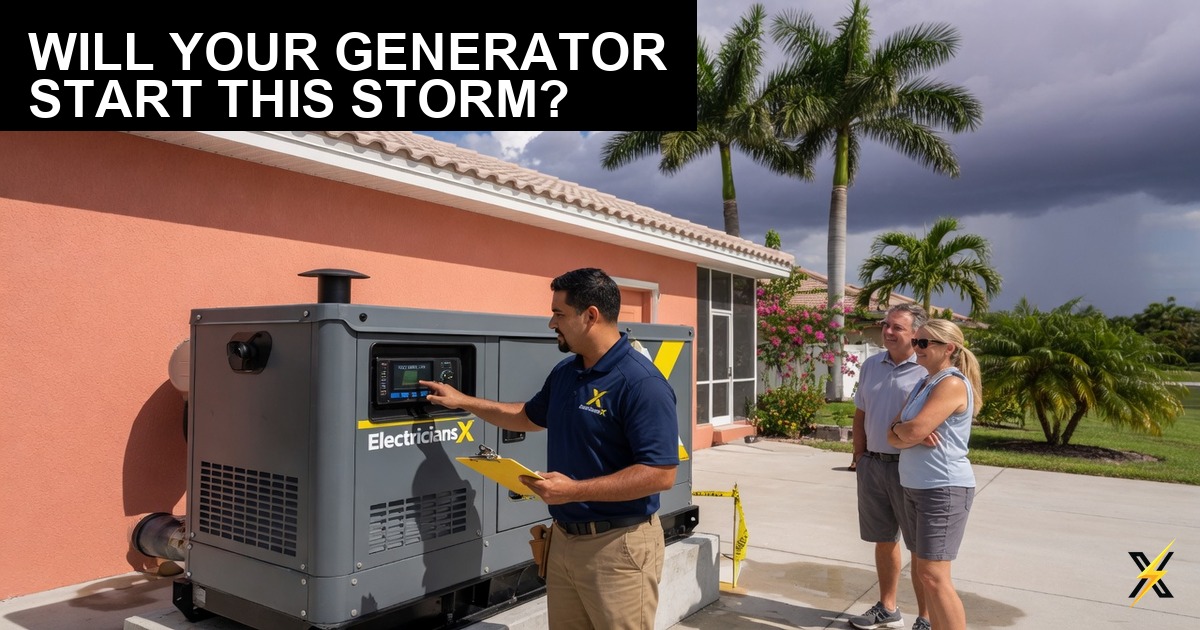
There is a particular kind of disappointment that only happens during a hurricane: the power goes out, the neighborhood goes quiet, everyone waits for the reassuring sound of the generator starting — and nothing happens.
We get those calls every season, always at the worst possible moment. And the frustrating part is that in most cases the failure was detectable weeks earlier, for very little money.
August through October is the peak of hurricane season in Southwest Florida. If you have a standby generator, this is the month to confirm it is actually ready.
The Battery Is Almost Always the Problem
If we had to name one component responsible for more no-starts than everything else combined, it is the battery — and it is not close.
A standby generator battery lives outdoors in Florida heat, which is brutal on batteries. Where a battery might last five or six years in a mild climate, here you should expect roughly two to three. It sits at rest most of the year, and then it is asked to crank a large engine on the one day it matters.
The tricky part: a weak battery will often still run the weekly exercise cycle just fine. The exercise is a brief, unloaded start under ideal conditions. Starting cold and immediately picking up your whole house is a much harder ask. A battery can pass the easy test every week for months and still fail the real one.
If your battery is more than three years old and you do not know its condition, replace it. It is one of the least expensive components in the system and by far the most likely to strand you.
Is the Exercise Cycle Actually Running?
Every standby generator runs a self-test on a schedule — typically weekly, for ten to twenty minutes. It keeps the engine lubricated, the battery charged, and the fuel system healthy.
Ask yourself honestly: when did you last hear it? Homeowners tell us all the time that they are not sure. If the exercise has quietly stopped — because of a controller fault, a tripped breaker feeding the battery charger, or a setting lost after a power event — the generator can sit dormant for months and nobody notices until it is needed.
Go stand outside during the scheduled window this week and confirm it runs. That one observation tells you a great deal.
What Else We Check
- Oil level and condition — generators consume oil over time, and running low is how engines get damaged during a long outage. After a multi-day run, an oil change is due.
- Air filter — ours load up with dust, pollen and lawn debris faster than most climates.
- Inside the enclosure — this is the one that surprises people. Wasps, ants and rodents love a warm, dry, sheltered box. We regularly open enclosures to find nests built into the air intake, and in a few cases chewed wiring. Look inside yours.
- The transfer switch — the generator is only half the system. The automatic transfer switch is what senses the outage and moves your house over. It has contacts that wear and a controller that can fault, and it needs to be tested under actual load, not just watched during an unloaded exercise.
- Fuel supply — for propane, know your tank level now rather than during an evacuation, and remember that a partially full tank delivers less vapor pressure. For natural gas, confirm the line still supports the unit’s demand, which we verify at the meter.
- Corrosion at connections — salt air near the coast is hard on terminals, lugs and the pad itself.
The Test That Actually Tells You Something
The weekly exercise is a health check, not a proof of readiness. What genuinely answers the question is a loaded test: shutting off utility power at the main, letting the transfer switch do its job, and letting the generator carry your real house for a while.
That test exposes what the exercise cannot — a battery that cranks but sags under load, a transfer switch that hesitates, a fuel supply that cannot keep up, or a load profile that has quietly grown past what the unit can handle.
That last one matters more than people expect. Homes accumulate load. A pool heater goes in, a garage gets a mini split, an EV charger appears in the driveway, a second refrigerator moves to the garage. A generator that comfortably covered your house six years ago may be undersized for the house you have now. If you are unsure, our generator sizing calculator will show you where you stand in a couple of minutes.
If You Do Not Have a Standby Generator Yet
Being straightforward: if you are reading this in the middle of August hoping to have one installed before the next named storm, the timing is tight. A proper installation involves a permit, a gas or propane connection, a concrete pad, the transfer switch, and an inspection. That is not a same-week project, and any contractor promising otherwise is skipping something.
What is realistic on short notice is a generator inlet and transfer switch for a portable unit you already own. It is a fraction of the cost, it can often be done quickly, and it is enormously safer than running extension cords — and vastly safer than backfeeding, which kills people every season. We wrote about why backfeeding is deadly if you have ever been tempted.
And if you want a whole-home standby unit properly installed, the smart move is to start the conversation now for installation before next season, rather than joining the queue everyone forms the week after a storm. See our generator installation page.
A Ten-Minute Version of All This
If you do nothing else this week: confirm the exercise cycle runs, find out how old the battery is, look inside the enclosure for nests, and check your propane level. That covers the majority of what actually goes wrong, and it costs you nothing but a few minutes in the yard.
If anything looks off — or if you would rather have it verified properly under load — that is exactly what we do.
Talk to a Licensed Electrician
ElectriciansX is a licensed and insured electrical contractor serving Cape Coral, Fort Myers, Naples, Bonita Springs, Estero, and all of Southwest Florida. We pull the permit, do the work to code, and stay through inspection. Call (239) 880-9473 or request a free quote.