
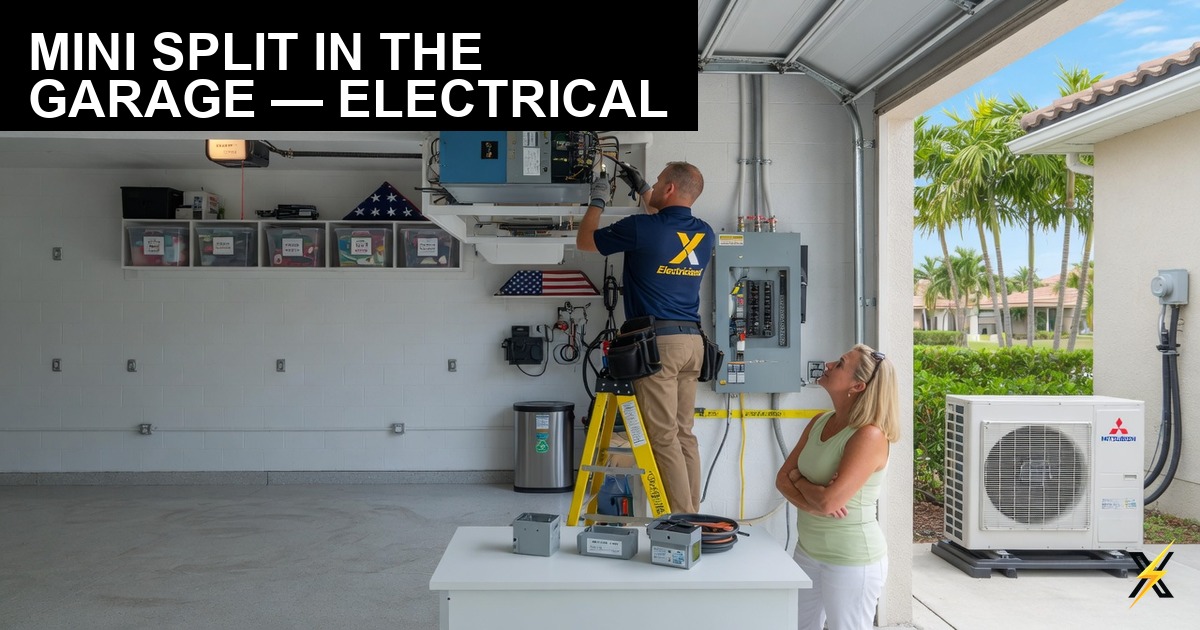
If you have ever tried to work in a Southwest Florida garage in August, you already know why mini splits have become one of the most requested add-ons we wire. A closed-up garage in Cape Coral or Fort Myers can sit twenty degrees above the outside temperature by mid-afternoon. That is miserable for a workshop, hard on tools and paint, and genuinely unsafe for anyone using the space as a gym.
A ductless mini split fixes that beautifully. It is efficient, it does not require ductwork, and it turns a garage into usable square footage. But there is a part of the project homeowners often do not think about until the HVAC installer is standing in the driveway: the unit needs its own power, and that is a separate trade.
Here is how the whole thing actually comes together, and how we make it painless.
Who Does What: HVAC vs. Electrical
A mini split installation is genuinely two jobs. The HVAC contractor sets the outdoor condenser, mounts the indoor air handler, runs the refrigerant line set, handles the condensate drain, and commissions the system. The electrical contractor brings power from your panel to the unit, installs the disconnect, and makes the final connections to code.
Some homeowners try to hire one company hoping to cover both. In our experience the better result comes from each trade doing what it does every day — and coordinating on timing so nobody is waiting on anybody.
Our HVAC recommendation: For the mechanical side of a mini split install, we recommend Tundra Air. Ask for Alex — he is the owner and he will take care of you.
You handle one call to Tundra Air for the equipment and installation, one call to us at (239) 880-9473 for the power, and we coordinate the rest between us.
What a Mini Split Needs Electrically
Most residential mini splits run on a dedicated 240-volt circuit. The specific breaker and wire size are not something to guess at — every unit has a nameplate listing its Minimum Circuit Ampacity (MCA) and Maximum Overcurrent Protection (MOP), and those two numbers govern the installation. A 12,000 BTU unit and a 24,000 BTU unit can have very different requirements even from the same manufacturer.
In broad terms, here is what a typical garage mini split project involves on our side:
- A dedicated circuit from your panel — sized to the unit’s nameplate, not to a rule of thumb. Sharing a circuit with garage receptacles or a door opener is not acceptable and will not pass inspection.
- A disconnect within sight of the outdoor unit — this is a code requirement, and it is also what lets a service tech safely work on the condenser later without going back to your panel.
- Proper conductor sizing for the run length — garages are often at the far end of the house from the panel. Voltage drop over a long run matters, and we size for it.
- A whip to the condenser and connection at the air handler — the final terminations on both ends, made to the manufacturer’s instructions.
- Outdoor-rated materials throughout — in this climate, corrosion-resistant fittings and properly sealed penetrations are the difference between an install that lasts and one that gives you trouble in three years.
- Permit and inspection — we pull it, and we are there for the inspection.
“Does My Panel Have Room for This?”
This is the first question worth answering, and it is a fair one. Many Cape Coral and Fort Myers homes are running panels that were sized for the house as it was originally built — before the pool got heated, before the EV charger went in, before the garage became a workshop.
Two things have to be true: you need a physical space for the breaker, and your service needs the capacity to carry the added load. Those are different questions. A panel can be physically full while your service still has plenty of headroom, in which case a tandem breaker or a small subpanel solves it. Or the panel can have empty slots while the service itself is already close to its limit.
If you would like a rough sense of where you stand before calling anyone, our free electrical calculators include a full residential load calculation that walks through it. And if the answer turns out to be that you need more capacity, a panel upgrade is a routine job for us.
A Few Things Worth Knowing Before You Start
- Insulation matters more than tonnage. An uninsulated garage door in full Florida sun will fight even a correctly sized unit. Ask your HVAC contractor about this — it affects what size system you actually need, which in turn affects the circuit we run.
- Plan the condenser location early. Where the outdoor unit sits determines the circuit route, the disconnect location, and sometimes the cost. Deciding this with both trades before anyone starts saves money.
- Consider surge protection while we are in the panel. A mini split has a control board in it, and control boards do not survive surges. If we are already working in your panel, adding whole-home surge protection is inexpensive at that point.
- Think about what else the garage needs. While we are running a circuit out there, it is the natural moment to add the outlets, workshop lighting, or an EV charger circuit you have been meaning to get to.
What It Looks Like From Your Side
You call Tundra Air and talk to Alex about the equipment. You call us about the power. We look at your panel, confirm capacity, and give you a firm number. The two crews coordinate so the electrical is ready when the HVAC install happens. We pull the permit, do the work, and meet the inspector. You get a cool garage.
That is genuinely the whole process. Most garage mini split circuits are a one-day job on our end.
Talk to a Licensed Electrician
ElectriciansX is a licensed and insured electrical contractor serving Cape Coral, Fort Myers, Naples, Bonita Springs, Estero, and all of Southwest Florida. We pull the permit, do the work to code, and stay through inspection. Call (239) 880-9473 or request a free quote.