
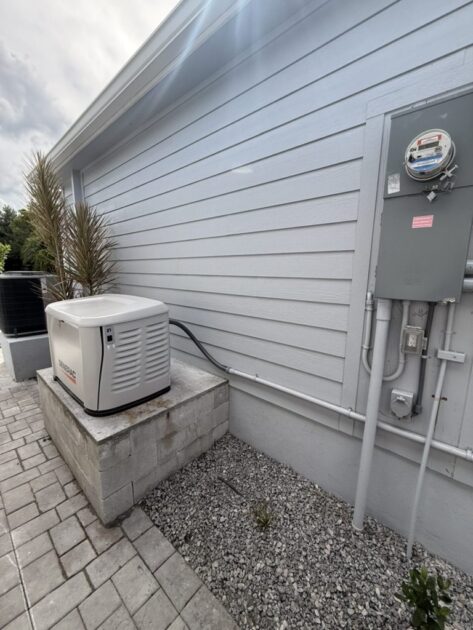
Here is the short answer. A whole house generator turns itself on the moment the power goes out and runs your entire home, air conditioning included, without you leaving the couch. A portable generator plugged into a generator inlet costs far less and still keeps your important circuits running. The catch is that you have to roll it out, start it, and plug it in yourself, usually in the middle of the storm that knocked the power out. For homeowners in Cape Coral and Fort Myers, that difference matters more than anything on the spec sheet.
We install both. Below is a plain comparison of the two, written from what we see on real jobs around Lee County, so you can decide which one fits your home, your budget, and the way you want to ride out the next storm.
Whole House Generator vs. Portable Generator at a Glance
| Whole house (standby) generator | Portable generator + inlet | |
|---|---|---|
| Cost | Much higher. Generator, transfer switch, pad, fuel supply, permits, installation. | A fraction of the cost. Inlet box, interlock or transfer switch, and the generator you may already own. |
| How it starts | Automatically, within seconds, day or night. | You do it. Roll it out, fuel it, start it, plug it in, flip the breakers. |
| What it powers | The whole house, sized to your load, including central AC. | Selected circuits: fridge, lights, fans, outlets, well or pool pump. Central AC is often too much. |
| Fuel | Propane tank or natural gas line. No gas cans. | Usually gasoline, refilled by hand every several hours. |
| During a storm | Nothing for you to do. | Hard to run safely in wind and rain. Most people wait until the storm passes. |
What Is a Whole House Generator?
A whole house generator, also called a standby generator or home standby generator, is a permanent unit that sits on a pad beside your home. It is wired to your electrical service through an automatic transfer switch. When utility power drops, the transfer switch senses it, starts the generator, and moves your house over to generator power on its own. When LCEC or FPL power comes back, it switches you back and the generator shuts down.
It runs on propane or natural gas, so there are no gas cans to fill. Many Cape Coral homes do not have natural gas service, so a propane tank is set on the property to feed the generator. In parts of Fort Myers, a natural gas line may already be available at the house.
Most of the standby units we install are Generac home generators. A properly sized unit, with load management modules where the house needs them, carries the whole home: central air, refrigerator, water heater, pool pump, lights, and outlets.
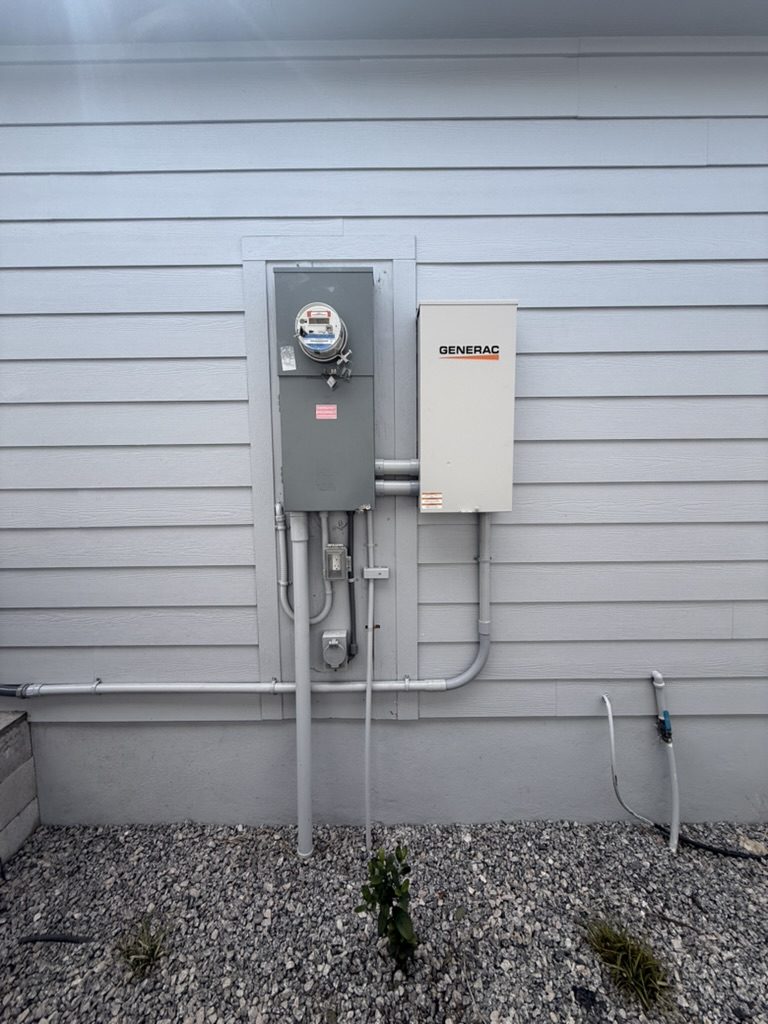
See our whole house generator installation page for how the job works from site visit to inspection.
What Is a Portable Generator Inlet?
A generator inlet is a weatherproof power inlet box mounted on the outside wall of your home, usually near the electrical panel. It is paired with an interlock kit or a manual transfer switch at the panel. You run one heavy-duty cord from your portable generator to the inlet, and the interlock makes sure your home can never be connected to the generator and the utility at the same time.
That last part is the whole point. It is the legal, safe way to power your house circuits from a portable generator, and it replaces a tangle of extension cords running through a cracked-open door. It also prevents backfeeding, which is how line workers get hurt after a storm. We wrote about why backfeeding a generator through a wall outlet is deadly if you have ever been tempted.
Inlets come in 30-amp and 50-amp versions, matched to the generator you own. With one installed, you choose which circuits to run, and you switch them on at the panel.
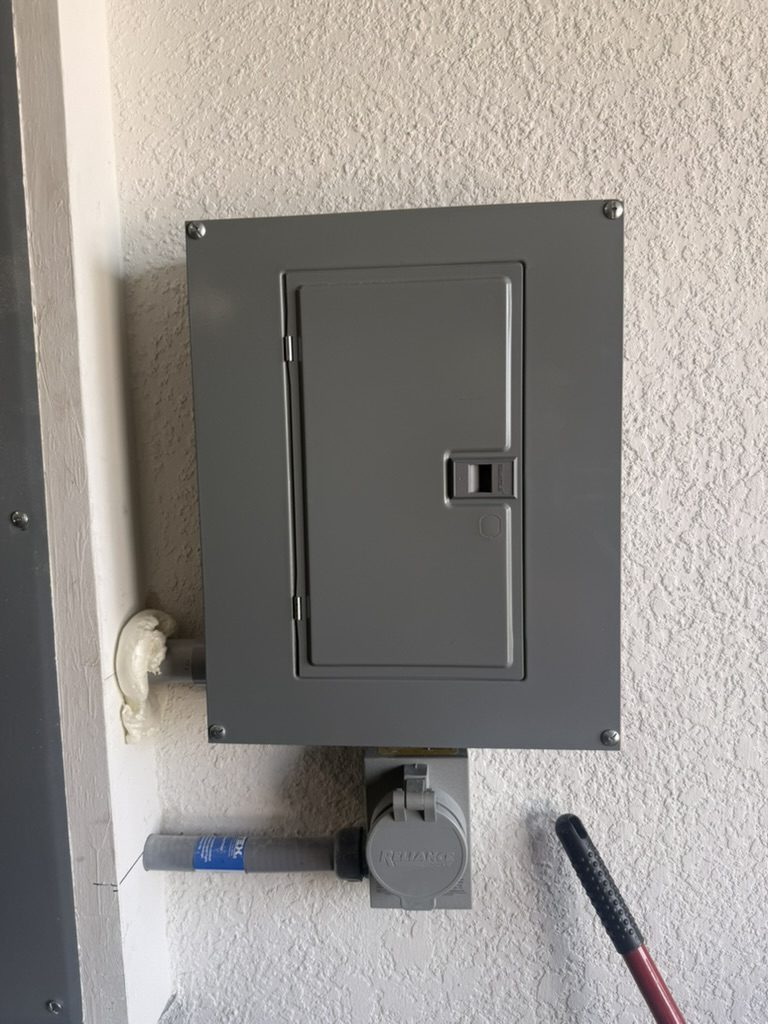
Learn more on our generator inlet and interlock kit installation page.
Difference #1: Price, and Everything That Comes With a Whole House Generator
The first difference is obvious. A whole house generator costs a lot more than a portable setup, and the price of the generator itself is only part of it. A standby installation involves:
- A propane tank placed on the property, or a natural gas connection
- A concrete pad or stand for a large unit attached to the side of your home
- An automatic transfer switch, plus load management modules on larger homes
- Electrical permits and inspections with the City of Cape Coral, the City of Fort Myers, or Lee County
- A licensed electrical contractor to install, test, and stay through inspection
A generator inlet is a much smaller job. If you already own a portable generator, the inlet and interlock are most of the cost. It still needs a licensed electrician and a permit, and we handle that paperwork, but you are not buying a second generator, a fuel tank, and a pad.
So the portable route gives you a real way to power your home after an outage without the big expense. That is a sensible choice for a lot of families, and we install plenty of them.
Difference #2: The Power Usually Goes Out in a Storm
This is the part people do not think about until it happens. In our experience, nine times out of ten, when the power goes out in Cape Coral or Fort Myers, it is because of a storm. Afternoon thunderstorms, tropical storms, and hurricanes take out more power here than anything else. Not every outage comes with rain, but most of them do.
Now picture what a portable generator asks of you at that moment. You have to drag it out of the garage, set it up away from the house, fuel it, start it, run the cord to the inlet, and flip the breakers. In a downpour, with wind and possibly lightning, you are going to get soaked, and you are working with electrical equipment in the rain.
You also cannot just run it in the garage to stay dry. A portable generator puts out carbon monoxide, and running one in a garage, even with the door open, can fill the house with a gas you cannot see or smell. Carbon monoxide poisoning is a real danger after every storm in Florida. The generator has to be outside, away from doors and windows.
So what most people actually do is wait. They sit in the dark until the storm passes, then go out and get the generator running. A portable generator still works. It just does not work during the storm.
A whole house generator does not care about the weather. It is already outside, already fueled, already connected. When the power drops, it starts.
Difference #3: Outages in the Middle of the Night
When the power goes out at 2 a.m., you are asleep. With a portable generator, you usually find out when the air conditioning stops and the house gets hot enough to wake you up. Then you are back to the same routine, in the dark, maybe in the rain.
With a whole house generator, most homeowners sleep right through it. The lights blink, the transfer switch moves the house over, and the AC keeps running. For families with young kids, older parents, medical equipment, or a refrigerator full of medication, that is the reason they choose standby.
Difference #4: How Much of the House Stays On
A whole house generator is sized to your home, so central air, the kitchen, the water heater, and the pool equipment can all run. On bigger homes we add load management so the generator never gets overloaded. You can check roughly what size your home needs with our generator sizing calculator.
A portable generator on an inlet runs what you choose, within its limit. That usually means the refrigerator and freezer, lights, ceiling fans, some outlets, the garage door, and maybe a window unit or a small mini-split. Many portable generators cannot start a typical central air conditioner, and that is the comfort gap you feel in a Florida summer outage.
Which One Is Right for Your Home?
A whole house generator makes sense if:
- You want the power back on automatically, without going outside during a storm
- You need air conditioning to keep running, for health or comfort
- Someone in the home relies on medical equipment
- You travel or own a seasonal home and want it protected while you are away
- You went through a long outage after Hurricane Ian or Milton and do not want to do it again
A portable generator inlet makes sense if:
- You already own a portable generator, or plan to buy one
- Your budget does not cover a standby system right now
- Keeping the fridge, lights, fans, and some outlets running is enough
- You are comfortable waiting until a storm passes to start the generator
Plenty of homeowners start with an inlet and move up to a standby generator later. That is a perfectly good plan.
Whole House Generators in Cape Coral Homes
Cape Coral homes are served by LCEC, and many of them do not have natural gas service, so a whole house generator here usually runs on propane. Canal-front homes also need careful placement for the generator and tank. Older Cape Coral homes can have unusual electrical services, like the house where we installed three Generac transfer switches for three separate services. If you are comparing options, start with our generator installation in Cape Coral page, or ask about a generator inlet in Cape Coral.
Whole House Generators in Fort Myers Homes
Most of Fort Myers is on FPL. Some neighborhoods have natural gas available, which can simplify a standby install, and many older homes off McGregor Boulevard are not concrete block, which changes how the transfer switch and conduit are run. See our generator installation in Fort Myers page, or our generator inlet installation in Fort Myers page if you already own a portable.
Common Questions
Can a portable generator run my central air conditioner?
Sometimes, but usually not. A central AC needs a big burst of power to start. A large portable on a 50-amp inlet can run some smaller systems, often with a soft-start kit on the condenser. Most portables cannot. If keeping the AC on is the goal, a whole house generator is the reliable answer.
Do I need a permit for a generator inlet or a whole house generator?
Yes, both are electrical work on your home’s service and need a permit and inspection. A whole house generator also involves the fuel supply. We handle the permit paperwork for both.
Can I start with an inlet and add a whole house generator later?
Yes. Many of our customers do exactly that. When you are ready for a standby unit, we size it to the house and install the automatic transfer switch.
Do you install Generac home generators?
Yes. We have installed Generac standby generators for about ten years, and we also do generator maintenance and transfer switch troubleshooting.
Talk to a Licensed Electrician in Cape Coral and Fort Myers
ElectriciansX is a licensed and insured electrical contractor (EC13016674) with 10+ years of electrical experience, serving Cape Coral, Fort Myers, Fort Myers Beach, and the rest of Lee County. Whether you want a whole house generator or a safe way to plug in the portable you already own, we will look at your panel, tell you honestly what makes sense, and handle the permit. Call (239) 880-9473 or request a free quote.